







Upgrading your RV to LiFePO4 (Lithium Iron Phosphate) batteries is essential to overcome the performance limits of traditional lead-acid systems. LiFePO4 batteries deliver a massive performance leap: they provide 2.5 times the energy density and boast a cycle life exceeding 2,000 cycles.
This transition significantly enhances your RV’s off-grid power, enabling continuous use of high-power equipment like air conditioners. Additionally, LiFePO4 batteries reduce your battery pack weight by over 60%.
While these performance advantages are clear, it is crucial to understand that unlocking them requires more than a battery swap. This transition is a systemic engineering effort , and system compatibility across charging, monitoring, and safety protection must be meticulously addressed.
Hal-hal Penting yang Dapat Dipetik
Upgrade to LiFePO4 batteries for 2.5 times the energy density and a cycle life exceeding 2000 cycles.
Ensure your charging system is compatible, requiring a dedicated algorithm and specific settings (e.g., 14.6V full-charge voltage).
The entire system wiring must be optimized to ensure total impedance is <50m ohm, using wires rated for≥30V.
Use a Battery Management System (BMS) to protect against overcharge (cutting off in 200ms at high voltage) and over-discharge (cutting off at 2.5V/cell).
Implement proper thermal management, keeping the battery operating temperature between -20℃ and 55℃, and strictly avoid over-discharging (maintain≥20% capacity)
Charging System Compatibility & Safety
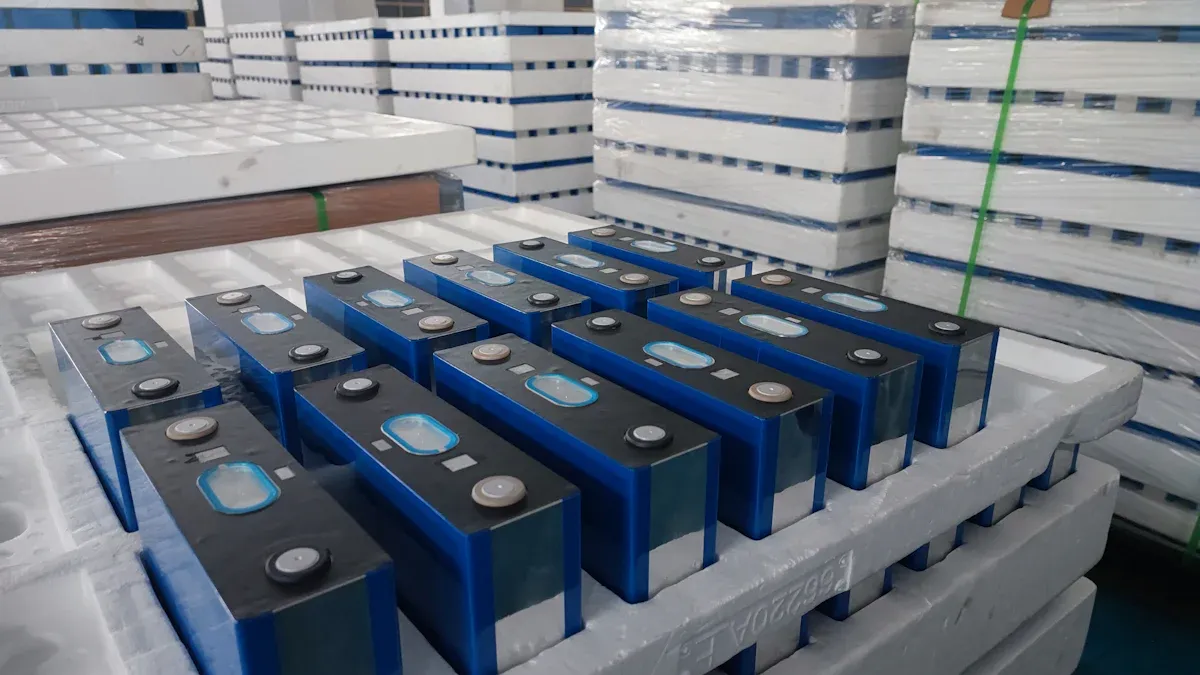
Upgrading your RV to lithium batteries requires careful consideration of your charging system. Ensuring compatibility and safety is crucial for maximizing performance and longevity.
Charger Compatibility & Thermal Risk Mitigation
When integrating LiFePO4 batteries into your RV, you must choose the right charger. Not all chargers are compatible with lithium iron phosphate technology.
The charging curves of lead-acid and LiFePO4 batteries have fundamental differences. Lead-acid batteries use constant-voltage current-limiting charging, with a full-charge voltage of 14.4V-14.8V and a float voltage of 13.5V-13.8V. In contrast, LiFePO4 batteries require segmented constant-current constant-voltage charging.
For a 12V LiFePO4 system, the charging equipment must support a dedicated lithium battery charging algorithm, which must have a configurable three-stage charging mode (constant-current charging – constant-voltage charging – float charging).
The charger must support setting a 14.6V full-charge voltage and a charging current strictly controlled (recommended ≤0.5C).
If the charging equipment does not support this dedicated LiFePO4 algorithm, it may lead to battery overcharging (triggering a thermal runaway risk) or inefficient charging (capacity utilization <80%).
Here are common compatibility issues you might encounter:
Issue Description | Details |
OEM Converters Limitations | OEM converters often remain in 13.6V absorption mode, which is insufficient for charging depleted LiFePO4 batteries. |
Charging Profile Requirements | Existing systems may not support the necessary segmented constant-current constant-voltage charging profiles for LiFePO4 batteries. |
Equalization Cycle Concerns | It is crucial to ensure that the existing converter is not performing an equalization cycle, as this can damage LiFePO4 batteries. |
Upgraded Charging Systems | Select a bidirectional inverter that supports a dedicated lithium battery charging algorithm. |
Thermal risks also arise during charging. High temperatures accelerate the capacity decay of LiFePO4 batteries. For every 10℃(the temperature exceeds 25℃), the battery life decays by about 10%.
The battery installation area must maintain an operating temperature between -20℃ and 55℃.
The charging ambient temperature should be kept between 0℃ and 45℃ if possible.
In cold winter, if charging is necessary, preheat the battery compartment or park the RV in a warm indoor area.
Solar Integration: MPPT Protocol and Current Match
Solar charging is an excellent way to keep your LiFePO4 batteries topped off. To maximize efficiency, you should prioritize a Maximum Power Point Tracking (MPPT) solar charge controller that supports the LiFePO4 battery charging protocol. This technology continuously monitors solar panel voltage and current output, calculating the optimal operating point for maximum power.
The efficiency of MPPT controllers is significantly higher, ensuring optimal energy conversion:
Technology | Conversion Efficiency |
|---|---|
MPPT | 94% – 99% |
PWM | 70% – 80% |
To ensure your solar system works effectively with LiFePO4 batteries, follow these critical specifications:
Controller Type and Voltage: Prioritize an MPPT controller that supports the LiFePO4 battery charging protocol, which needs a wide voltage input range of 15V-150V.
Dynamic Adjustment: The controller must dynamically adjust the charging voltage according to the real-time state of the LiFePO4 battery, with an accuracy of 0.1V.
Current Matching (Crucial): Special attention should be paid to the controller’s maximum charging current (recommended 0.2C of the battery capacity). For example, a 100Ah LiFePO4 battery bank should be paired with a controller with a charging current of 20A to avoid wasting solar energy (charging efficiency improves by over 30%).
Safety Features: Ensure the controller has built-in reverse connection protection and over-temperature protection.
Generator Input and Transient Voltage Protection
When using a generator to charge your LiFePO4 batteries, you must ensure stable and regulated power.
Voltage Setting: For a 12V LiFePO4 system, the generator’s rated voltage should be set to 14.6V ±0.2V. The output voltage stability should be (fluctuation rate ≤ ±5%).
Overload Protection: The overload protection current should be ≥0.8C of the battery capacity (e.g., a 200Ah battery bank needs ≥160A protection).
Matching with an RV-dedicated variable-frequency generator is recommended, which should feature Automatic Voltage Regulation (AVR) and an output sine wave distortion degree of <3%. This avoids traditional generators’ harmonic interference causing the LiFePO4 battery protection board to malfunction.
You must install a DC circuit breaker (breaking current ≥1.5 times the generator’s maximum output current) and a surge protector (response time <1 microsecond) between the generator and the battery bank. This prevents the battery from being impacted by transient startup voltages, which can reach over 18V.
Engineering & System Optimization Standards
Integrating LiFePO4 batteries into your RV requires adherence to specific engineering and system optimization standards. These standards are crucial for maximizing their performance and lifespan.
BMS Deep Integration and Cell Selection
A well-integrated Battery Management System (BMS) is crucial for the performance of your LiFePO4 batteries. The BMS must be deeply compatible with the entire vehicle’s electrical equipment’s voltage range (12V/24V/48V), discharge current (matching peak power), and protection mechanisms (over-temperature, over-current, short-circuit protection). This prevents equipment malfunction or safety hazards.
Key aspects to consider when integrating a BMS with your LFP batteries:
Key Aspect | Details |
Compatibility | Must match the vehicle’s 12V/24V/48V electrical equipment and discharge current. |
Charge/Discharge | BMS stops charging if cell voltage exceeds 3.65V; disconnects load below 2.5V. |
Menyeimbangkan | Passive or active cell balancing to maximize capacity and life. |
Installation | Clean, dry area away from vibration, heat, and moisture; ensure ventilation and access. |
When selecting cells, prioritize A-grade LiFePO4 cells for good consistency and high stability.
Wiring & Impedance Control
Proper wiring is essential for minimizing impedance in your RV’s LiFePO4 battery installation. High impedance can lead to energy loss (excessive line voltage drop) and reduced performance, affecting the normal operation of equipment.
Impedance Standard: Use a milliohmmeter to measure the impedance of the main power cables, ensuring the total impedance is <50m ohm.
Cable Recommendation: For a 100Ah battery bank, using copper wires of 16mm² is recommended. This low resistance effectively reduces line loss (resistance per meter <0.12 ohm).
Voltage Rating: Wires with a voltage rating of only 16V in some 12V systems are prone to heat up or even short-circuit during high-current LiFePO4 battery charging. They must be replaced with wires rated for 30V.
Installation: Keep the positive and negative cables of equal length and away from high-current wires to minimize electromagnetic interference.
Monitoring and Thermal Management Standards
Effective monitoring and thermal management are vital for maintaining the health of your LiFePO4 batteries.
Monitoring:
A high-precision shunt-type coulomb counter is recommended for precise power usage.
Accuracy: It calculates the remaining power with an accuracy of up to ±1%.
Purpose: This avoids over-discharge caused by estimating power based on experience (precise control of protection voltage at 12.0V± 0.1V).
Integration: Models with an RS485 communication interface can link with the RV’s central control system to display the battery’s SOC, SOH, and charge/discharge curves in real-time.
Thermal Management:
Use temperature sensors to monitor the temperature of the battery installation area under different operating conditions.
Operating Temperature Range: The temperature must be maintained between -20℃ and 55℃.
Decay Risk: High temperatures accelerate the capacity decay of LiFePO4 batteries; for every 10℃ the temperature exceeds 25℃, the battery life decays by about 10%.
Ventilation: The installation location should be equipped with a good ventilation system. For example, installing an exhaust fan at the top of the battery compartment and opening air inlets at the bottom to form convection heat dissipation prevents heat accumulation.
Compliance, Validation, and Maintenance
Ensuring compliance and validation is crucial when upgrading to LiFePO4 batteries in your RV. You must adhere to various certifications and regulations to guarantee safety and performance.
Product Certification and Regulatory Compliance
Choose certified products, rejecting hand-assembled battery packs. Hand-assembled packs lack professional safety testing , and the risk of thermal runaway is over 5 times higher than that of regular products.
Key certifications to look for:
Sertifikasi | Description |
UN38.3 | Indicates the LiFePO4 battery has undergone rigorous testing (high-altitude, thermal, vibration, shock) and meets air transport safety standards. |
CE | Ensures the product complies with EU safety, health, and environmental requirements. |
UL / IEC | Common standards that evaluate battery safety and performance for various applications. |
Regulatory Compliance Standards:
The upgraded system must comply with the “Safety Technical Specification for Lithium-ion Battery Packs for RVs”.
Grounding Resistance: The resistance must be <0.1 ohm to ensure current can be quickly guided to the ground in case of leakage.
Insulation Resistance: The resistance must be >100 ohm/V to guarantee the insulation performance of the electrical system.
Professional Safety Testing
Invite a professional technical team for system joint debugging and safety testing.
BMS Calibration: Calibrate parameters—set the equalization voltage to 3.65V/cell (about 14.6V for 12V) and the cut-off current to 0.05C (e.g., 5A for 100Ah).
Protection Function Verification:
Simulate Overcharge: Forcing a 15V input voltage. The BMS should quickly cut off the charging circuit within 200ms.
Simulate Over-discharge: Discharging the battery to 2.5V/cell. The BMS should similarly cut off the discharge circuit.
Full-Load Testing: Conduct full-load charge and discharge testing. Immediately stop the test if the battery pack temperature exceeds 50℃ or the charger temperature exceeds 65℃.
Long-Term Asset Maintenance Protocols
Establish a regular maintenance mechanism to maximize the lifespan and performance of your LiFePO4 batteries.
BMS Balancing Check (Quarterly): When the voltage difference between cells is >50mV, the BMS should automatically activate balancing.
Internal Resistance: If the internal resistance increase is >10%, it indicates cell performance degradation.
Avoid Over-discharge: Strictly control the depth of discharge (DOD), not exceeding 80% DOD. When the LiFePO4 battery has 20% remaining capacity, it should be recharged promptly.
Temperature Avoidance: Avoid charging during high-temperature periods.
Upgrading your RV to LiFePO4 batteries is fundamentally a reconstruction of the entire power system. Only by focusing on system compatibility—from charging algorithms (14.6V) to wiring impedance (<50m ohm) and safety validation (200ms cut-off)—can you unlock the full benefits and prevent safety hazards.
We strongly recommend commissioning a professional organization for power system simulation analysis before the upgrade. If you require expert guidance for seamless integration and system optimization, we suggest consulting with the Herewinpower specialist team to ensure your transition is safe, reliable.
PERTANYAAN YANG SERING DIAJUKAN
What are the main benefits of upgrading to LiFePO4 batteries?
Upgrading to LiFePO4 batteries offers higher energy density, longer cycle life, and reduced weight. You gain more usable power, enjoy fewer replacements, and improve your RV’s overall efficiency.
How do I ensure my charger is compatible with LiFePO4 batteries?
Choose a charger specifically designed for LiFePO4 technology. Ensure it provides the correct voltage and avoids float charging, which can harm battery health.
Can I use my existing solar panels with LiFePO4 batteries?
Yes, you can use your existing solar panels. However, ensure you have a compatible MPPT solar charge controller to optimize charging efficiency for LiFePO4 batteries.
What maintenance is required for LiFePO4 batteries?
Regularly check the battery’s state of charge and ensure proper ventilation. Avoid extreme temperatures during charging and discharging to extend battery life.
Are there safety concerns with LiFePO4 batteries?
LiFePO4 batteries are generally safer than other lithium batteries. However, ensure proper installation, use a reliable BMS, and avoid overcharging to mitigate risks.
Lihat Juga
Effective Strategies for RV Lithium Capacity Planning Explained
2025 FPV Drone Battery Essentials: Selection, Care, and Optimization
Essential Maintenance Practices for Extending Lithium Battery Lifespan
Comparative Performance Analysis: Lead-Acid Versus Lithium Batteries
Transitioning Golf Carts: Lead-Acid to Lithium Battery Case Studies




 Bahasa Indonesia
  English
  Español
  한국어
한국어  Deutsch
  Français
  日本語
日本語  Русский
  ไทย
ไทย  العربية
  Português do Brasil
  Italiano
  Nederlands