



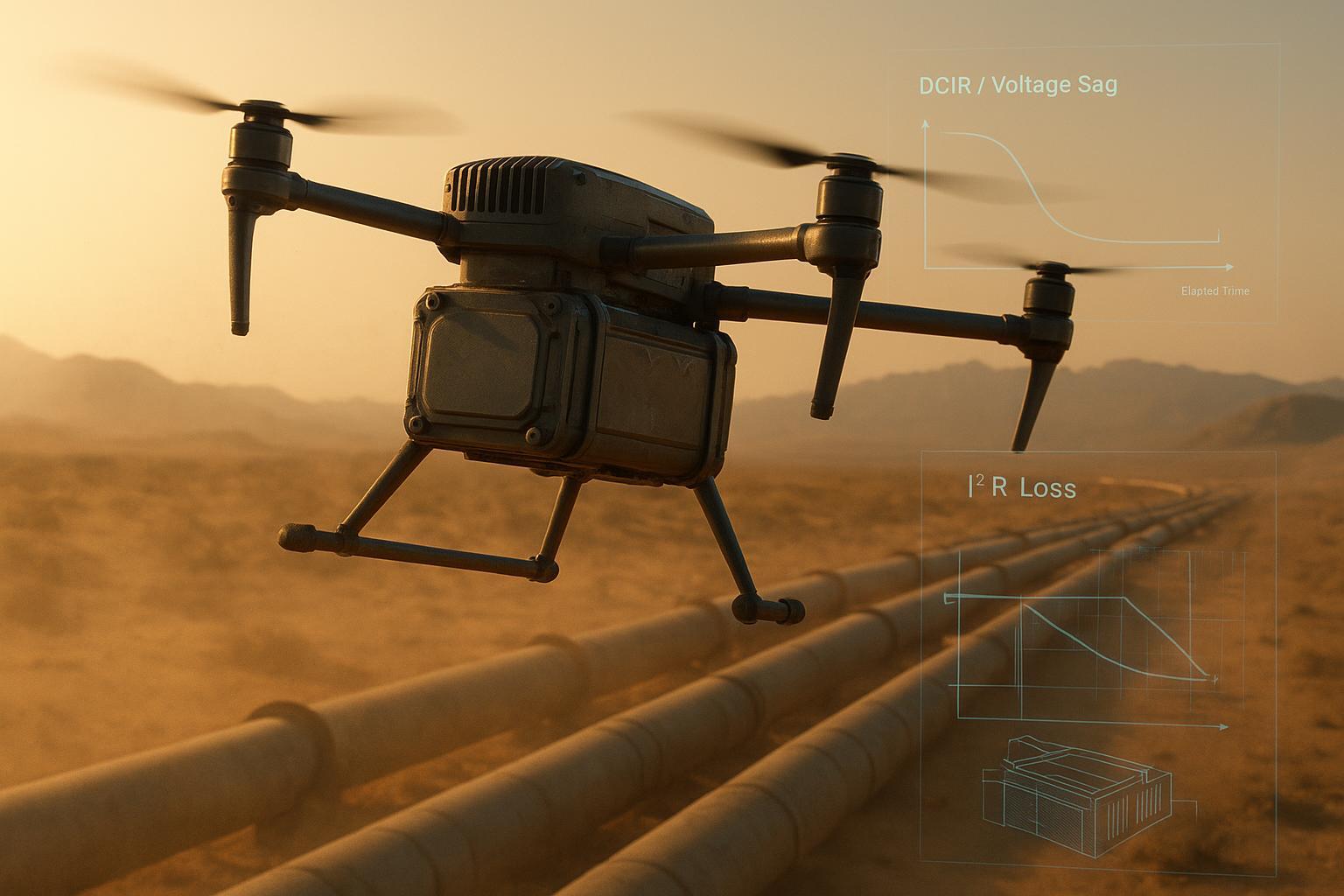
When MEA summers push ambient temperatures past 50°C, the “Perfect Storm” of surging internal resistance (DCIR) and transient voltage sags isn’t just a flight risk—it’s a financial drain. Internal fleet data confirms that battery-related failures and premature aging account for up to 40% of total UAV operating costs (TCO).
To protect your missions and your bottom line, this guide moves beyond marketing labels. We tie the physics of BVLOS Voltage Sag directly to actionable engineering choices in chemistry, voltage architecture, and maintenance SOPs.
The Physics Link: Why 60.0°C is the “Red-Flag” Zone
At the electrochemical level, high heat accelerates parasitic side reactions at the electrode–electrolyte interfaces. While short-term heat might temporarily lower electrolyte viscosity (reducing internal resistance), sustained operation in the 55–60°C range creates a catastrophic inflection point for cell health.
Technical benchmarks and empirical stress tests indicate that breaching this threshold triggers irreversible SEI (Solid Electrolyte Interphase) layer reconstruction. As the electrolyte decomposes to repair this passivation film, it consumes active lithium ions and thickens the charge-transfer pathways.
Two Nuances for BVLOS Operations:
Impedance-Capacity Coupling: Once the SEI stability is compromised at >60°C, the capacity decay rate can surge by over 30% compared to standard operating windows. This isn’t just a loss of runtime; it’s a permanent elevation of DCIR (R).
The “Voltage Sag” Multiplier: BVLOS missions are defined by sharp current spikes (I)—takeoff, wind-gust compensation, and gimbal surges. Following Ohm’s Law (ΔV=I·Rtotal), even a marginal rise in DCIR multiplies the depth of the bus sag. In extreme MEA heat, this “Sag” often breaches the minimum voltage headroom of flight controllers, leading to sudden mid-air shutdowns.
Beyond electrical failure, electrolyte side reactions at high temperatures generate internal gas pressure. This manifests as cell swelling (bloating), which, in a sealed UAV housing, compromises heat dissipation paths and may escalate into thermal runaway if the heat-path design is inadequate.
Chemistry Choices: The Semi-Solid Transition
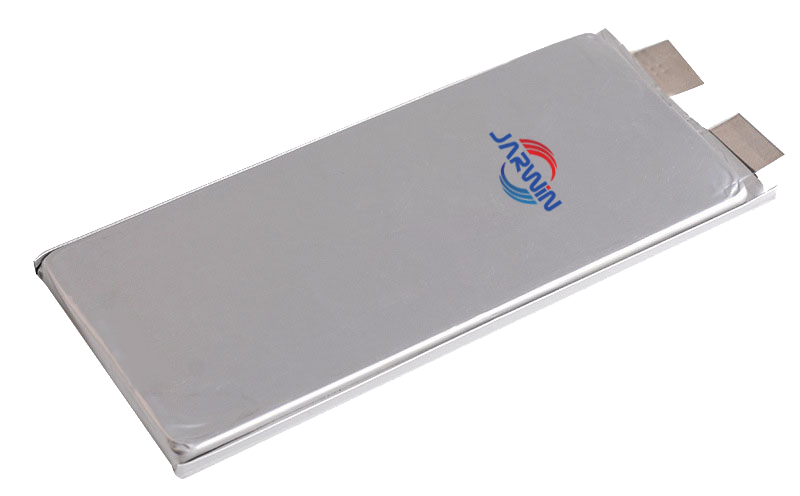
The stability of the SEI (Solid Electrolyte Interphase) governs long-term impedance growth. In traditional LiPo cells, high-temperature solvent decomposition constantly reconstructs the SEI, thickening the resistance path. Semi-solid architectures aim to break this cycle by replacing volatile liquids with robust solid-state frameworks.
Unlike generic “gel” marketing, a true industrial-grade semi-solid architecture is defined by an oxide-based (such as LLZO or LATP) solid electrolyte scaffold representing 90%–95% of the electrolyte body. Liquid electrolyte is restricted to a mere 5%–10% fraction, used only to optimize interfacial ion conduction.
Why this matters for BVLOS:
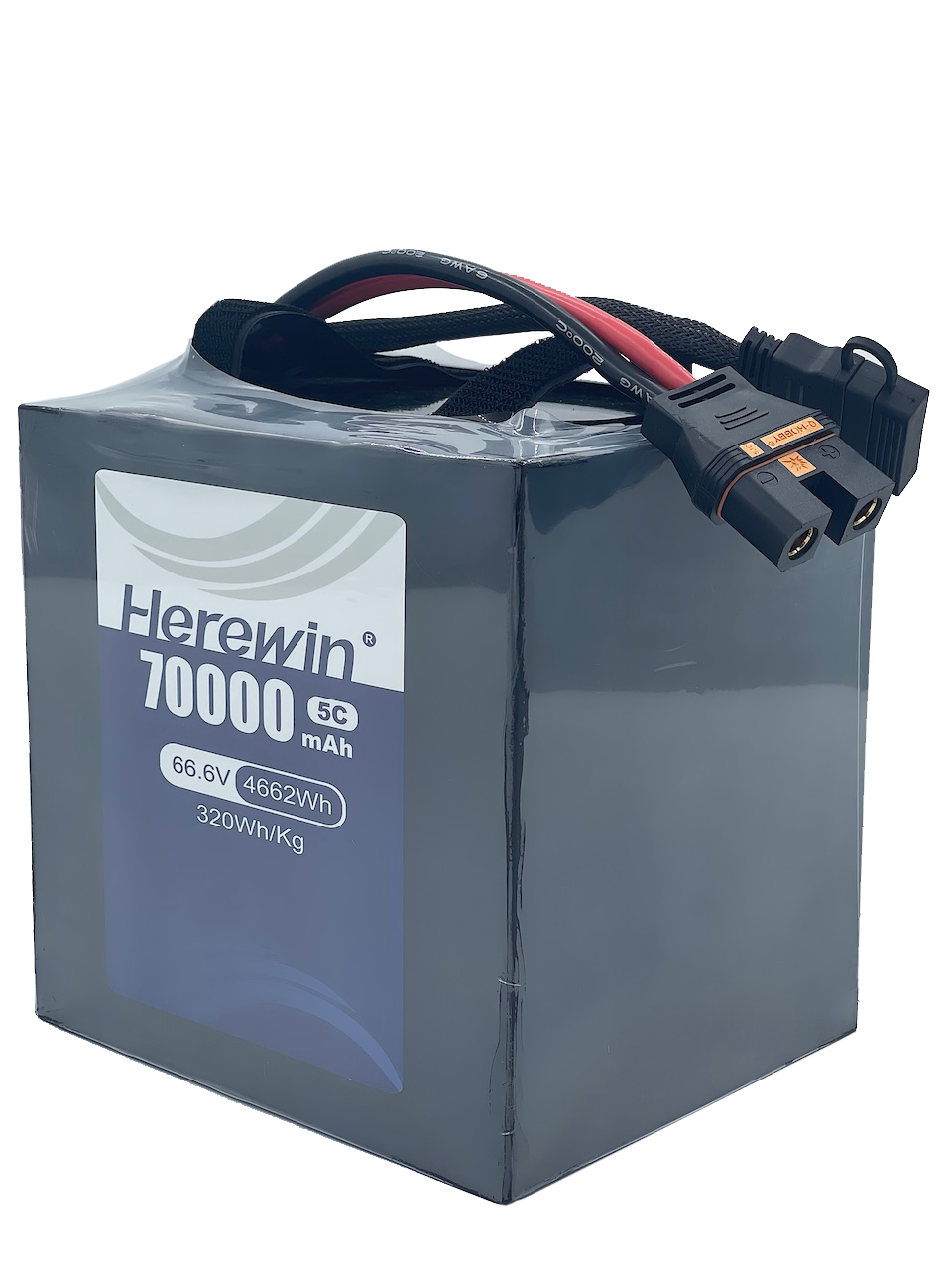
To understand the performance ceiling of this architecture, we can look at the technical benchmarks from Herewin’s semi-solid series, which serve as a reliable reference for industrial-grade applications:
Energy Density: Achieves 300–400 Wh/kg (a 30%–50% increase over conventional cells), extending mission radius without a weight penalty.
Thermal Stability: Shows a 60% reduction in temperature rise rate during high-current discharge pulses, preventing the pack from hitting the 60.0°C “Red-Flag” zone.
Rate Performance: Supports 5C fast charging, significantly increasing the sortie-to-charge ratio for intensive fleet operations.
What should an engineering team do today?
Demand “Solid-to-Liquid” Transparency: Treat “semi-solid” as an architecture class. If a supplier cannot confirm the liquid electrolyte percentage (aim for <10%), it may not offer the thermal stability required for MEA climates.
Prioritize Interfacial Robustness: For hot-climate UAV duty cycles, the mechanical integrity of the electrolyte often matters more than a headline Wh/kg number.
Validate via Method-Bound Evidence: Request specific test logs including SoC window, C-rate, and ambient temperature. If you don’t see a clear sample size and methodology, press pause on procurement.
If you’re conducting a trade-off analysis between lifecycle, energy density, and thermal safety, this comparative matrix provides the engineering logic required for fleet-level selection.
Pack Architecture: Why Higher Voltage Calms the Bus
Power law and Ohm’s law provide a practical playbook for MEA deployments. For a fixed electrical load (P), raising pack voltage reduces current (I), and that directly reduces resistive heating (I²R). If resistance stays roughly constant, doubling pack voltage quarters I²R loss.
This has two direct impacts on BVLOS stability:
Trimming bus sag: Lower current reduces the instantaneous IR drop (ΔV = I · R_total), preserving voltage headroom for flight controllers and payload rails.
Thermal decoupling: Lower current slows I²R heat accumulation in cells, tabs, harnesses, and connectors—helping keep the pack away from high-temperature regimes where degradation accelerates.
Engineering Benchmark for 10–50 kg Class UAVs:
For heavy-lift industrial platforms, transitioning from 12S (~44V) to 24S (~88V) or higher is a primary reliability driver. Based on selection guides for high-intensity missions, these systems should be paired with cells supporting a continuous 20C–30C discharge rate to ensure the voltage floor remains stable under maximum payload maneuvers.
Sizing Shortcuts
Use these formulas to sanity-check sizing before running full mission logs:
Required capacity (in mAh)
Capacity (mAh) ≈ (P_avg × t × 1000) ÷ (V_nom × η)
Required C-rating
C-Rating ≥ I_peak ÷ Capacity (Ah)
P_avg: Average electrical power over the mission.
I_peak: Worst-case transient (takeoff, wind-gust compensation, or payload surge).
V_nom: Nominal pack voltage.
η (Eta): Total efficiency factor (ESC + motor + thermal effects).
If you are evaluating the trade-offs between energy density and high-current performance during the sizing process, this provides the engineering logic required to optimize your power-to-weight ratio.
Enclosure & Environment: Shielding Against the MEA Reality
In BVLOS missions across the Middle East and coastal regions, heat is only half the battle. Airborne sand and corrosive salt spray are “silent killers” that compromise battery connectivity and thermal stability.
1. The IP Rating Threshold: Sand & Dust Protection
In desert deployments, fine dust (<75 μm) can abrade seals and contaminate contacts, leading to high-resistance “hot spots.”
Engineering requirement: For industrial drone battery systems, IP65/IP67 is a common baseline for outdoor reliability.
What it means: The first digit “6” means dust-tight (IP6X: no dust ingress under specified test conditions). The second digit “5” means protection against water jets (IPX5), while “7” means protection against temporary immersion (IPX7, commonly tested around 1 m for 30 minutes).
2. Corrosion Resistance: The Salt Spray Filter
Coastal BVLOS corridors expose battery terminals to high-salinity air, which triggers rapid galvanic corrosion. When evaluating suppliers, demand evidence of compliance with:
ISO 9227 (NSS) / ASTM B117: These are the industry screening methods for corrosion. Ensure that connectors and coatings have passed the Neutral Salt Spray (NSS) test (typically atomized 5% NaCl at 35°C).
Validation Logic: Treat these lab results as an early filter. True field reliability depends on your specific sealing stack-up and drainage path design.
3. Thermal Integration in Sealed Packs
While an IP65/IP67 enclosure protects against the environment, it also traps heat. To prevent the internal chemistry from breaching the 60.0°C degradation threshold, your design must include:
High-conductivity thermal interface materials (TIM).
Structured heat paths to dissipate I²R heat from the cells to the external casing.
Thermal Design: PCM as a “Thermal Buffer”
In IP65/IP67-rated (sealed) housings, air convection is virtually zero, creating a “thermal trap.” Phase-change materials (PCM) act as a thermal capacitor, absorbing transient heat peaks that would otherwise cause a rapid voltage collapse.
Composite PCMs with high-conductivity fillers (e.g., graphite or BN) spread heat across the pack much faster than pure paraffins. This is critical for preventing the localized hot spots that accelerate DCIR growth.
This transition from pure to composite PCM follows established selection criteria for industrial energy density, as detailed in ACS Energy & Fuels (2024) regarding thermal stability in high-drain systems.
Practical Guidelines for MEA Deployment:
The 50°C Band: Select a PCM transition temperature between 48°C and 52°C. This ensures latent heat absorption engages before the internal chemistry reaches the 60.0°C degradation threshold.
Energy Budgeting: Size your PCM mass based on your most aggressive mission segment (e.g., a 60-second takeoff surge).
Validation: Always validate thermal behavior under full dust sealing. Sealing changes the internal pressure and convection, often shifting hot spots to areas that were stable during open-bench testing.
From alarms to foresight: DCIR‑driven predictive maintenance
In high-intensity MEA operations, relying on real-time voltage alarms is a reactive—and often terminal—strategy. True operational safety requires Foresight, driven by the tracking of Direct Current Internal Resistance (DCIR).
1. DCIR-Centric Screening: The Pre-Flight Stress Test
Aging is never uniform across a fleet. Instead of waiting for a mid-air collapse, we prioritize DCIR consistency as the primary health metric:
The Protocol: Perform a controlled pulse test at a fixed SoC to generate a DCIR proxy for each pack.
Predictive Logic: By flagging outliers who deviate from the fleet mean, operators can identify “weak links” before they ever touch the sky. If you control DCIR dispersion before takeoff, you eliminate the primary driver of unexpected voltage sags in flight.
SOH Modeling: These datasets feed into hybrid physics-plus-ML frameworks (Digital Twins) to predict remaining useful life.
Validation: Our diagnostic pipelines are built upon the implementation scaffolds described in PMC Reviews on Cloud Smart Batteries and the SOH modeling frameworks from MathWorks (2019).
2. Operational Policy: Optimizing TCO and Fleet Life
Predictive maintenance (PdM) moves the needle from “break-fix” to “planned replacement,” directly impacting the Total Cost of Ownership (TCO).
Threshold-Based Actions: Instead of a rigid cycle-count retirement policy, we implement a DCIR-based threshold (e.g., a 25% growth over baseline) to trigger decommissioning.
The ROI of Foresight: This prevents the premature disposal of healthy assets while ensuring that high-risk BVLOS missions are only flown with verified, low-DCIR packs.
Operational Guide: For mission planning in extreme heat, we adhere to the protocols outlined in the Fleet Operator’s Guide to High‑Temperature UAV Battery Management and TCO to balance airframe safety with asset depreciation.
Engineering Transparency: The Data Reporting Protocol
To ensure the credibility of our performance claims, every dataset we publish adheres to a rigorous transparent method summary:
Configuration: Full chemistry (Semi-solid NMC), cell format, and sample size (n).
Stress Profile: SoC/DoD windows, C-rates, and precise pulse/rest profiles.
Environment: Ambient setpoints, airflow, and enclosure sealing (IP65/IP67) status.
Data Integrity: DCIR computation method (e.g., HPPC pulse 10s window) and uncertainty estimates.
Compliance & Standardization: De-risking the Procurement Cycle
Transport, safety, and environmental tests are complementary, not interchangeable. For BVLOS tenders, the regulatory mapping below ensures that technical performance is backed by global compliance mandates.
Objective | Typical standard(s) | What it demonstrates | Where to cite in bids |
|---|---|---|---|
Safe transport eligibility | UN38.3 (T1–T8); IATA DGR guidance | Withstands altitude, thermal, vibration, shock, external short, impact/crush without fire/rupture; OCV retention | Shipping compliance section; dangerous goods classification |
Cell/pack safety baseline | IEC 62133‑2; selected IEC 60068 mechanicals | Abuse/vibration/thermal tests at cell/pack level; links to protective circuitry effectiveness | Product safety appendix |
Ingress protection | IEC 60529 IP6X/IP67 | Dust‑tightness and immersion tolerance for enclosures/connectors | Environmental durability; outdoor deployment claims |
Corrosion screening | ISO 9227 NSS | Resistance of metals/coatings/connectors to salt‑spray corrosion | Coastal/industrial environment readiness |
References for procurement teams: see the original UN Manual Section 38.3 (UNECE landing page) and the current IATA Lithium Battery Guidance Document (2026).
Practical Implementation: From Design Choices to Flight-Line SOP
Execution is where theory meets operational reality. To translate electrochemical advantages into mission reliability,especially for repeated perimeter-inspection BVLOS programs with takeoff surges and payload transients.we implement a four-stage execution framework:
1. Pre-Design Strategy (Voltage Architecture)
Transition to higher series counts (e.g., migrating from 12S to 24S) to reduce I2R heating and ΔV = I·R voltage droop. Run parametric sweeps against your measured mission pulses to confirm that bus sag stays well inside the flight-controller headroom, even as contact resistance drifts in dusty environments.
2. Chemistry & Package Selection (Environmental Isolation)
Shortlist candidate packs based on method-bound evidence (same SoC window, ambient, pulse profile) rather than marketing labels. Prioritize semi-solid candidates for mechanical robustness under high thermal loads, and mandate IP65/IP67 sealing with ISO 9227 screening to ensure readiness for coastal and industrial tenders.
3. Thermal Budgeting (Heat Dissipation)
Allocate PCM (Phase Change Material) mass and conduction paths during the early design phase. In an IP-rated sealed bay, verify the “time-to-limit” in a 55°C chamber using your worst pulse segment. If PCM is considered, treat it as an optional buffer and validate it as part of the total heat-budget.
4. Fleet Operations (Proactive Screening)
Add a pre-mission DCIR (Direct Current Internal Resistance) pulse gate at a standardized SoC and temperature before every BVLOS sortie. Bench outliers before launch, track resistance drift over time, and stream telemetry to a cloud dashboard to build high-fidelity SOH/RUL models.
(Note: Where does a supplier fit into this workflow? A vendor like Ini dia. becomes a practical reference when you need engineering spec sheets, demo units, or interface reference designs to reproduce the thermal tests above and integrate telemetry into your maintenance pipeline.)
For a comparative analysis of architecture cost and uptime, refer to the Industrial Drone Battery Buyer’s Guide 2026.
Why this reduces TCO
The path to an auditable reduction in “per-flight-hour” costs is built on three pillars.
Lower Current: Higher series counts reduce I2R heating and transient bus droops.
Environmental Isolation: Keeping dust and salt out stabilizes contact resistance and eliminates nuisance voltage dips.
Proactive Screening: Identifying high-DCIR packs before takeoff prevents incident reports and moves failure modes from the field to the bench.
By controlling DCIR dispersion before wheels-up, you tame the primary driver of BVLOS voltage sag events, ensuring operational safety and maximizing asset longevity.
References
To maintain the engineering rigor of our framework, we recommend the following primary sources for your compliance and technical teams.
SOH & Predictive Modeling: Refer to the implementation scaffolds in the NIH/PMC review “Cloud Smart Batteries and Battery Management Systems” and the practical pipeline guidance in MathWorks “Building Battery State of Health Estimation Pipelines” (2019).
Thermal Design: For composite PCM selection criteria and thermal-stability considerations, see ACS Energy & Fuels review on composite PCM selection (2024).
Safety & Logistics: Use the IATA Lithium Battery Guidance Document (2026) and the UN Manual of Tests and Criteria, Section 38.3 (UNECE Rev.8 landing page) as primary references.
Closing and next steps
In extreme MEA operating corridors, reliability usually comes down to a few controllable levers: keeping current reasonable through an appropriate voltage architecture, sealing interfaces for dust and water exposure, and screening pack-to-pack DCIR consistency before BVLOS sorties.
If your fleet economics show that batteries are a major driver of operating cost, the practical goal is simple: move avoidable failures from the field to a repeatable bench test and a disciplined maintenance workflow.
To discuss thermal architecture optimization or validate your specific duty cycle requirements, please reach out to our technical experts for a one-on-one consultation.


 Bahasa Indonesia
  English
  Español
  한국어
한국어  Deutsch
  Français
  日本語
日本語  Русский
  ไทย
ไทย  العربية
  Português do Brasil
  Italiano
  Nederlands