





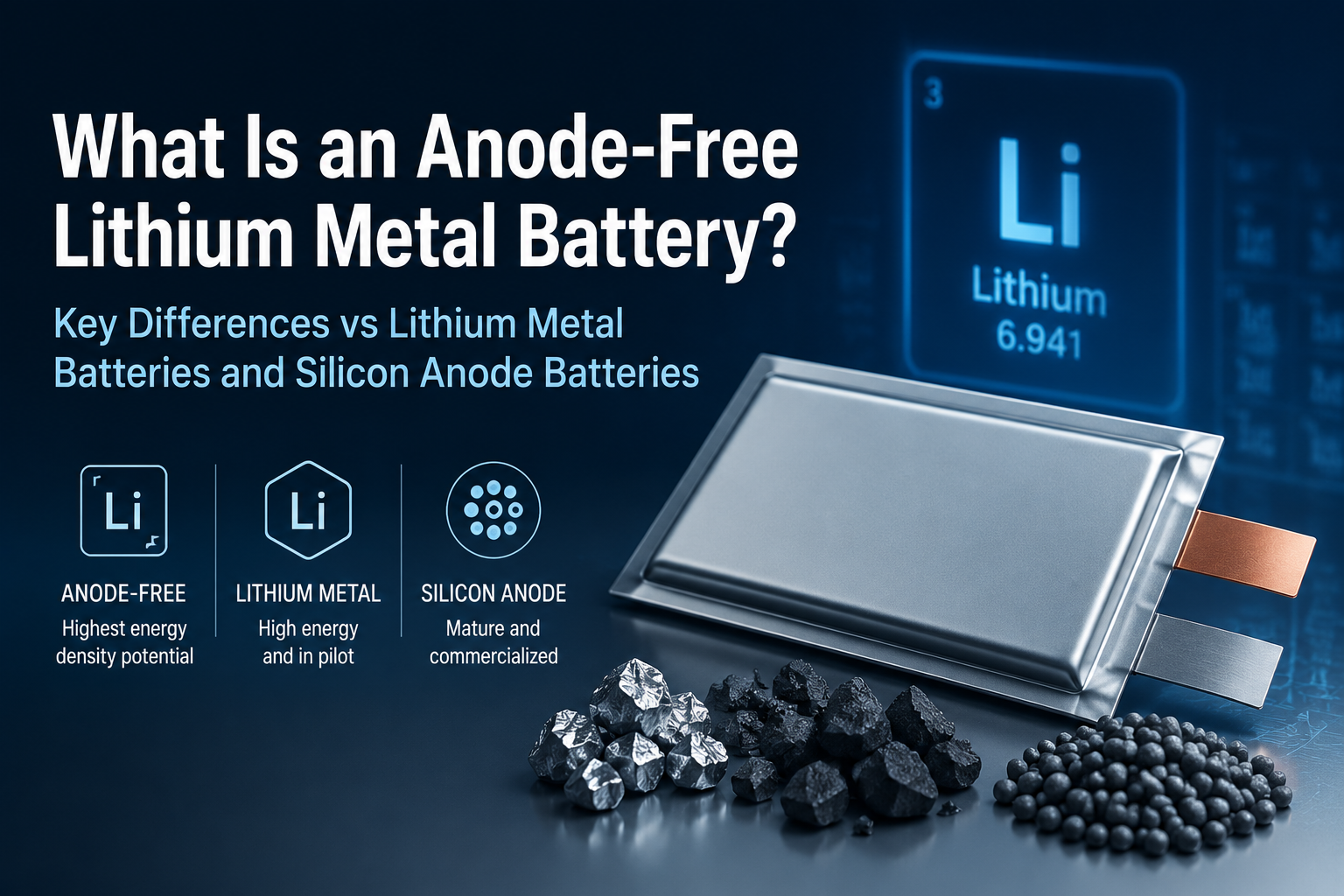
In next-generation lithium battery development, three high-energy-density pathways are frequently discussed but often misunderstood even within the industry.
These include anode-free lithium metal batteries, traditional lithium metal batteries, and silicon anode lithium-ion batteries. While they all aim to push energy density beyond conventional lithium-ion systems, their underlying architecture, lithium storage mechanism, and failure modes are fundamentally different.
In recent years, anode-free lithium metal batteries have become a recurring topic in academic research and industrial R&D, emerging as one of the most closely watched directions in advanced energy storage systems.
Understanding this technology requires focusing less on materials alone and more on how lithium is structurally stored and redistributed inside the cell.
The shift from material optimization to structural redesign
Conventional lithium-ion batteries rely on graphite-based anodes, where lithium is stored through intercalation. This architecture has been optimized for decades and is now highly mature across industrial applications.
However, as energy density improvements begin to plateau—typically around the range of 400–500 Wh/kg at system level under advanced configurations—further gains are becoming increasingly incremental.
Instead of continuing to optimize the anode material, researchers have begun exploring a more radical question:
What if the anode does not exist at the manufacturing stage at all?
This question leads directly to the concept of anode-free lithium metal batteries.
In this architecture, the cell is assembled without any pre-installed anode active material. There is no graphite coating, no silicon composite layer, and no metallic lithium foil. The negative electrode side contains only a copper current collector, while all lithium originates from the cathode and is redistributed during operation.
The most important shift here is not material substitution, but structural elimination of the anode as a manufactured component.
How anode-free lithium metal batteries operate
Anode-free systems rely on reversible lithium plating and stripping on a copper substrate rather than a pre-existing anode structure.
During charging, lithium ions are released from the cathode and migrate through the electrolyte toward the copper current collector. Once they reach the copper surface, they gain electrons and are reduced into metallic lithium. This process gradually builds a lithium layer directly on the copper foil, effectively forming the anode in real time.
In simple terms, the anode does not exist at the beginning—it is “grown” during charging.
During discharge, the opposite process occurs. The plated lithium is oxidized back into lithium ions, which migrate back to the cathode and reinsert into its crystal structure. As discharge continues, the lithium layer gradually disappears, and at full discharge the anode side may contain almost no active lithium.
This dynamic behavior fundamentally distinguishes anode-free systems from all conventional lithium battery architectures.
SEI formation and interface instability
Once lithium is deposited on the copper surface, it immediately reacts with the electrolyte, forming a solid electrolyte interphase (SEI) layer.
A stable SEI is essential because it helps:
- Reduce continuous side reactions between lithium and electrolyte
- Regulate lithium deposition morphology
- Suppress dendrite formation to a certain extent
However, SEI behavior is also one of the primary sources of instability in anode-free systems.
When the SEI repeatedly cracks and reforms during cycling, fresh lithium surfaces are exposed, triggering additional electrolyte decomposition. This leads to continuous consumption of both lithium and electrolyte, reducing Coulombic efficiency and causing irreversible capacity loss.
Unlike traditional lithium metal systems, anode-free batteries do not have any lithium reservoir on the anode side. As a result, these losses cannot be buffered and directly accumulate into permanent degradation.
This lack of buffering capability is one of the key structural limitations of the technology.
Comparison with traditional lithium metal batteries
Traditional lithium metal batteries differ fundamentally because they already include a pre-installed lithium metal foil on the anode side. In this case, lithium exists in two forms: stored in the cathode and stored directly as metallic lithium in the anode.
This means the anode is physically present from the beginning of cell assembly, while in anode-free systems, it is formed only during operation.
This structural difference leads to clear performance divergence.
Traditional lithium metal batteries generally show more stable cycling behavior because excess lithium can partially compensate for irreversible losses. The deposition process is also more controllable, which improves tolerance to side reactions.
By contrast, anode-free systems rely entirely on lithium plating onto a bare copper surface. This results in more uneven nucleation, lower Coulombic efficiency, and faster capacity decay under repeated cycling.
In terms of maturity, traditional lithium metal batteries are already entering semi-solid and pilot-scale validation stages, with potential applications in aerospace systems, high-end electronics, and early electric vehicle prototypes.
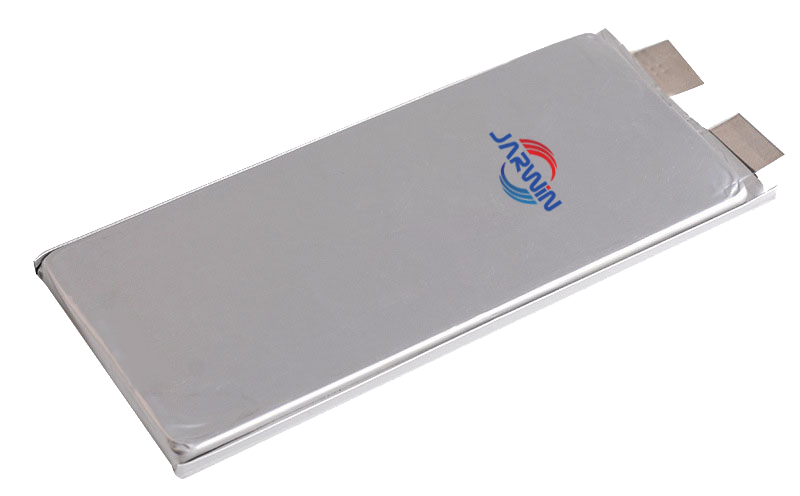
Anode-free batteries, however, remain at an earlier stage of development, primarily limited to laboratory research and small pouch cell experiments. Their future applications are expected in ultra-lightweight power systems, high-end UAVs, and solid-state battery integration platforms, but large-scale commercialization is still distant.
Silicon anode batteries and a different limitation pathway
Silicon anode batteries represent a different evolutionary direction within conventional lithium-ion technology. Instead of removing the anode, they replace graphite with silicon-carbon composite materials to increase lithium storage capacity.
Silicon has an extremely high theoretical capacity of approximately 4200 mAh/g, significantly higher than graphite. However, this advantage comes with a major structural challenge: silicon undergoes up to ~380% volume expansion during lithiation.
This repeated expansion and contraction leads to particle fracture, electrode structure collapse, and gradual loss of electrical connectivity. Even with nano-structuring and binder optimization, this mechanical degradation cannot be fully eliminated.
In contrast, anode-free systems avoid solid-state expansion entirely because there is no fixed anode structure. Lithium is deposited directly on the copper current collector. However, this introduces a different set of challenges, particularly dendrite formation, interfacial instability, and the high reactivity of metallic lithium.
At the system level, silicon anode batteries currently achieve approximately 300–350 Wh/kg in commercial applications. Anode-free systems, when paired with high-nickel or lithium-rich cathodes, are theoretically capable of reaching 500–600 Wh/kg, although this remains at a conceptual stage.
From a safety perspective, silicon anode systems benefit from mature lithium-ion safety frameworks. Anode-free systems, however, involve metallic lithium directly exposed during cycling, which increases the risk of dendrite penetration and thermal runaway if not properly controlled.
Technology readiness and industrial positioning
Silicon anode batteries are already widely commercialized and deployed in electric vehicles, with ongoing improvements focused on cycle life and mechanical stability.
Traditional lithium metal batteries are closer to pilot-scale deployment, with development efforts centered on balancing energy density and stability, often through semi-solid or hybrid architectures.
Anode-free lithium metal batteries remain at an early research stage. The main challenges include low Coulombic efficiency, dendrite growth, and limited cycle life. Addressing these issues requires breakthroughs in electrolyte chemistry, interface engineering, and potentially solid-state electrolyte integration.
As a result, anode-free systems are still considered a long-term frontier technology rather than a near-term commercial solution.
Future outlook
From an engineering perspective, anode-free architecture represents one of the most extreme simplifications of lithium battery design. By eliminating the anode manufacturing step entirely, it fundamentally redefines how lithium storage systems are structured.
If key technical barriers can be overcome, this architecture could significantly reshape battery manufacturing by reducing process complexity and improving compatibility with advanced cell-to-pack and cell-to-chassis designs.
Potential applications include long-range electric vehicles, industrial UAVs with extended endurance, aerospace systems, deep-sea equipment, and long-duration energy storage systems.
Industry consensus suggests that anode-free systems will not replace silicon anode or lithium metal batteries in the short term. In the mid-term, they are likely to be integrated into solid-state battery development pathways. In the long term, they may gradually emerge in niche applications where maximum energy density is the primary requirement.
Understanding the fundamental differences between anode-free lithium metal batteries, traditional lithium metal batteries, and silicon anode batteries is essential for accurately evaluating next-generation energy storage technologies.
While silicon anode systems are already shaping today’s EV industry, and lithium metal batteries are progressing through pilot validation stages, anode-free architectures remain at the earliest stage of scientific and engineering exploration.
However, with continued progress in electrolyte design, interface engineering, and solid-state integration, this direction remains one of the most closely watched pathways toward achieving a step-change in lithium battery energy density.





 Bahasa Indonesia
  English
  Español
  한국어
한국어  Deutsch
  Français
  日本語
日本語  Русский
  ไทย
ไทย  العربية
  Português do Brasil
  Italiano
  Nederlands