




Managing a drone training fleet comes down to three metrics: Operational Safety, Availability, and Cost. As your primary consumable, battery management is the difference between a seamless training schedule and a budget-draining operation.
This guide outlines a data-driven framework to:
- Tier your fleet: Match high-cycle packs for basic drills and high-rate packs for advanced modules.
- Standardize SOPs: Unify BMS rules and DCIR monitoring to eliminate instructor guesswork.
- Compress Turnaround: Shift from sequential to concurrent charging to cut downtime by 50%.
Here is how to build a battery ecosystem that is as reliable as your airframes.
What high attendance requires: Multi-drone Battery Queue Charging
High attendance is about turnaround time, not pack count. Target KPI: a partial top‑up of 0→~80% in under 30 minutes for small‑to‑mid packs when the charger and BMS allow it. Achieving this requires true multi‑channel independent charging (one monitored channel per bay), a hot‑swap pool at the flight line, and queueing that groups batteries by SoC and SOH.
Use independent charger channels rather than ad‑hoc parallel wiring; keep each bay under its own thermal and BMS supervision. Respect cooldown windows—heat left in a pack after a sortie often equals or exceeds charging time—so reserve separate cooldown bays or stagger sorties rather than compressing cooling and charging into the same slot.
For quick capacity planning, estimate required channels as: batteries per sortie × simultaneous sorties, then confirm you can refill that many units to ~80% within your turnaround window while leaving extra bays for cooldown and maintenance.
| Training Scale | Target TTR | Independent Channels | Backup / Cooldown Bays | Typical Application |
|---|---|---|---|---|
| Small (5–8 Drones) | 30–40 min | 6–8 Channels | 2 Bays | Basic maneuvers / Indoor labs |
| Standard (10–15 Drones) | 45 min | 12–16 Channels | 4 Bays | Mixed fleet / Outdoor circuits |
| Enterprise (5+ Heavy Units) | 60 min | 8–10 Channels | 4 Bays | Mapping / Thermal / Inspection |
Finally, separate quick top‑ups (0→~80%) from deep maintenance, run full charges, capacity calibration, and balance cycles on a distinct schedule and in separate bays so maintenance work never blocks peak charging throughput.
A layered selection stance: Basic Flight Training Drone Batteries vs. Performance Tiers
1. Standard-Cycle Packs for Core Maneuvers
For basic maneuver training and novice courses, prioritize Standard-Cycle LiPo/LiHV packs. Instead of chasing high energy density, these packs are optimized for durability and stability.
- The 1,000-Cycle Goal: While typical LiPo packs last 200–300 cycles, you can extend this significantly by setting conservative charge ceilings (e.g., capping at 4.15V instead of 4.35V).
- Trade-off: This “under-clocking” reduces flight time by 10–15% but materially lowers the TCO (Total Cost of Ownership) per training hour. This is the ideal stance for line-of-sight drills and pattern work where the flight envelope demands are modest.
2. High-Performance Packs for Advanced Modules
For aerial cinematography, mapping sprints, or heavy-lift modules, use High-Rate Performance packs. These provide the sustained power and energy density required for professional mission profiles.
- Strict Oversight: These packs require tighter operating windows. Enforce mandatory cooldown periods and use earlier retirement triggers.
- Performance Monitoring: Monitor voltage sag under load as a real-time proxy for rising internal resistance (DCIR). When a pack can no longer sustain the required current without significant voltage drops, it should be transitioned to “ground-use only” status.
3. Unified BMS and Charging Ecosystem
Regardless of the battery tier, unify your BMS telemetry and charging profiles so instructors aren’t juggling exceptions.
- Standardization: Use consistent protection thresholds (over/under voltage, temperature windows) and log SOH/DCIR data for every cycle.
- Predictive Maintenance: A unified BMS allows you to spot outliers—packs that are aging faster than the rest of the batch—allowing for proactive rotation or retirement before an incident occurs during a class.
Drone Training Battery Batch Charging Solutions: Slashing Wait Times
Keep the staging workflow high-level and industrialized so staff can follow it quickly; put step-by-step checks on the wall as a separate, concise SOP. The two common failure modes in training benches are heat accumulation and missing event records — solve both with disciplined staging, heat gating, and a per-pack data closed‑loop.
Key staging principles
- Voltage‑band grouping: pre‑sort incoming packs into SoC bands (e.g., <20%, 20–50%, 50–80%) so each charger spends less time in long CV/balance phases and more time in high‑power CC charging.
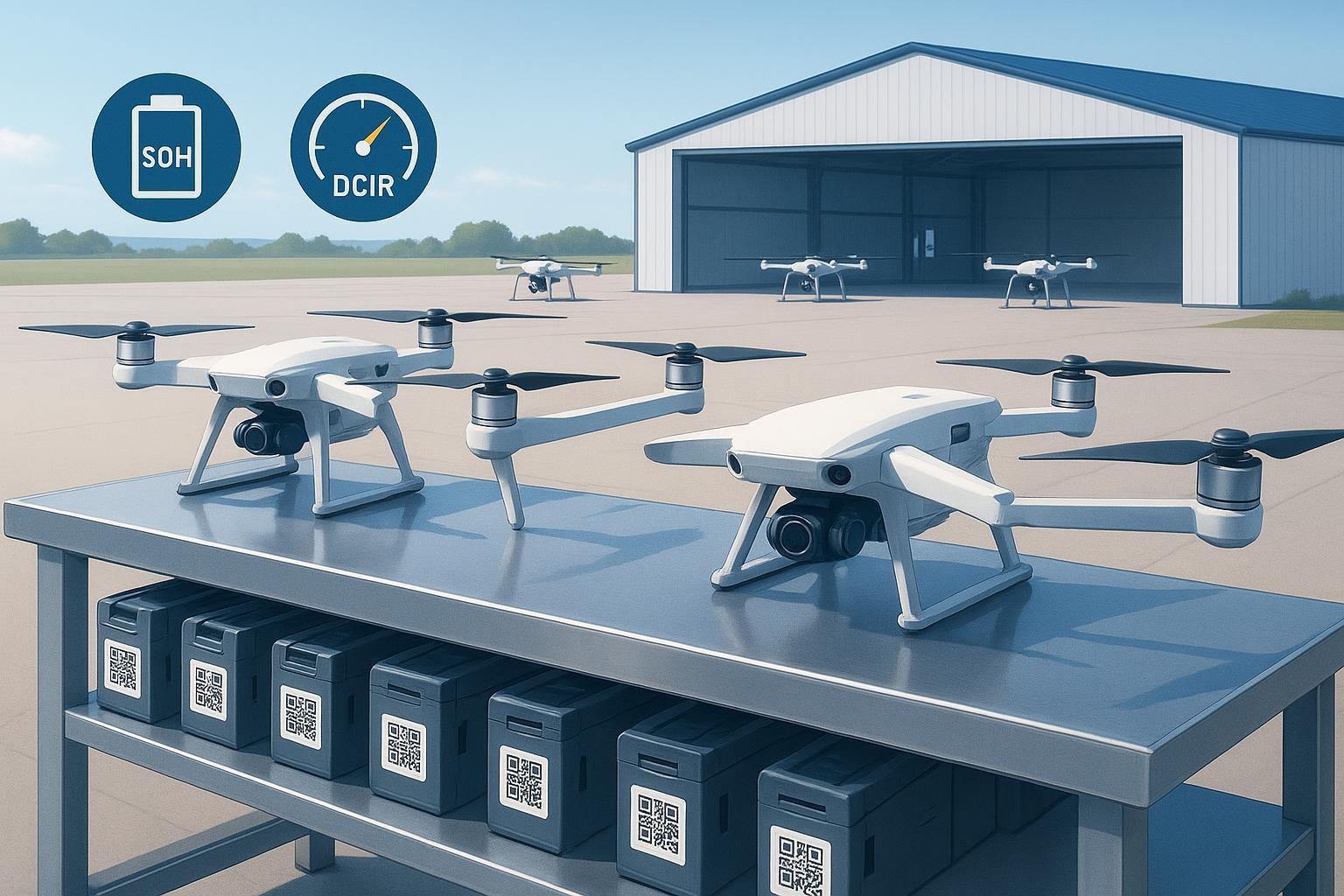
- Health‑based queueing: route packs with SOH below your operational threshold (suggest flight retirement at SOH <80%) or with DCIR growth >20–30% vs baseline to a slow/repair queue; never let degraded packs occupy fast bays.
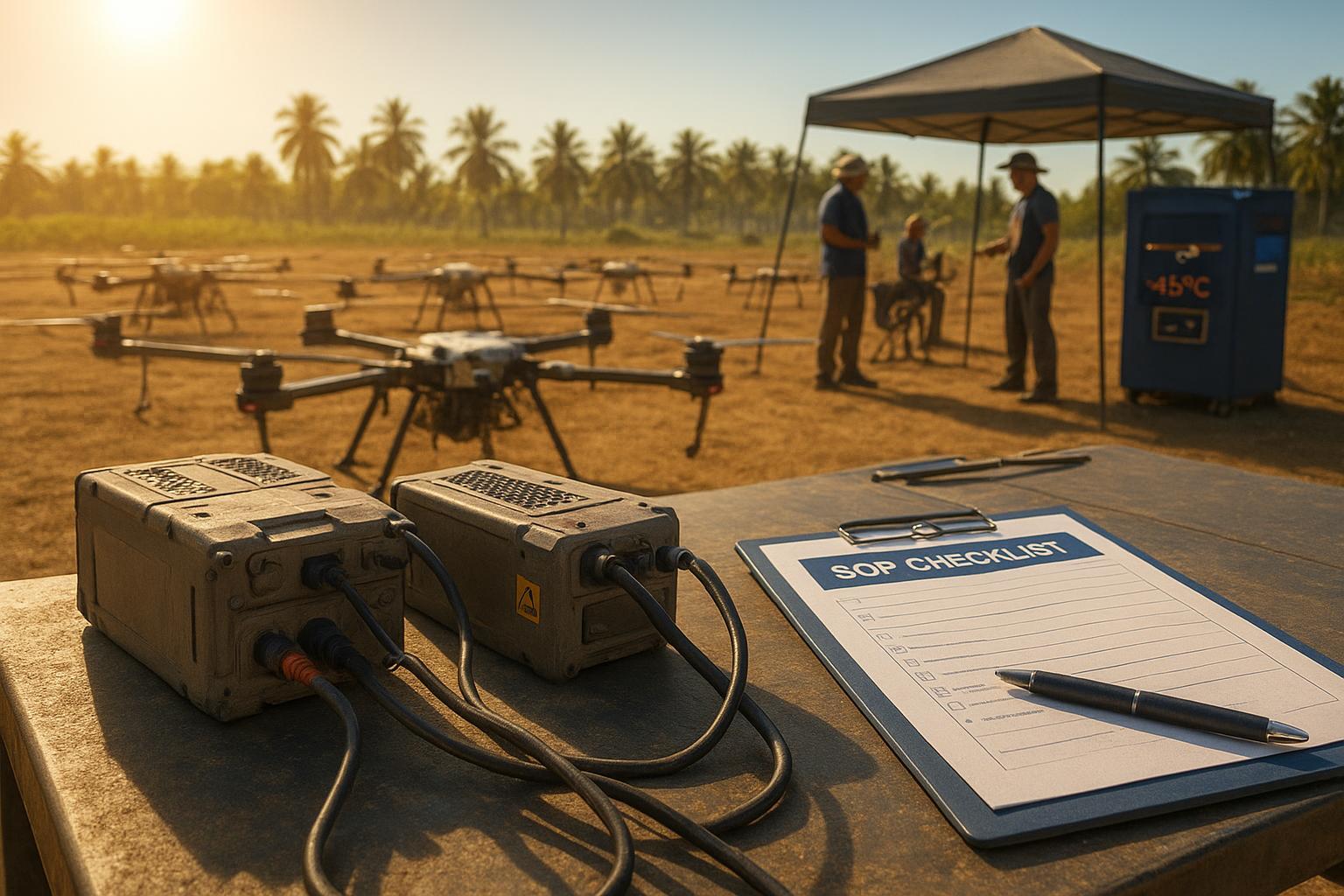
- Thermal staging (cool‑down buffer): enforce a cooldown rule: a pack must be within the OEM charge temperature window before entering a charging bay. Where per‑pack telemetry is unavailable, use a simple touch/IR gate (not hot to the touch or within OEM surface °C). “First cooldown, then charge.”
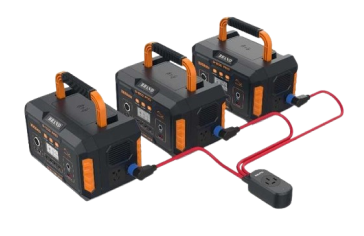
- Concurrency via hub density: achieve parallel throughput with multiple independent charger channels (one monitored channel per bay) rather than by paralleling outputs. Size hub count to expected simultaneous sorties and confirm facility AC capacity and breaker limits.
- Isolation & incident zoning: designate a clearly marked Isolation Zone ~10 ft (≈3 m) from the charging area with approved containment (sand/metal box or certified thermal bag) for any pack that shows swelling, hissing, smoke, or unexpected heat.
- Data closed‑loop: require a retrievable per‑pack record for every charge event (see SOP). Use these logs to run weekly analytics that flag rising DCIR, repeated thermal events, or SOH decline faster than cohort average.
When to scale operational levers
- If median time‑to‑80% > 30 minutes for your target pack class, add independent charger channels or increase swap‑pool size rather than increasing charge current. Heat, not current, should be the gating variable.
- If a growing fraction of packs hit DCIR or thermal alerts, move them to the Repair queue and review charging profiles, cooldown policy, and hub density.
Charging safety remains primary: ventilated area, non‑combustible surfaces, per‑bay or spot temperature monitoring, and a reachable Class D / lithium‑specific extinguisher. For technical grounding on charge limits and institutional controls see Battery University — BU‑808: How to Prolong Lithium‑based Batteries dan NFPA — Lithium‑ion battery safety guidance.
Charging Bay SOP
Post this checklist at every bench; keep it short so technicians can read it at a glance.
- Quick pre‑start (pass/fail, tape box): Pack ID scanned; pack status not flagged; surface temp in charge window.
- Stage: Place pack in the Voltage Band rack assigned for this bay (Low / Mid / High).
- Start log: record Pack ID, start time, charger ID, start SoC/SOH.
- Monitor: check temperature and charger status at midpoint and end; abort and isolate on heat spikes, hissing, or smoke.
- End log: record end time, end SoC/voltage, end temp, and any event notes; tag pack Green/Amber/Red per status.
- Storage/Transit: set Storage SoC ≈50% for hibernation; set Transport SoC ≤30% for air shipments per carrier rules and UN/IATA guidance.
Make the full SOP and incident forms available digitally (CSV export or fleet‑tool) and link the charging‑bay checklist to the incident reporting template so every event is searchable and auditable.
Diagnostics & Fault Troubleshooting that prevent mid‑class surprises
To ensure zero-incident training, shift from reactive swap-and-dispose to a Predictive Retirement policy based on the “Big Three” metrics: SOH, DCIR, and cell delta. Track these per pack and act on trends, not single events.
1.The Golden Baseline & Weekly Sampling
- Commissioning: For every new pack, record a “Golden Baseline”: open-circuit voltage (OCV), verified capacity (measured discharge), and pulse DCIR under a standardized load.
- Weekly sampling: Use your smart charger, BMS telemetry, or a handheld BMS analyzer to sample the fleet weekly and log results to the pack record. Keep timestamps, test method, and operator initials in the record to ensure traceability.
2.The “Big Three” Health Metrics
Use quantified thresholds to decide when to monitor, restrict, or retire a pack.
- DCIR (internal resistance)
- Why: DCIR usually rises before capacity loss and predicts heat/power failure under load.
- Alert: +25% vs baseline — flag for increased monitoring and restrict to lower-duty missions until cleared.
- Retire: +50% vs baseline — remove from flight after verification; move to Ground‑Use or Repair pool.
- Voltage delta (cell consistency)
- Why: Growing per-cell deltas indicate imbalance or cell degradation.
- Warning: single-cell delta > 0.05 V at idle or under load — run two slow balance cycles and re-test.
- Retire: If delta persists > 0.05 V after balancing, move the pack to Repair/Recycle (do not return to flight until inspected).
- SOH (state of health / verified capacity)
- Why: SOH defines usable mission energy and is the primary retirement metric for high-load sorties.
- Flight trigger: SOH < 80% of nominal — transition the pack to Ground‑Use only (bench, demos) and schedule replacement.
3.Asset Tiering: Traffic Light System
Label every pack with a durable color tag and a Pack ID (QR/NFC) that maps to its live record. Update tags immediately when status changes.
- Flight Pool (Green): Matched, low-DCIR, balanced packs cleared for full operational sorties.
- Ground‑Use Only (Amber): SOH < 80% or minor DCIR rise; safe for bench tests, firmware updates, and demos, not for student flights.
- Repair/Recycle (Red): Swollen, gassing, rapid self-discharge, DCIR above retire threshold, or persistent cell delta after balancing — isolate for RMA or compliant disposal.
4.The 35‑Second Pre‑Flight SOP (every sortie)
Instructors must run this quick Go/No‑Go check before each flight to enforce the predictive policy at point of use:
- Identity (5 s): Scan Pack ID; confirm status is Green and that the pack passed the weekly SOH/DCIR check.
- Contacts (8 s): Inspect gold-fingers and power pins for pitting, black carbon, deformation, or looseness.
- Flat‑table test (5 s): Place the pack on a flat surface; if it rocks or “pillows,” ground it immediately.
- Thermal window (7 s): Confirm surface or telemetry temperature within the OEM takeoff range (typical training window 15°C–40°C); if in doubt, apply the cooldown rule.
- Telemetry sanity (10 s): Power on and check the GCS for cell delta < 0.05 V; if telemetry is absent or inconsistent, remove the pack from flight and send to Ground‑Use for diagnostics.
Operational notes
- Trend as the driver: Treat weekly trends as the decision driver — a single marginal reading triggers monitoring; repeated excursions trigger sidelining and repair workflows.
- Don’t mix statuses: Never return an Amber or Red pack to a Green flight set, even temporarily. Use pick-lists and visual tags during pre-flight to enforce this.
- Measurement consistency: Use the same test method and equipment for baseline and weekly samples to avoid false positives from measurement noise.
This Predictive Retirement approach reduces surprise failures during classes, concentrates repair effort where it’s needed, and preserves the highest-value packs for flight duty.
Critical Safety Protocols: Swollen Pack Handling
When a pack shows swelling (pillow, separation, or deformation), treat it as an immediate safety event and follow a strict SOP: do not return it to flight or charge it.
- Isolate immediately
- Move the pack to a designated Isolation Zone away from the charging area and flight line (metal or sand‑filled containment preferred). Keep the area ventilated and clearly marked.
- Power and disconnect
- Remove the pack from the aircraft and chargers; disconnect all cables. Do not attempt to force connectors or charge the pack.
- Do not puncture or compress
- Never puncture, press, or attempt to mechanically flatten a swollen pack. Mechanical damage can trigger thermal runaway and is strictly prohibited.
- Record the event
- Take photos, record ambient and pack surface temperatures, and export any available telemetry (Pack ID, last SoC, SOH, recent charge events). Log the incident in the asset record with operator initials and timestamp.
- Quarantine and technician review
- Move the pack to the Quarantine/Repair bin (Red status). Only a qualified technician or the supplier should open, test, or approve further action.
- Compliant disposal or RMA
- Arrange compliant disposal, recycling, or supplier RMA per local hazardous‑waste rules and the vendor return policy. Do not improvise disposal methods; follow local regulations and your supplier’s instructions.
Keep this swollen‑pack SOP as a single‑page poster near charging bays and include the incident log template in your fleet tool so every event is auditable.
Logistics for Downtime: Storage & Transport
Good storage and transport practices preserve cycle life and keep your fleet compliant.
Storage SoC and inspection cadence
- Target Storage SoC: ~50% for chemical stability during long idle periods. Avoid leaving packs at 100% or fully depleted for extended time.
- Parasitic draw: Smart packs and BMS telemetry draw a small current that can lower SoC over weeks. Implement a scheduled inspection cadence—recommend every 30 days—to verify SoC and top packs back to the Storage SoC if needed. Record each check in the asset log.
Separate Storage vs. Transport SoC
- Storage SoC: ~50% (long‑term preservation).
- Transport SoC: ≤30% for air shipments as a compliance practice; always confirm carrier rules and the current DGR edition before shipping.
Transport and regulatory compliance
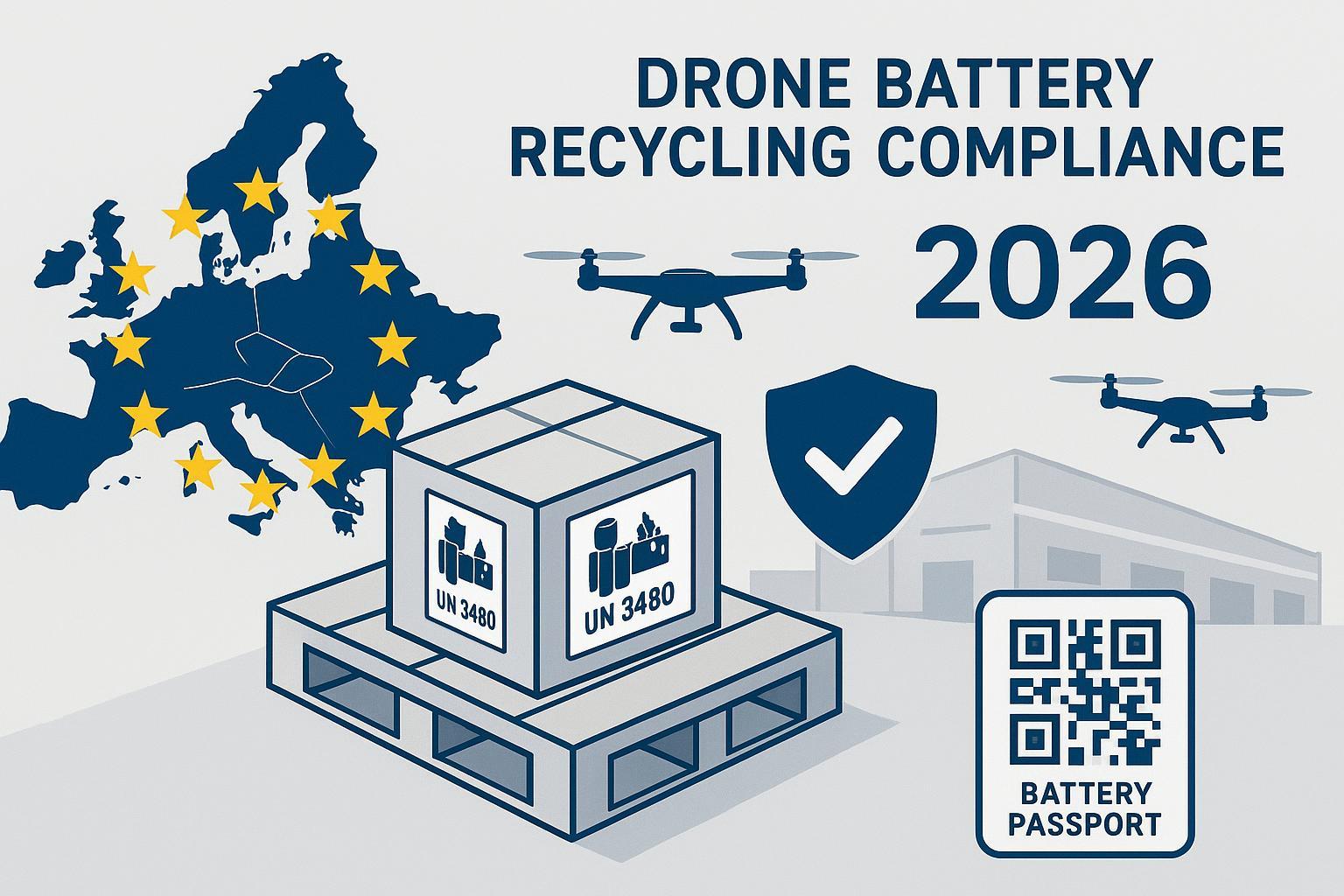
- Verify UN38.3 test evidence for every pack shipped and package, label, and document shipments per the UN Manual of Tests and Criteria Section 38.3 (see the canonical reference in the UN Manual of Tests and Criteria, Section 38.3).
- For air transport follow the applicable IATA/ICAO rules; consult the current IATA Dangerous Goods Regulations for SoC limits and packing/marking requirements (example: IATA DGR). Carrier and national rules may vary—always confirm before shipment.
Practical notes for administrators
- Keep a checked list for every packed shipment: Pack ID range, UN38.3 evidence, declared SoC, packaging type, and emergency contact.
- Restore packs to Storage SoC (~50%) after arrival and before returning to service.
- Store packs in a cool, dry room within OEM temperature guidance and away from direct sunlight and heat sources.
Case Study: Achieving 30-Minute Turnaround for Drone Training Batteries
In a 12‑airframe class using small‑to‑mid packs, the operational goal was to cut turnaround from roughly 60 minutes to under 30 minutes (0→~80% partial top‑ups).
To achieve this, the team replaced the standard “first-come, first-served” approach with two operational levers:
- True Concurrency: Moving from sequential charging hubs to multiple independent bays to eliminate bottlenecks.
- Health‑Based Queuing: Grouping packs by voltage band and SOH so that weak packs didn’t “clog” the fast-charging lines.
The setup relied on chargers that prioritized wattage and thermal monitoring, while the BMS provided per-cell telemetry. This allowed staff to enforce strict cooldowns and avoid “heat stacking”—a critical factor in extending battery lifespan.
Over a two‑week trial, this combination reduced the median time‑to‑80% to just 28–32 minutes and virtually eliminated heat‑related charge aborts.
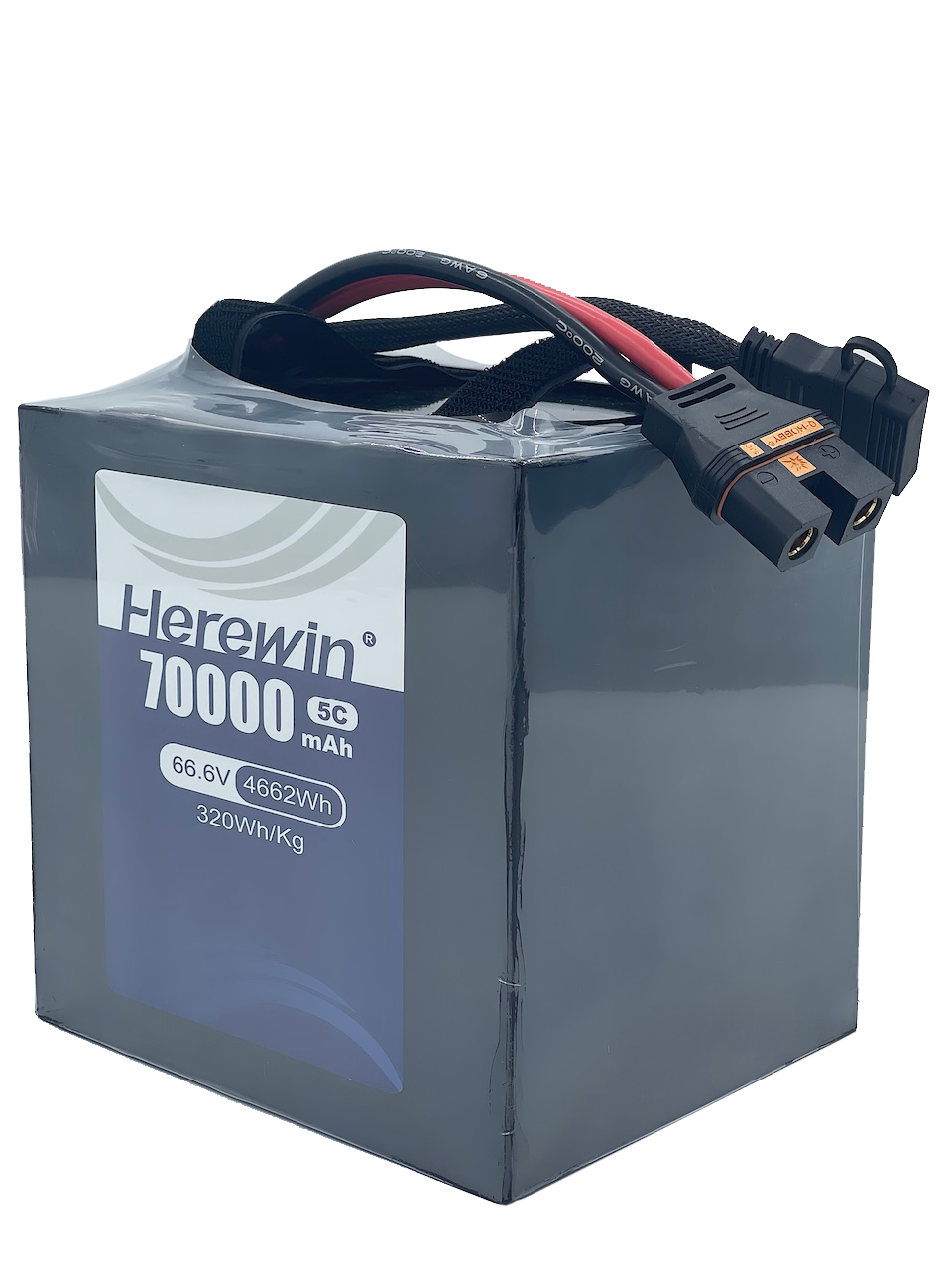
The success wasn’t just operational—it was hardware-driven. Because the selected reinforced training cells are engineered for 5C peak charging, running a continuous ~2C charging loop (to hit ~80% in 30 mins) keeps the cell well inside its thermal comfort zone.
Why this matters: Standard batteries pushed to 2C often overheat, forcing the charger to throttle down (thermal throttling). But for a 5C-rated industrial pack, 2C is merely a “cruising speed.” This hardware headroom—combined with disciplined cooling—was the secret to consistently hitting the 30-minute target without compromising safety.
TCO math for Industrial Drone Training Battery Solutions
The Economy Model: Why “Cheaper” Batteries Cost More To convince finance, move the conversation from “Purchase Price” to “Cost per Flight” (CPF).
1.The Core Formula
Cost per Flight (CPF) = Purchase Price ÷ Cycle Life
2. Financial Comparison: Consumer vs. Industrial
Here is the math comparing a standard consumer pack vs. a voltage-capped reinforced industrial pack:
| Option | Unit Price | Strategy | Expected Cycles | Cost per Flight (CPF) |
|---|---|---|---|---|
| A — Consumer LiPo | $180 | Standard full charging | 250 | $180 ÷ 250 = $0.72 |
| B — Reinforced Industrial LiPo | $260 | Voltage capping (4.15V) | 800 | $260 ÷ 800 = $0.325 |
Result: Moving from Option A to B drops the operational cost by ~55% (from $0.72 to $0.325 per flight), despite the higher upfront price.
3.Quantifying the Hidden Cost: Downtime
- Scenario: 10 students delayed for 1 hour.
- Cost Basis: Instructor ($40/hr) + Facility ($100/hr).
- Direct Loss: ($40 + $100) × 1 hour = $140.
The “Buffer” Logic: The price premium for a reinforced pack is $80 ($260 – $180). Buying two extra reinforced packs costs $160—roughly equivalent to just one hour of downtime.
4.Decision Trigger
If Cost of Downtime > Incremental Battery Cost, invest in higher-cycle packs or a larger swap pool immediately.
Short Takeaway for Procurement Use CPF as the primary procurement metric for training fleets. It aligns operations with finance and reveals the true cost of “budget” batteries.
PERTANYAAN YANG SERING DIAJUKAN
How do I size the charger bench for my schedule?
Use the 1.2:1 redundancy rule: For every 10 active airframes, plan for at least 12 independent charging channels. This 20% buffer accounts for thermal cooldown cycles and maintenance staging that formulas often overlook.
Will a layered battery policy (Standard vs. Performance) complicate training?
Not if you enforce visual standardization. Color-code your packs (e.g., Blue for Maneuvers, Red for Media) and use unified BMS profiles. This ensures instructors can manage different tiers without juggling complex settings.
What temperatures are safe for intensive training camps?
Never charge below freezing (0°C) or above the OEM’s thermal cutoff (typically 45°C). Use the “Cool-down Buffer” strategy: if a pack is hot to the touch, it stays on the cooling rack until telemetry confirms it has returned to the ambient operating window.
What is the right policy for semester breaks?
Adopt the 30-day manual check: Store at 50% SoC in a cool room. Do not rely solely on auto-discharge features; parasitic draw from the BMS can lead to deep-sleep lockouts. Re-verify and top up to 50% every month.
Do we need specific compliance for shipping batteries between campuses?
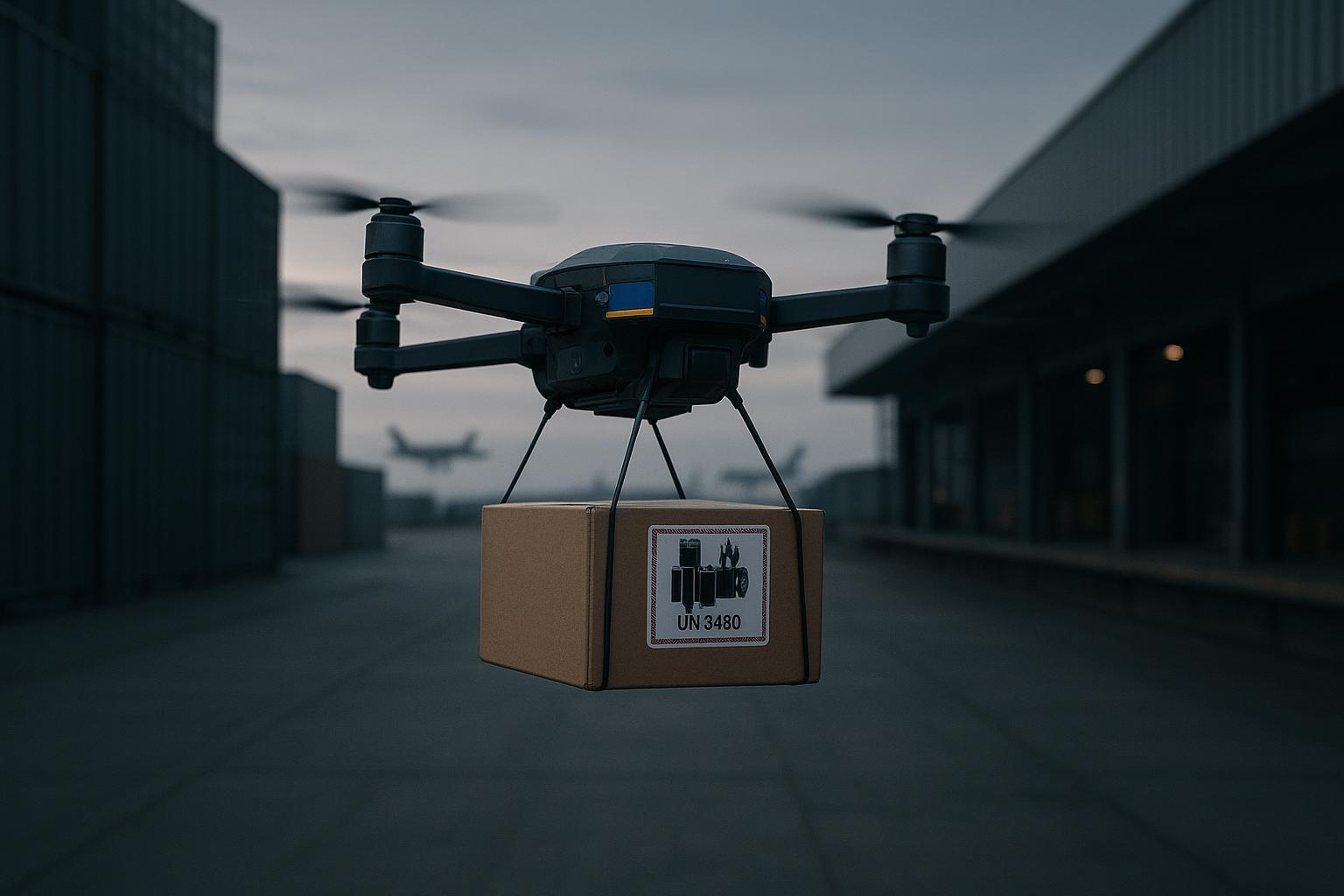
Yes. For air transport, you must enforce the IATA ≤30% SoC mandate. Ensure every pack has UN38.3 evidence and is labeled UN3480. For ground, 50% SoC is acceptable but requires fire-rated packaging and compliant documentation.
Standards & OEM Boundaries
The thresholds used in this article (for example: 0.05 V per‑cell delta, DCIR alerts of +25% / +50%, SOH retirement near 80%, or example charge rates like 2C / 5C) are illustrative operational guidance only.
Always treat OEM/BMS datasheets and applicable standards as primary:
- Shipping: Tests per UN Manual of Tests and Criteria, Section 38.3.
- Safety: Safety/compatibility notes in the IEC/UL battery standards guidance.
- Best Practices: Practical charge/storage practice summarized in Battery University.
For product‑specific limits, telemetry fields, and optimized charging configurations, consult the Herewin Technical Team for a direct assessment.

 Bahasa Indonesia
  English
  Español
  한국어
한국어  Deutsch
  Français
  日本語
日本語  Русский
  ไทย
ไทย  العربية
  Português do Brasil
  Italiano
  Nederlands