







Industrial drones are getting smarter—and battery selection has quietly become an integration decision, not just a spec-sheet decision.
On paper, procurement can still look simple: Select battery → Install battery → Test flight
But in modern platforms, the first integration loop often looks like this:
Select battery → Connect BMS → Flight controller misreads telemetry → SOC mismatch / false warnings → Test delays → Firmware tuning or redesign
OEM teams usually start with the specs that are easy to compare:
Voltage
Capacity
Berat
C-rate
Kepadatan energi
Those matter. But they don’t answer the question that protects your schedule:
Can the aircraft interpret the battery’s data reliably—every flight, in every corner case?
For smart drone systems, compatibility isn’t only electrical. It’s also system communication compatibility.
Why Electrical Compatibility Is No Longer Enough for Intelligent Drone Batteries
An “intelligent drone battery” isn’t defined by chemistry alone. It’s defined by whether the pack can publish trustworthy telemetry into the aircraft’s decision loop.
A battery can hit the correct nominal voltage and still derail a program.
That’s because, in many industrial UAV architectures, the battery is no longer only a power source. It’s also a data-producing subsystem.
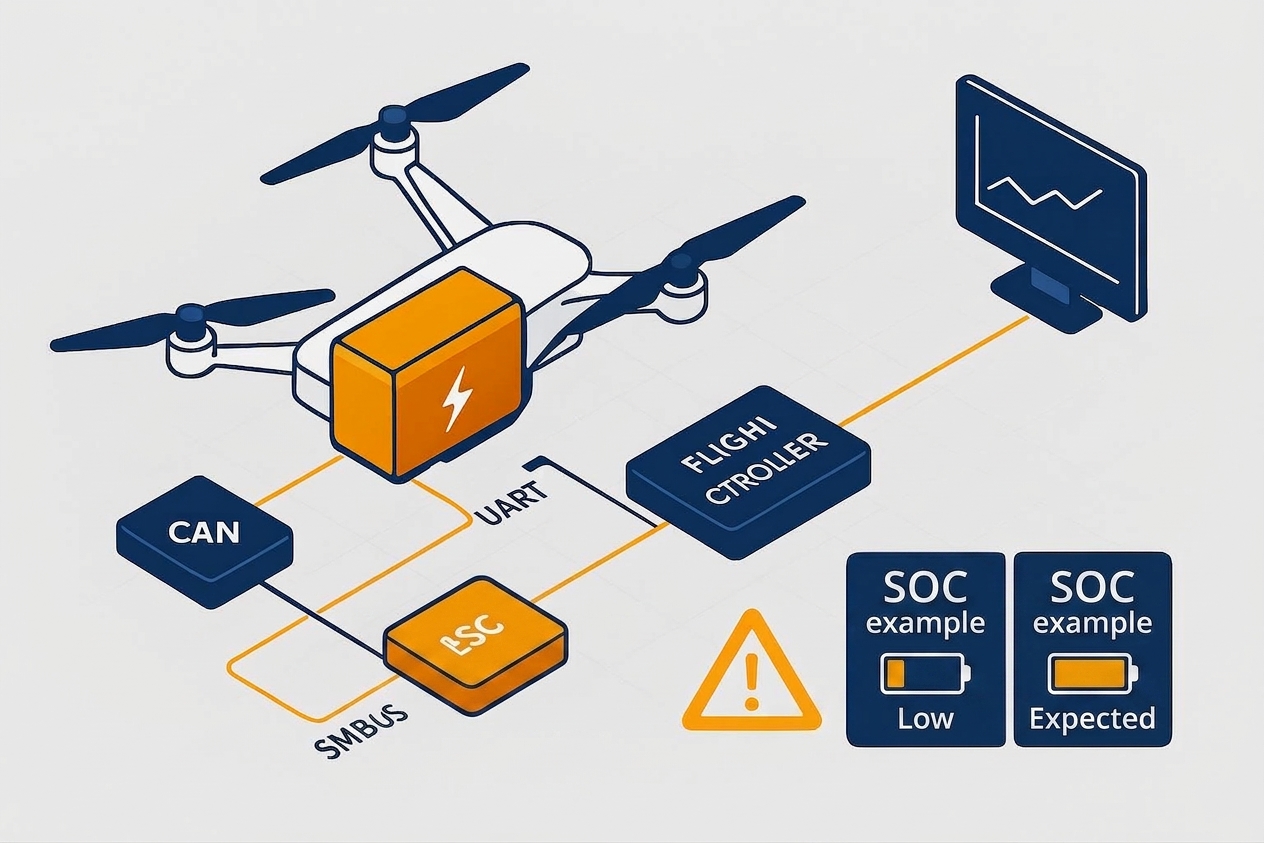
At minimum, the aircraft needs a reliable path for telemetry to move through the stack:
Battery → BMS → Flight controller → Ground station (and sometimes ESC / power-management ECU)
When that path is missing—or worse, present but semantically wrong—you get an integration failure that doesn’t look like a battery defect. It looks like “software instability,” “random warnings,” or “unreliable flight time.”
This is why procurement teams get surprised: the pack meets the electrical datasheet, yet integration still fails.
If your flight controller can’t trust SOC and fault status, it can’t make deterministic safety decisions—no matter how good the cells are.
How Battery Communication Affects Drone System Integration
Communication compatibility has two layers:
Interface/protocol fit: can the battery talk to the flight stack on the right physical/data interface?
Data semantics fit: does the aircraft interpret the fields correctly (units, scaling, IDs, thresholds, validity flags)?
If either fails, the integration timeline expands.
“Battery protocol compatibility” is a major part of drone battery compatibility, and it often becomes the hidden blocker in UAV battery integration programs.
CAN, UART, and SMBus: Different Protocols, Different Integration Requirements
This isn’t about which protocol is “best.” It’s about what your aircraft is designed to ingest—and whether the battery speaks that language.
CAN (often DroneCAN/UAVCAN in UAV ecosystems)
Strengths: robust in noisy environments, supports multi-node networks, good fit for industrial harnesses.
Integration reality: CAN-based battery integration requires alignment on communication settings, message definitions, and system configuration.
This is where UAV battery CAN communication becomes an integration gate.
UART (often used as a MAVLink data path)
Strengths: simple point-to-point link, straightforward bring-up.
Integration reality: you still need consistent link settings and a verified message definition so the aircraft interprets values correctly.
SMBus / I2C smart battery interfaces
Strengths: widely used for “smart battery” style data exchange.
Integration reality: compatibility depends on whether your flight stack supports the monitor mode and data fields you need.
If your platform is built around one interface but the battery ships with another—or ships with proprietary message definitions—you’ve created a translation project.
That translation work is rarely planned in procurement timelines.
BMS Telemetry and Data Semantics Are More Than Monitoring
A modern BMS is expected to output more than pack voltage.
Typical telemetry fields include:
SOC (State of Charge)
SOH (State of Health)
Pack voltage and current
Temperatures (pack / cell groups)
Fault codes / status flags (over-current, over-temp, under-voltage, etc.)
This is the core of drone battery BMS communication: the aircraft isn’t just “reading a battery,” it’s ingesting a stream of operational inputs.
These fields drive real system logic:
Flight-time estimation: If SOC is wrong, your “minutes remaining” model collapses.
Warning thresholds: A pack can be electrically fine while the system throws a low-battery warning because the data stream says so.
Maintenance and fleet diagnostics: Without readable fault logs and consistent SOH reporting, you can’t manage reliability at scale.
If you want a deeper overview of how BMS capabilities impact safety and lifespan, see Herewin’s explainer on advanced BMS functions for UAV safety and lifespan.
Incorrect Battery Data Can Create Operational Risks
Most teams recognize the risk of an electrical mismatch.
Fewer teams account for data mismatch, which can be just as operationally dangerous.
Example: SOC mismatch
Actual pack SOC (based on energy removed): ~40%
SOC reported to the aircraft: ~15%
Even if the pack can still deliver the power, the aircraft logic may:
trigger premature Return-to-Launch / auto-land behavior
enforce power limits earlier than necessary
force conservative mission planning that reduces productivity
The inverse is worse:
Actual SOC: low
Reported SOC: high
Now your reserve margin is fiction.
Example: fault semantics mismatch
If the BMS flags an event as “critical” but the flight controller treats it as “informational” (or vice versa), you get either nuisance aborts or unsafe continuation.
Hidden Costs of Battery Protocol Incompatibility
Protocol incompatibility rarely shows up as “battery failure.” It shows up as engineering time.
Longer Integration and Validation Cycles
When a battery doesn’t match the flight stack’s expected interface and data mapping, the fix is usually software work:
message field mapping (units, scaling, IDs)
parameter tuning (warning thresholds, failsafe timers)
gateway/translator development (CAN ↔ UART ↔ SMBus bridges)
repeated bench + flight validation loops
That consumes the scarcest resource in drone OEM programs: engineering hours during EVT/DVT.
Poor Diagnostics Increase Maintenance Difficulty
Even if you “make it work,” poor data accessibility turns into a long-term reliability tax.
If your maintenance team can’t:
read BMS event logs
interpret fault codes consistently
correlate battery events with flight logs
Then field issues become slower and more expensive to resolve.
This is where “protocol compatibility” becomes “maintainability.”
A simple TCO lens: what protocol mismatch actually costs
You don’t need a full financial model to see exposure. Track three indicators that show up in every program:
Engineering hours spent on mapping/debug and edge-case handling
Validation cycles added (bench re-tests + flight re-tests after firmware changes)
Field diagnostic cost (time to isolate battery-related issues when logs/fault semantics aren’t consistent)
If you can’t estimate these early, it’s hard to defend a battery choice internally.
What OEMs Should Confirm Before Selecting a Smart Drone Battery Supplier
Below is a procurement checklist designed for drone OEM electrical engineers. Every item is intentionally binary.
1) Communication interface and protocol fit
Does the battery support the interface our flight stack expects (CAN / UART / SMBus)?
If CAN is used, are the message definitions documented (e.g., DBC/register map), and are IDs stable across firmware versions?
Is there a defined plan for gateways/translators if the interface doesn’t match natively?
2) Data mapping (units, scaling, validity)
Can the supplier provide a field map for SOC/SOH/voltage/current/temperature/fault flags?
Are there validity flags (e.g., SOC-valid) or quality indicators to avoid acting on bad data?
Have you validated that the ground station display matches the BMS raw values (no scaling errors)?
3) SOC accuracy expectations (under dynamic load)
Has SOC behavior been validated under mission-like load profiles (takeoff peaks, steady hover/cruise, reserve margin)?
Is the SOC estimation method documented at a high level (coulomb counting + correction vs voltage-only heuristics)?
Do you have a defined acceptance criterion for SOC error at key points (e.g., at 30% and 15%)?
4) Fault codes and aircraft response
Is there a fault dictionary (definition, threshold, hysteresis, reset condition) for each fault flag?
Is the mapping between BMS faults and aircraft actions explicitly defined (warning vs critical vs immediate land)?
Have you tested fault injection (or simulated faults) to verify the aircraft response?
5) Communication loss behavior
If telemetry drops out, does the aircraft enter a defined safe mode (voltage-based fallback, conservative thresholds, mission abort rules)?
Have you tested communication loss on the bench and verified logs show the event clearly?
6) Flight controller configuration evidence
This is where many “compatible on paper” batteries turn into integration work—because the battery monitor mode and field mapping have to match what the flight stack expects.
Does your integration plan include explicit flight stack parameters and verification steps?
Have you confirmed your stack’s expected smart battery mode and bus settings?
Most flight stacks require battery monitor configuration and validation steps before deployment.
7) Firmware support and change control
Will the supplier commit to firmware support during EVT/DVT (response time, versioning discipline)?
Is there a change-control process for protocol changes (IDs/fields) to prevent silent regressions?
Can the supplier provide anonymized logs from prior integrations as evidence of maturity?
A Short Integration Case Example
A drone OEM selected a battery with matching voltage and capacity. Integration looked fine in early bench checks—until flight test.
What showed up:
SOC drifted under dynamic load
Warning messages were inconsistent
Part of the battery status couldn’t be interpreted reliably
The pack wasn’t “bad.” The interface was.
Result:
extra firmware/debug cycles
delayed flight testing
unplanned effort to build and validate a mapping layer
That’s the hidden risk: you can buy a pack that meets the datasheet and still miss your schedule.
The Best Smart Drone Battery Must Communicate Reliably
For smart drone platforms, the “best” battery is not just one that delivers power.
It’s one that:
communicates on an interface your aircraft is designed to ingest
outputs telemetry your flight controller can interpret correctly
behaves predictably under faults and communication loss
supports maintainable diagnostics across the fleet lifecycle
If you want to reduce integration risk early, treat battery selection as a system interface decision—not a component purchase.
For OEM programs requiring customized battery communication, an experienced ODM/OEM partner should be able to provide protocol documentation, integration support, and validation assistance.
Herewin supports industrial UAV battery programs with customized BMS communication, pack design, and system validation support. If you’d like to discuss an integration approach for your platform, you can contact the Herewin team.




 Bahasa Indonesia
  English
  Español
  한국어
한국어  Deutsch
  Français
  日本語
日本語  Русский
  ไทย
ไทย  العربية
  Português do Brasil
  Italiano
  Nederlands