





A drone flight time calculator is only as good as the two quantities you feed it: how much energy the pack can actually deliver, and how much power the aircraft actually draws. Those two sit on opposite sides of a single relationship, and everything else in the calculation is built from them.
Flight time ≈ usable battery energy ÷ average aircraft power
Take each side in turn. Usable energy is your nameplate capacity trimmed down by the usable-energy factor, while average power is what the aircraft draws across a real mission rather than at its peak. Payload and battery mass both shift that draw, so they belong to a single mass-to-power chain instead of two separate fields.
Get both sides right and the same relationship runs backwards: from a target flight time, you can size the capacity a pack needs to carry. The rest of this guide works through the calculator’s inputs and outputs, how to run the numbers, why payload shifts them, and how to size a pack for the endurance you need. The examples and sizing logic come from our own pack-development work, applying the same methods we use to size UAV packs.
This guide is published by Herewin, a UAV battery manufacturer, and reflects our own pack-development practice.
Drone Flight Time Calculator
A drone flight time calculator answers one question: how long can this aircraft stay airborne on this pack? It does that by dividing the energy the battery can deliver by the power the aircraft draws. Think of a fuel tank feeding an engine: the tank holds the energy, and the engine sets how quickly it drains. When you collapse those two into a single efficiency percentage, you bury the assumption that matters most — the one we see trip up sizing conversations the most often.
Here are the fields you’ll work with.
Inputs:
Nominal voltage (V)
Battery capacity (Ah)
Usable-energy factor
Average aircraft power (W)
Optional inputs:
Aircraft mass
Payload
Battery mass
Target flight time
Outputs:
Estimated flight time
Usable energy
Required capacity for a target flight time
That list looks long, but it isn’t. Behind all those fields there are only two sides to the calculation, and the fields are just where each side comes from:
Battery energy available — derived from three things: nominal voltage, capacity and the usable-energy factor. Voltage × capacity gives nominal Watt-hours, and the usable-energy factor trims that down to what you’ll actually commit in flight.
Aircraft power demand — represented by one thing: average power over the mission. The optional mass figures (aircraft, payload, battery) give context for interpreting or estimating that power, but they do not produce a power figure on their own.
So the fields arrange themselves into three layers rather than one flat list:
Raw inputs — what you read off the pack and the aircraft: nominal voltage, capacity, average power, and the optional mass figures.
Derived energy — what you calculate from those: nominal energy (V × Ah) and usable energy, once your usable-energy factor is applied.
Flight time — the single output: derived usable energy divided by average power.
Nominal voltage and capacity feed the energy side, average power feeds the demand side, and the optional mass fields help explain how power demand changes without setting it for you. Everything else in this calculation is derived from those two sides.
The one input people get wrong is the usable-energy factor. Treat it as the fraction of nominal battery energy you plan to use during the mission — reserve and usable-energy factor are the same thing stated two ways: a 20% reserve means a 0.80 usable-energy factor, a 30% reserve means 0.70. Fix that single number and the rest of the arithmetic follows from it.
It isn’t a datasheet constant. You need reserve for return, landing, wind, route changes and voltage sag, so the usable-energy factor you’re willing to commit depends on chemistry, cutoff settings, current, safety policy and mission risk. Simply put, there’s no single universal number. Choose yours deliberately, and keep it consistent on both the forward and reverse calculations. The habit we’d push back on is borrowing a “standard” figure from another operator’s setup: a number that looks tidy is far easier to trust than it deserves to be.
Flight time = usable battery Wh ÷ average power W. Usable energy is a mission decision, not a datasheet number.
How Payload and Battery Weight Affect Flight Time
Adding payload and adding battery capacity look like separate decisions on a spec sheet. In flight they’re the same decision. Both end up as mass the rotors have to lift, so both push average power up and eat into the energy the pack has to give.
The chain is straightforward: payload plus battery add up to total mass, total mass drives power demand, and power demand sets how fast you burn through energy.
Payload increases power demand
Add payload and you add mass, and mass is what the rotors have to hold aloft. The extra weight means the rotors must generate more thrust, which generally draws more power — and in many airframes the increase outpaces the weight gain itself, though how much depends on the design. There is no fixed kilograms-to-minutes conversion — the effect depends on the airframe, its rotor area and how it flies. That is why a generic payload-to-flight-time ratio will always mislead you. It is also why, in agricultural drone battery selection, a full spray tank changes the endurance picture mid-mission rather than staying fixed.
A larger battery also adds weight
This is where the intuition breaks. A bigger pack carries more watt-hours, but it also adds mass the aircraft must now lift, and that extra mass raises the aircraft’s power demand and changes the electrical load the pack must support. Our breakdown of the energy-density and high-C trade-off lays out the two effects running at once: part of the added watt-hours gets consumed by the very mass that carries them.
What this means in practice is that a larger battery doesn’t always buy you proportionally longer flight time, and there’s no universal payload-to-flight-time multiplier to lean on. Aircraft-specific power data is the only figure worth trusting here — use it whenever you have it, and treat any generic curve as nothing more than a first guess.
How to Calculate Drone Flight Time
Two steps cover the whole estimate: turn the pack into usable energy, then divide by the power the aircraft draws.
Convert battery capacity to energy
Wh = V × Ah
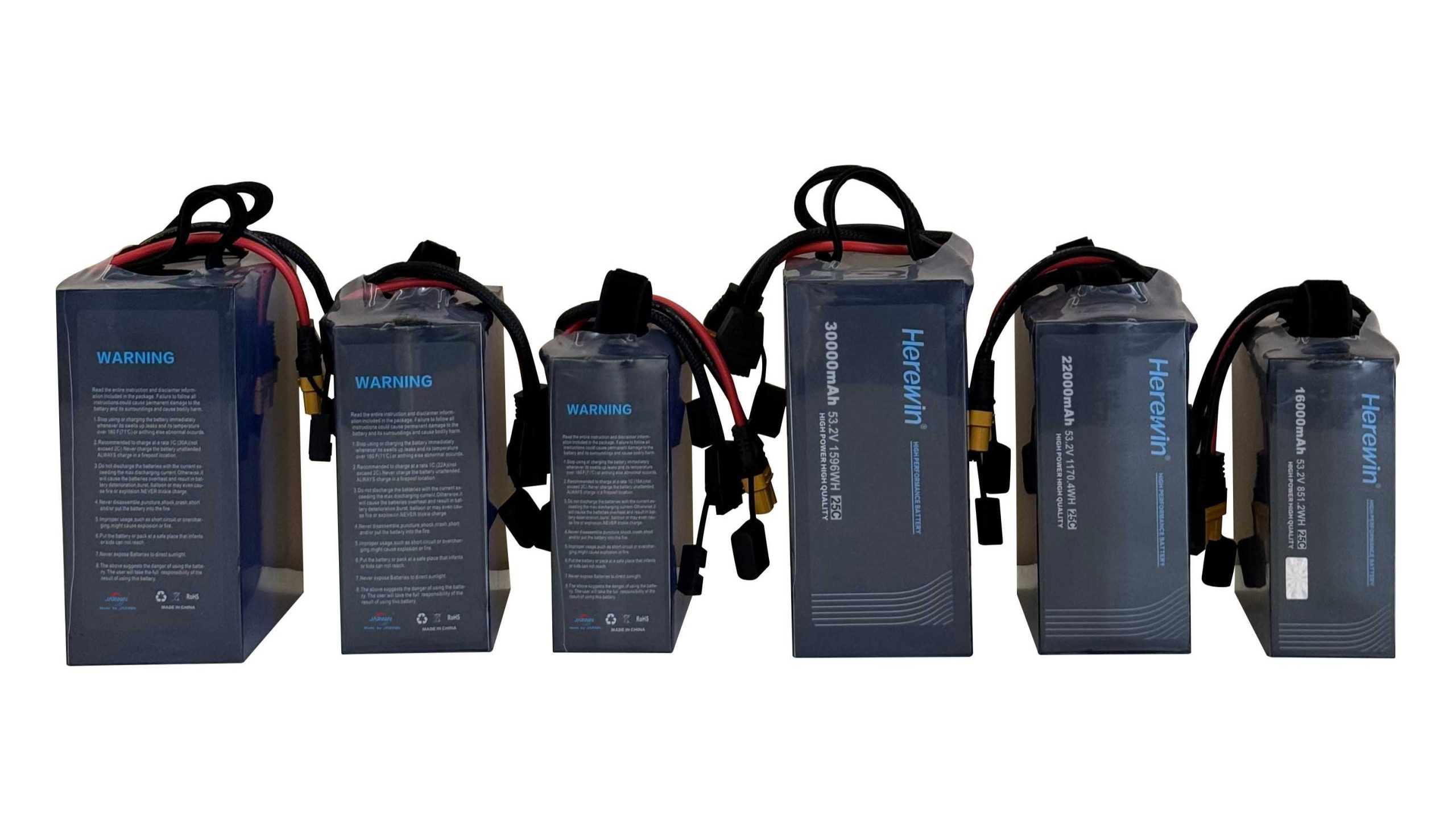
Use nominal voltage, not fully charged voltage. A 12S pack at 44.4 V and 22 Ah gives 44.4 × 22 ≈ 977 Wh; the same pack rated at 50.4 V would overstate energy by roughly 13%. Nominal voltage represents the pack across its whole discharge curve rather than its first minute, which is why it’s the planning figure — and why it’s the number we quote on our own pack datasheets.
Divide usable energy by average power
Flight time = E_usable ÷ P_avg
Apply your usable factor first, then divide. A 200 Wh pack at an 80% factor gives 160 Wh usable, which at 1,000 W draws 0.16 hours, or about 9.6 minutes. The 80% here is an example policy, not a default — the 0.85 to 0.9 range sometimes quoted isn’t a standard either.
One caveat matters more than the arithmetic: average power is not peak power. Takeoff, climb and aggressive manoeuvres pull far more current than level cruise, so the number you divide by should be the mission average, not the burst maximum.
Example: 12S 22Ah UAV Battery
Take a 12S pack at 44.4 V nominal (50.4 V at full charge), 22 Ah, drawing 3,000 W average in hover-dominant flight.
Nominal energy: 44.4 V × 22 Ah = 976.8 Wh.
Usable energy at an 80% factor: 976.8 × 0.80 = 781.4 Wh.
Flight time: 781.4 Wh ÷ 3,000 W = 0.2605 h ≈ 15.6 minutes.
This is an illustrative estimate based on 3,000 W average power, not a measured value. Treat it as a feasibility input, not a flight-test result — change the average power and the answer moves with it.
How to Size a Battery for a Target Flight Time
Sizing for a target flight time runs the same arithmetic backwards: start from the minutes you need, work back to capacity, then check that the resulting pack still fits the aircraft.
Calculate required mission energy
E_mission = P × t
A 12S platform drawing 3,000 W average for a 30-minute target needs 3,000 W × 0.5 h = 1,500 Wh of mission energy. If you plan to retain 20% as reserve, that corresponds to a 0.80 usable-energy factor, so the required nominal battery energy is 1,500 ÷ 0.80 = 1,875 Wh. Keeping reserve inside the equation, rather than bolting it on afterwards, is what stops the pack coming out undersized — and because the reserve and the usable-energy factor are the same decision, you apply it once, not twice. This is exactly the flow we run when a customer hands us a target endurance and a payload.
Convert required energy into battery capacity
Ah = (P × t) ÷ (V × usable-energy factor)
At 44.4 V nominal and a usable-energy factor of 0.80, 1,875 Wh works out to about 42.2 Ah. That is the capacity the mission implies, before you weigh it.
Target flight time | Required capacity at 2,000 W avg | Required capacity at 3,000 W avg |
|---|---|---|
20 min | 19 Ah at 12S | 28 Ah at 12S |
30 min | 28 Ah at 12S | 42 Ah at 12S |
45 min | 42 Ah at 12S | 63 Ah at 12S |
Read the table as a feasibility screen, not a specification. A 45-minute target at 3,000 W requires substantially more battery energy than the 20- or 30-minute examples. At that point the question is no longer capacity alone — pack voltage, battery mass and aircraft weight limits become part of the sizing decision. For a project at this stage, the pack may need a different series configuration, or a different balance between voltage, capacity and battery mass.
Before you commit, check the resulting battery mass against the aircraft’s payload and takeoff-weight limits. A pack that meets the energy target but blows the weight budget isn’t a solution — it’s a redesign. In our experience it’s usually the weight budget, not the energy figure, that ends up deciding the pack. For a closer look at how this plays out across industrial airframes and duty cycles, see our battery selection guide for industrial inspection missions.
How to Validate the Estimate
A calculator gives you a feasibility estimate. A flight test is what validates it, and in our experience the gap between the two almost always sits in four places. When we review a customer’s logs, these same four account for nearly every discrepancy that isn’t just noise.
Measured average power. Your logged current tells you what the aircraft actually drew, not what you assumed. Compare it against the figure you typed in; hover, wind and aggressive manoeuvres all push the real average above the planning number.
Logged energy consumption. Check the mAh the flight actually consumed against the capacity you credited. If the pack emptied faster than the usable-energy figure implied, your usable-energy factor was optimistic.
Actual flight conditions. Altitude, headwind and cold all cut into endurance. Cold temperatures can reduce available battery performance and usable energy, so note the battery and ambient conditions when comparing flight results.
Reserve. Confirm the flight still left the margin your policy requires. A flight that lands on fumes isn’t a valid data point for sizing.
If the gap between prediction and logged time is material and repeatable, re-check the measured average power, your usable-energy factor assumption and the flight conditions before trusting the estimate. There’s no fixed percentage that separates “close enough” from “wrong” — mission profile, telemetry accuracy, battery age and wind all shift the line. The habit to build is a simple one: let the calculator hand you the feasibility estimate, and let the flight test deliver the validation.
PERTANYAAN YANG SERING DIAJUKAN
How accurate is a drone flight time calculator?
It is only as accurate as the assumptions behind its two sides: usable battery energy and average aircraft power. The energy side is usually solid, because capacity and nominal voltage come from the spec sheet. The average-power side is where the uncertainty lives, so a calculator built on your own telemetry — the same aircraft, the same mission profile — is far more useful than one fed a generic figure. Treat the result as a planning estimate, not a flight-test result.
Should I use nominal voltage or fully charged voltage?
Use nominal voltage (12S ≈ 44.4 V). Fully charged voltage (50.4 V for 12S) describes only the first minute of the pack, so dividing by it overstates available energy by roughly 13%. Nominal voltage represents the pack across its whole discharge curve, which is what a mission-average calculation needs.
What if I don’t know my aircraft’s average power?
Start with the best data you can get, then refine it. Logged telemetry from a similar flight is ideal. If you don’t have any, use the manufacturer’s hover-power figure or run a controlled hover test and record the current. A power figure with a known basis is worth far more than a guessed percentage efficiency — and it’s usually the first thing we ask for when a customer wants a pack sized.
What information should I provide when sizing a UAV battery?
To get a useful answer rather than a generic curve, bring: all-up aircraft weight, payload, target flight time, system voltage, expected current (average and peak if known), your planned usable-energy factor or reserve, and any dimensional or weight limits for the pack bay. With those, the sizing can be run against your actual mission instead of a first-guess assumption. Share them with our team and we’ll take it from there.
A drone flight time calculator comes down to two quantities that stay separate: the usable energy your pack can deliver, and the average power your aircraft actually draws. Divide the first by the second and you have an estimate. The usable-energy factor and the payload-driven mass chain move that estimate far more than the nameplate capacity printed on the label.
Run the same arithmetic backwards and you go from a target flight time to the capacity and series configuration that can plausibly reach it — then check the resulting pack mass against the aircraft’s limits. That is the decision chain this guide is built around, and the same method behind our own drone battery solutions.
Treat every number as a feasibility input, not a flight-test result — bench and hover telemetry is what closes the gap. If you’d like the sizing checked against your aircraft, send your payload, aircraft data and target flight time, and we’ll work through the pack options with you.

 Bahasa Indonesia
  English
  Español
  한국어
한국어  Deutsch
  Français
  日本語
日本語  Русский
  ไทย
ไทย  العربية
  Português do Brasil
  Italiano
  Nederlands