








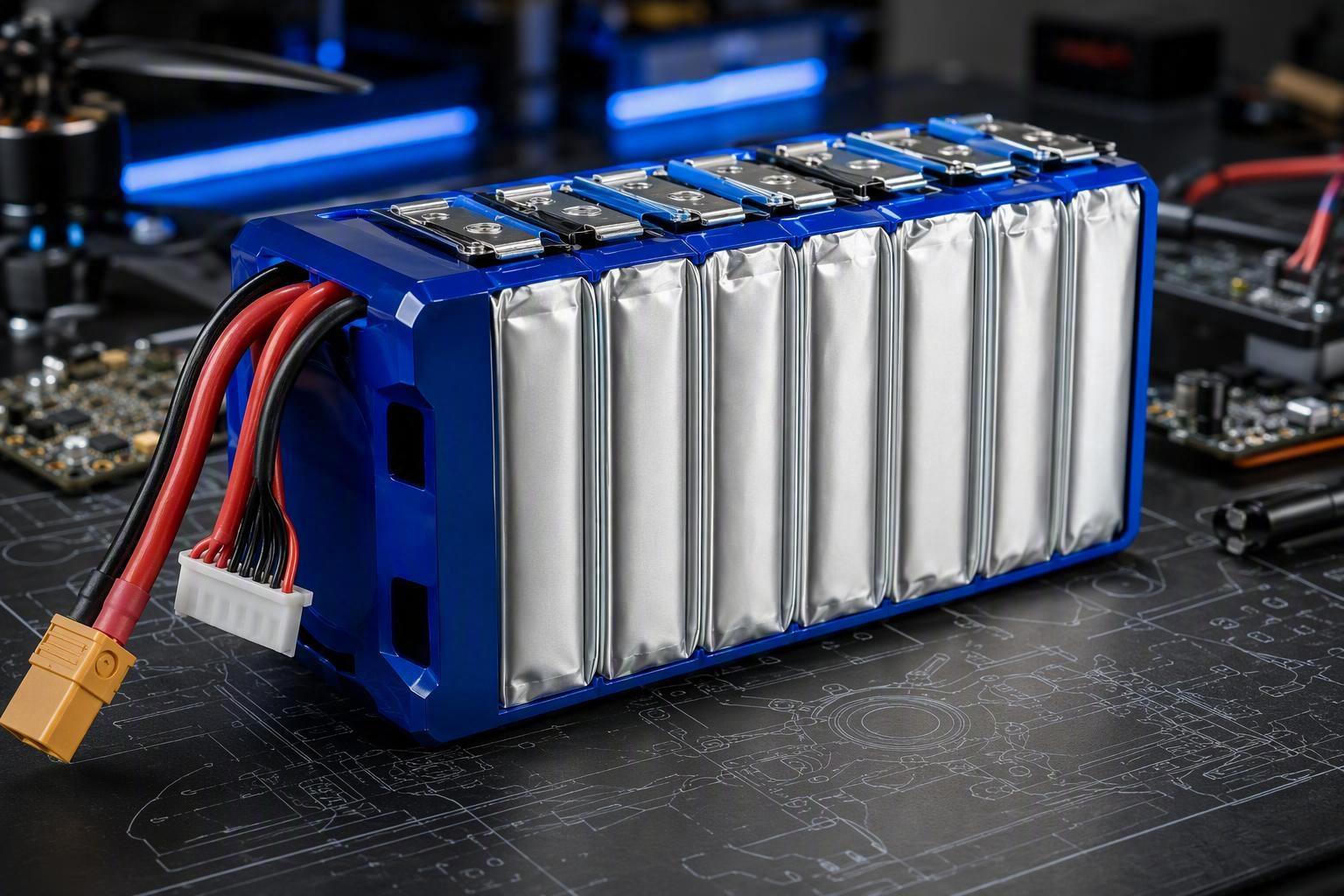
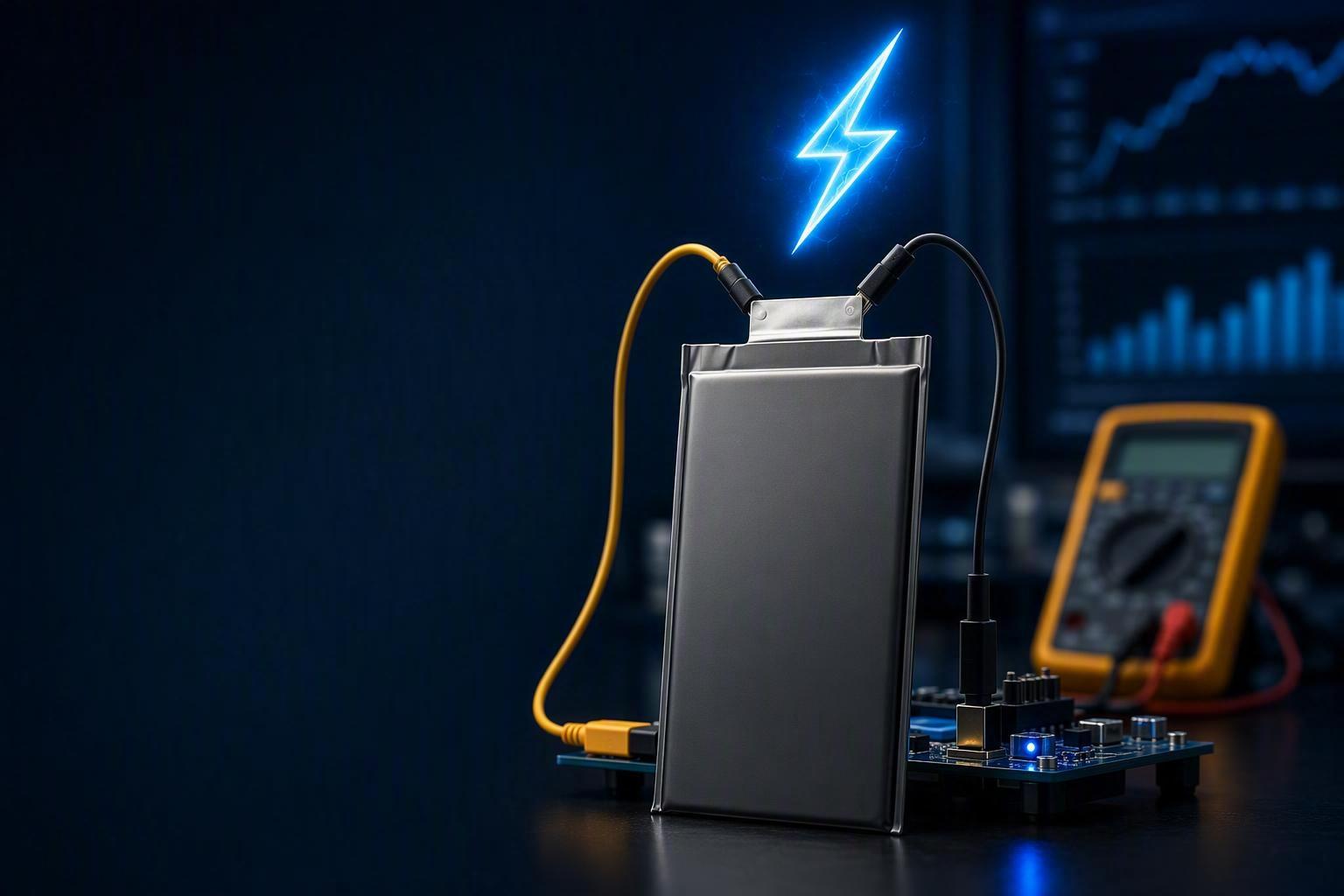
A UAV manufacturer wants more energy without meaningfully adding capacity or weight to the pack. A LiHV battery looks like an obvious answer: raise the cell’s full-charge voltage and pull more energy out of the same capacity class. On paper, that is exactly what happens.
But higher voltage does not come for free. The charger has to support the higher charge target. The ESC, motor, and power electronics have to tolerate a higher maximum pack voltage. The cell chemistry has to be designed and validated for a wider voltage window. Aging behavior can change at the top of charge, and pack-level validation becomes more demanding when the pack is going into an existing airframe.
That is the real story behind LiHV. It is a different operating point that changes both the energy potential and what the system around it must handle, which is why this is not a “LiHV is better than LiPo” article. What follows covers what you gain, what you pay, and how to decide whether the exchange is worth it.
What Makes LiHV Different from Standard LiPo?
Before weighing the trade-offs, it helps to be precise about what actually changes at the cell level.
Higher Full-Charge Voltage
A standard lithium-polymer cell is commonly charged to around 4.2 volts per cell at full charge. LiHV cells are designed for a higher specified full-charge voltage. Many LiHV cells use around 4.35 volts per cell, although the exact upper limit depends on the individual cell design and is set by the manufacturer’s specification, not by the label.
This single number drives most of what follows. Saying “LiHV charges to 4.35V” is common shorthand and roughly true for many LiHV cells, but the correct figure is whatever the specific cell datasheet allows. Design decisions should start from that value, not from a generic rule.
Energy Is the Product of Voltage and Capacity
Three figures get confused in battery discussions, and the distinction matters for a LiHV decision:
Capacity (mAh or Ah) is how much charge the cell holds.
Voltage (V) is the electrical potential it delivers.
Energy (Wh) is the product of the two over discharge.
Because energy combines voltage and charge, a higher voltage at a similar capacity rating can provide more energy. But the energy a cell delivers depends on its voltage across the whole discharge, not just the full-charge ceiling. A cell must keep a healthy voltage profile as it empties, or the extra top-of-charge capacity will not show up as usable mission energy.
For a practical decision, one takeaway matters most: higher voltage can increase the energy available from a similar capacity class. The size of that gain, and whether a system can use it, is where the engineering begins.
Capacity is not energy. A higher full-charge voltage can add usable energy from the same capacity class, but what counts is the voltage profile the cell holds through discharge, not just its ceiling.
How Much Can a Higher Voltage Gain You?
More Energy at a Similar Capacity Rating
In the same nominal amp-hour class, a higher operating voltage can deliver more watt-hours. That is useful wherever battery size and weight are constrained, which is almost always the case in UAVs, FPV craft, industrial drones, RC aircraft, and other high-power mobile systems. Where a standard LiPo remains the balanced default for many builds, this energy gain is the reason FPV and multi-rotor power systems weigh a higher-voltage cell when endurance is the priority.
The gain is not a fixed marketing number. It depends on the cell design and the usable voltage range the system can accept. Two cells marketed as the same chemistry can differ in usable energy because of how their voltage profile behaves under load.
Potentially Longer Flight or Operating Time
More usable battery energy can support longer operating time, but the actual gain depends on power consumption, battery mass, propulsion efficiency, and the operating profile of the aircraft.
If the aircraft draws the same average power and the LiHV pack provides more usable energy without adding disproportionate mass, endurance can improve. That is the logic to keep in mind: the endurance benefit is conditional on the power draw and the mass, not an automatic result of switching chemistries.
Why Higher Voltage Can Mean Lower Current
Power is the product of voltage and current. If a system delivers the same power at a higher voltage, the current is lower.
Lower current through cables and connectors means lower resistive losses and less heating in the wiring and interconnects, which can be attractive in high-power aircraft where conductor sizing and heat are real constraints.
This does not automatically make the complete system more efficient. Motor, ESC, wiring, and power electronics all have to be designed for the higher voltage; the system-level gain only appears if every component in the power chain respects the new ceiling. The same relationship explains why a higher pack voltage is one route to less voltage sag under load in high-current platforms.
What Are the Trade-Offs of LiHV?
The main trade-off is straightforward: higher voltage creates more energy potential, but it also places greater demands on the cell and on the system around it.
Higher Voltage Can Increase Aging Stress
Operating at a higher upper voltage puts more electrochemical stress on the cell. That stress can drive more side reactions, faster resistance growth, and faster capacity loss over repeated cycles.
This does not mean a LiHV cell will always age faster than a standard one, and it does not mean LiHV inherently has short life. The important question is whether the cell was designed and validated for the specific high-voltage operating window it is being asked to run in. A cell engineered and tested for 4.35 volts per cell can behave very differently from one that is simply pushed past a 4.2 volt design. A cycle-life figure should be read with the same care you would apply to any lithium battery cycle-life claim: the test conditions, voltage window, and end-of-life definition decide what the number means.
Electrolyte and Interface Stability Become More Important
Higher voltage places greater stress on the electrolyte and on the electrode-electrolyte interfaces. Where the chemistry or cell design is not well matched to the voltage window, this can lead to more side reactions, gas generation, higher internal resistance, and faster degradation.
This makes electrolyte stability and interface design more important when the cell operates at a higher voltage.
Gas Generation and Swelling
Pouch cells can generate gas and swell over time, changing how the cell fits inside the pack and stressing the internal structure. Swelling that disrupts the pack fit or the layers is a reliability concern.
Swelling should not be equated with an explosion. Still, significant swelling is an abnormal condition and a reliability plus safety concern. Severe swelling can also indicate broader cell degradation and should be investigated before continued use, which is why pack-level monitoring and mechanical design matter in a high-power system.
Charging Must Match the Cell Specification
Charging is where the higher voltage creates one of the clearest system-level requirements. The charger must support the LiHV charge voltage, hold accurate voltage control, and apply a charge profile that matches the cell specification. Temperature monitoring and, where present, a BMS or protection system are part of that picture.
Not every LiPo charger is suitable. A charger built only for a 4.2 volt per cell limit must not be used to charge a cell specified for a higher voltage unless it explicitly supports that chemistry and target.
Never charge a standard LiPo cell with a LiHV charge profile. Overcharging a cell beyond its designed full-charge voltage is unsafe. Match the charge profile to the cell you are actually charging.
LiHV vs LiPo: What Changes in a Real Application?
The table below summarizes how the two operating points differ in practice.
Factor | Standard LiPo | LiHV |
|---|---|---|
Full-charge voltage | Typically around 4.2 V per cell | Higher specified charge voltage |
Energy potential | Baseline | Higher at a similar capacity class |
Charger | Standard LiPo-compatible charger | LiHV-compatible charger required for full benefit |
System voltage | Standard design range | Higher maximum pack voltage |
ESC / power electronics | Standard voltage rating | Must support the higher max voltage |
Aging considerations | Standard-voltage validation | Higher-voltage validation becomes more important |
Cycle-life expectations | Depends on test conditions | Depends strongly on cell design and the voltage window |
System validation | Required | More important when upgrading an existing system |
Energy
The clearest advantage of LiHV is the energy potential. At a similar capacity class and physical footprint, a higher operating voltage can store more energy, which is the value in weight- and space-constrained aircraft.
Siklus Hidup
Cycle life cannot be judged from voltage alone. It depends on the chemistry, charge and discharge rates, the voltage window used, depth of discharge, temperature, and the end-of-life criterion applied. A cycle-life claim should be evaluated under the actual operating conditions of the aircraft rather than by comparing headline cycle counts, using the same report-reading discipline described earlier in this article.
System Compatibility
Compatibility is the layer most often underestimated. Charger, ESC, motor, BMS or protection, connectors, and power electronics all sit in the same voltage domain as the pack. Battery compatibility is a system-level question, not only a battery question.
Can You Simply Replace a LiPo Pack with a LiHV Pack?
This is the question many readers are actually trying to answer, so it deserves a direct response.
Not necessarily.
Swapping in a LiHV pack is not a like-for-like capacity change. The full-charge voltage moves, and the components around the pack have to be compatible with the new voltage range. A short checklist makes the risk visible.
Check the Maximum System Voltage
Consider a four-cell example. A four-cell standard LiPo reaches roughly 16.8 volts at full charge; a four-cell LiHV designed for 4.35 volts per cell reaches 17.4 volts at full charge. The exact figure depends on the cell.
The point holds at any cell count: the same number of cells does not necessarily mean the same maximum pack voltage. A “4S” label describes the number of cells, not the full-charge ceiling.
Check the ESC and Motor Ratings
The ESC has a maximum input voltage, while the motor has its own operating range and electrical limits. The ESC must tolerate the higher full-charge voltage of the LiHV pack, and the motor and powertrain must remain compatible with the resulting operating conditions. Confirming “it’s a 4S drone” is not enough, because a 4S LiPo and a 4S LiHV can have different full-charge voltages, and the difference lands on the ESC at the moment of full charge.
Check the Charger and Protection System
The charger needs a LiHV mode with the correct termination voltage. The charge path also needs voltage monitoring and temperature protection, and a BMS or protection system where one is present, so the higher charge target is controlled rather than assumed.
Check Whether the Energy Gain Is Worth the Design Change
This is the decision that separates a considered change from a reflexive one. Does the additional energy meaningfully improve the mission? If the gain is a slight endurance improvement, but it requires a new charger, perhaps an ESC change, fresh validation, and added cost, then the exchange may not be worthwhile.
How to Choose LiHV for UAV and High-Power Applications
Treat this as a parameter check rather than a product recommendation. The engineering question is whether a higher-voltage cell fits the mission and the powertrain that already exists or is being designed.
Start with the Mission Profile
Define the operating envelope before considering chemistry: required flight time, payload, average power, peak power, operating temperature, and the number of cycles expected over the pack’s life. These numbers decide whether the extra energy is useful at all.
Match the Cell to the Power Requirement
The cell cannot be chosen on amp-hours alone. Continuous current, peak current, voltage sag under load, and thermal behavior all need to line up with the power the aircraft demands, not just the energy the mission needs.
Match the Pack to the Powertrain
The pack is only one node in a power chain. Motor, ESC, charger, wiring, connectors, and protection or BMS all have to be consistent with the pack’s voltage window. This is why battery selection must go beyond capacity and C-rating and be anchored in measurable terms.
Validate the Complete Pack
A cell specification does not automatically guarantee pack-level performance. The full pack needs validation for pack voltage, current, temperature, voltage sag, charging behavior, cycle life, and mechanical condition. It is at this stage that the rigor of the whole design is either proven or exposed.
How Herewin Approaches LiHV Battery Design
We do not select a LiHV cell simply because it has a higher full-charge voltage. The higher ceiling is only useful if the whole system can use it safely and cost-effectively.
For UAV and other high-power applications, we weigh the energy requirement against the continuous and peak current, the usable voltage limits, charger compatibility, ESC and motor ratings, thermal conditions, and the expected service life of the pack. Cell-level specifications need to be validated at pack and system level before production deployment. At Herewin, we approach LiHV selection from the same system-level perspective rather than assuming that a higher voltage is automatically better.
If you are evaluating a LiHV battery for a new UAV or industrial application, share your voltage, capacity, current, and operating profile with the Herewin team. We can help determine whether a higher-voltage design is actually a good fit for the system.
Conclusion
The honest case for LiHV is energy. Within a similar capacity rating, a higher operating voltage can lift the energy potential, and that is the reason the chemistry exists.
The cost sits on the other side. Higher voltage also raises the bar for cell design, charging, power electronics, and validation; none of those demands is automatic, but all of them are real.
Weigh the two together and the decision sharpens to a single question: not “Is LiHV better than LiPo?” but “Does the additional energy justify the changes required by the system?”
LiHV is best understood as a different operating point, not simply a higher-energy replacement for standard LiPo.






 Bahasa Indonesia
  English
  Español
  한국어
한국어  Deutsch
  Français
  日本語
日本語  Русский
  ไทย
ไทย  العربية
  Português do Brasil
  Italiano
  Nederlands