


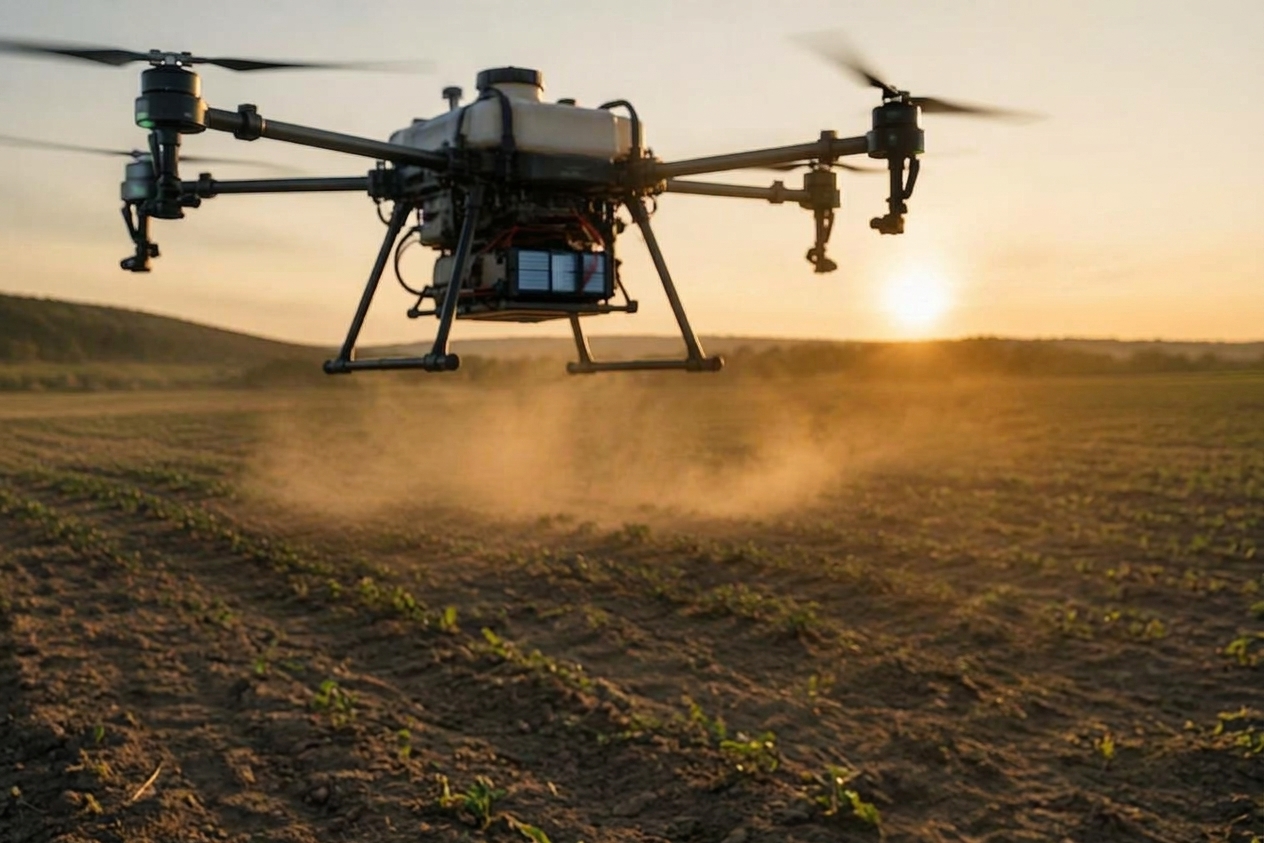
Buying a UAV battery is not a capacity, C-rate and price decision. Those three figures are not enough to describe a battery pack or how it will behave in an aircraft — a power system that has to hold voltage through a hard climb, survive dust and vibration, and keep charging safely when the fleet is landing, swapping and relaunching on a tight schedule. As UAV fleets scale, that procurement decision deserves the same rigor as any other critical system component.
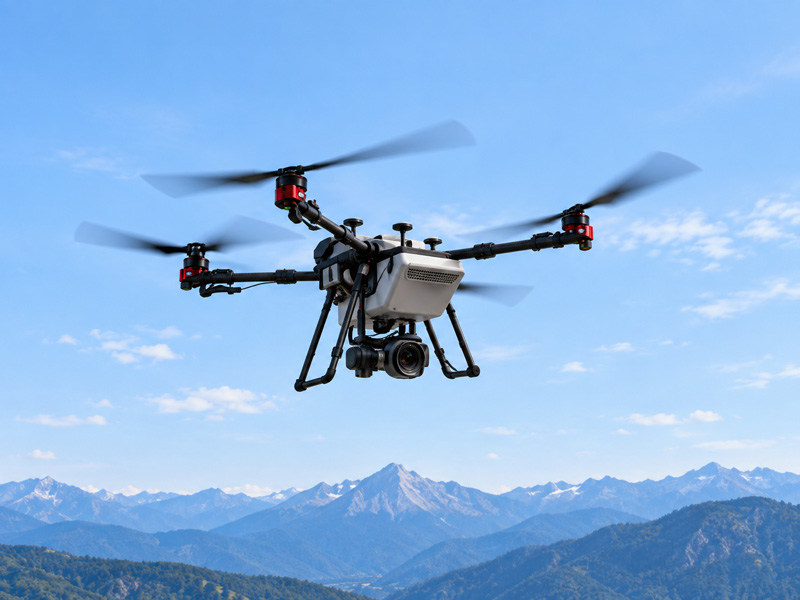
Industrial and agricultural UAVs fly very different missions, yet they can run into the same procurement problem: a pack that was never properly matched to the aircraft or validated in the actual system. A spraying platform lives on short, heavy, high-current cycles in heat and humidity; an inspection, mapping, delivery or heavy-lift platform may prioritize endurance, payload stability, peak-power response or environmental exposure instead. Different duty cycles, one shared requirement — the battery has to fit the airframe and prove itself in the actual system before volume commitment.
This guide gives you that path in sequence: define aircraft requirements, translate them into battery requirements, build the supplier evidence pack, validate a sample in the aircraft, then make the procurement decision. Throughout, the evidence class is the same — test reports, certification scope, and cell-to-pack traceability records.
A UAV Battery Is a System-Fit Decision
The aircraft defines the battery requirement — you do not pick one from a supplier’s stock list. Airframe type and payload class set the voltage architecture and current demand; target flight time and payload requirements help determine usable energy and capacity; and integration details set pack mass, dimensions, connector and BMS interface. Get that order backwards and you end up buying a pack that fits the catalog but not the aircraft — which is exactly the failure the rest of this guide is built to prevent.
Move from “send me a price on a pack” to requirements-first procurement. The same requirement set should give engineering, operations, procurement and management a common basis for evaluating technical fit, throughput, cost and supply risk.
Step 1: Define the Aircraft Requirements Before You Talk to Any Supplier
The aircraft defines the battery, not the other way around. Before you request a single quote, write down the requirement set your suppliers will answer against: airframe type and payload class, mission profile (takeoff, hover, climb, payload actuation, landing), target flight time, worst-case ambient, and turnaround model.
The category label — agricultural or industrial — tells you far less than the mission profile. Two platforms in the same category can need completely different packs.
Agricultural platforms are shaped by spray payload, repeated short sorties, field charging and high-frequency battery swaps. That combination makes charge speed, connector durability and thermal recovery under heat and humidity throughput-critical rather than nice-to-have, and it is why CropLife Asia’s drone spraying guidance commonly recommends operating below roughly 35 °C under specified humidity conditions.
Industrial platforms look different again. Inspection, mapping, surveying and delivery drones often chase endurance and sensor uptime; heavy-lift drones chase peak power and payload stability; platforms exposed to wind, dust or coastal air chase environmental robustness. None of those priorities maps onto a spray cycle, yet each one lands on the same battery. The battery requirement comes from the mission profile, not simply the UAV category.
Aircraft input | Battery requirement it drives |
|---|---|
Airframe type and payload class | Pack voltage, capacity and weight ceiling |
Mission profile | Continuous and peak current demand |
Target flight time | Usable energy after reserve |
Worst-case ambient | Thermal design and charge limits |
Turnaround model | Charge rate and connector cycle life |
Use this table as the document suppliers answer against. It is a requirement set, not a shortlist.
Step 2: Translate Aircraft Requirements into Battery Requirements
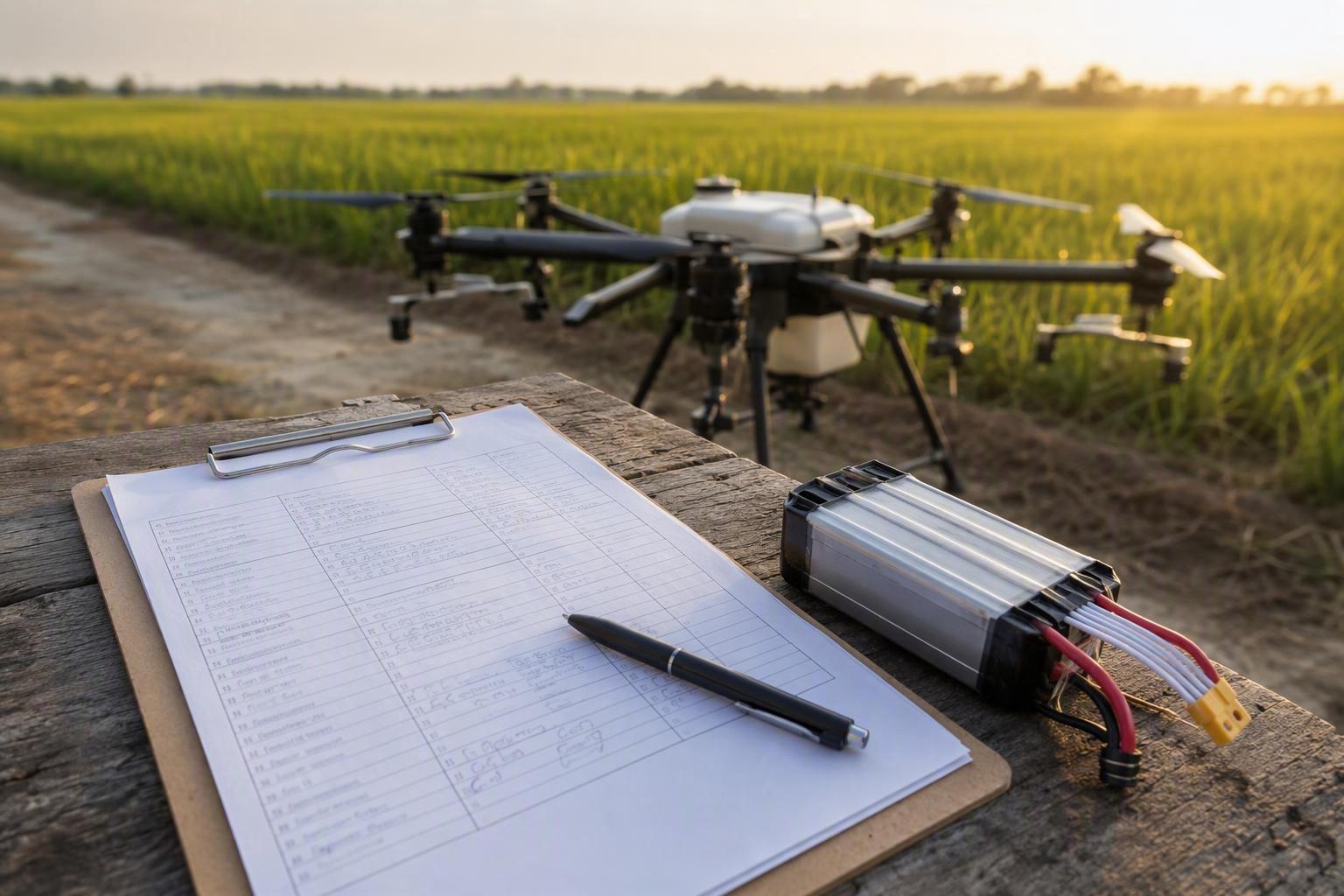
Voltage architecture comes first, because it decides which packs are even compatible with your ESC input range — the voltage window your electronic speed controller accepts. The pack has to sit inside the propulsion system’s operating envelope, from fully charged down to the low-voltage cutoff you actually fly to.
Exact configurations vary by aircraft class and manufacturer. Agricultural multi-rotors commonly use higher-voltage multi-cell configurations, while heavier industrial platforms can require substantially higher pack voltages, so treat any single number you see online as a starting point rather than a specification. Confirm the target voltage window with your airframe maker, then ask the battery supplier to quote against it.
Then read past the headline C-rating. C-rate expresses charge or discharge current as a multiple of capacity, and a rating is not a duty cycle. Ask suppliers to state continuous and peak current separately, together with the test conditions behind those figures. For comparing packs, voltage sag under your own load and internal resistance are usually more useful than a headline C-rating alone.
Record voltage, usable capacity, continuous and peak current, mass budget, connector type and BMS interface (the battery management system that reports state and protects the pack) on one worksheet before you contact a supplier. That worksheet is the basis of every industrial drone battery selection decision that follows.
Turn the Worksheet into an RFQ
A worksheet is an internal document. An RFQ is that same worksheet written so suppliers can quote against it without guessing. Keep it to a short, fixed set of fields:
Voltage window — nominal voltage and the acceptable range your ESC and airframe can accept.
Usable energy — watt-hours available after the reserve you will not fly below, rather than a bare amp-hour figure.
Continuous and peak current — both figures, each with the duty and conditions behind it.
Mass, dimensions and center of gravity — maximum pack weight, the mounting envelope the pack must fit, and the allowable center-of-gravity location.
Connector and BMS or communication interface — connector type, pinout, and the protocol or telemetry you expect.
Operating environment — minimum, normal and maximum ambient temperature, plus humidity, dust or other exposure the pack must tolerate.
Sample and production requirements — sample quantity, target production volume, MOQ, ramp schedule and required production lead time.
Send the RFQ as requirement fields, not as a capacity number with a price request. If two suppliers quote against the same fields, you can compare their answers instead of their marketing.
Step 3: Choose the Chemistry Against Your Duty Cycle, Not the Datasheet
Chemistry is a trade-off, not a ranking. Higher energy density can reduce battery mass, but chemistry selection also affects cycle life, thermal behavior, charge rate, cost and safety margin. There is no single best cell for every UAV — only the cell that fits your duty cycle.
The buying logic follows from that. High-frequency fleet operations, where packs are charged and swapped all day, may prioritize cycle life and thermal robustness over squeezing out the last few watt-hours. Payload-constrained aircraft, where every gram comes out of flight time or payload, may place greater value on energy density instead.
The practical rule: compare chemistry at the pack level and against the actual duty cycle, not by cell-level energy density alone. A cell that looks light on paper can lose its advantage once packaging, cooling and BMS overhead are added — and a denser cell that ages faster can cost more per flight than a heavier one that lasts. For a deeper cell-level comparison across LiPo, LiFePO4 and solid-state, see the further reading at the end of this guide.
By the end of this step you should be able to name the chemistry your flight profile justifies, and say why it fits the mission.
Step 4: Set the Discharge, Charge and Thermal Envelope
By the end of this step you will have a written discharge, charge and thermal envelope with its conditions attached, and that document is where field failures are either prevented or designed in.
Discharge envelope. Start with continuous discharge demand — the steady current the pack must hold for most of the flight — and dynamic peak demand, the short burst at takeoff and high-load moments. Treat them as separate requirements, because the pack may tolerate a short peak that it cannot sustain continuously. Some vendor field observations report very high dynamic discharge demands in agricultural spraying applications, particularly during takeoff and high-load operation, according to AYAA’s analysis of agricultural drone battery degradation. Those figures vary substantially with aircraft size, payload and propulsion system, so request continuous current, peak current and peak duration for your own mission profile rather than borrowing a number from someone else’s platform.
Charge envelope. The charge side is defined by charge rate, cell temperature at the start of charge, and rest or cooling time before the pack goes back on the charger. These limits matter more than any headline fast-charge figure, so require the supplier to state the charge rate together with the cell temperature and resting conditions under which it applies.
Thermal envelope. Then set the thermal limits: maximum cell and pack temperature under load, worst-case ambient, and how the pack is cooled or ventilated in the airframe. Write the envelope down as the operational triggers for pack aging — heat soak and hot-climate operation, sustained high-rate discharge under heavy payload, aggressive fast charging of warm packs, deep or over-discharge, storage at full charge, and mechanical and vibration stress on connectors and wiring. Then require the supplier to state the conditions under which each limit holds.
Step 5: Build the Supplier Evidence Pack You Will Request
Every supplier claim becomes a question with a required document. Before purchase, ask for a defined pack of evidence:
A UN 38.3 test report and test summary for the exact cell or pack model and configuration, carrying report ID, test date, lab name, model or SKU, rated voltage and capacity.
A certification scope statement separating cell-only, pack-only and pack-plus-BMS coverage, with exclusions and version numbers.
Cell-to-pack traceability records mapping shipped packs to test reports.
A datasheet with voltage, capacity, Wh, dimensions, weight, connector and C-rate limits, plus performance test data for your duty cycle.
Evidence item
What it proves
What a weak version looks like
UN 38.3 test report and summary
The tested model completed T.1 to T.8
A summary with no report ID, lab name or test date
Certification scope statement
Which configuration is covered
“Certified” with no exclusions or version listed
Cell-to-pack traceability
Shipped packs map to test reports
A generic cell datasheet, no pack linkage
Duty-cycle performance data
Behavior at your C-rate and temperature
A single headline capacity figure
Manufacturing and traceability documents
Cell source, QC controls and lot records
No lot traceability, no QC documentation
A report covering a different model or configuration does not transfer. Check that the model and version identifiers on the report match your shipping documents.
The standards behind a UAV battery procurement checklist differ in scope. UN 38.3 addresses transport testing, while standards such as IEC 62619, UL 1642 and UL 2054 address different product and application levels. Treat each as a scope question, not a badge, and confirm which standard applies to the finished pack and target market.
Step 6: How to Compare UAV Battery Suppliers
Compare suppliers on two separate axes — technical fit and supply capability — because a technically qualified pack from a supplier who cannot hold lead time is still a failed procurement. Verify technical fit against mission-profile flight data rather than datasheets, then examine manufacturing control: cell sorting tolerances, lot consistency, BMS configuration lock, cell source and QC controls, traceability, and pilot-batch consistency. Certification scope and capacity to scale — lead-time commitments, daily output, redundant lines, and long-term component availability — belong in the same pass.
Use the table below as a comparison framework, not a scoring sheet. It tells you what to verify with each supplier and what a weak answer sounds like.
Criterion | What to verify | Red flag |
|---|---|---|
Technical fit | Flight data from a mission profile like yours | Datasheet-only claims, no flight data |
Manufacturing control | Cell sorting tolerances, lot consistency, traceability | No meaningful information on cell source, QC controls or traceability |
Zertifizierung | Scope documents for your target markets | Certificate images with no scope |
Capacity to scale | Written lead-time commitment, redundant lines | Verbal lead times only |
Engineering support | Named contact during qualification | No response during sample phase |
Lifecycle support | After-sales terms, warranty and RMA process, replacement path | No defined warranty, RMA or replacement process |
Supply continuity | Second-source compatibility and qualification path | No plan for alternate sourcing or component substitution |
Quoted lead times for qualified custom packs can run 8–16 weeks, depending on cell allocation, qualification and production scheduling. Run the same comparison for your second source, not after the first one slips.
When Does a UAV Need a Custom Battery?
A standard pack is usually sufficient when its voltage window, usable energy, mass, dimensions, connector, BMS interface and environmental limits already fit the aircraft. Custom design becomes justified when a standard pack misses a critical requirement — such as the form factor, center of gravity, peak-current profile, connector, communication protocol, thermal envelope or certification configuration. The point is not to customize for its own sake, but to remove a system constraint that a standard pack cannot meet.
Step 7: Validate the Sample in the Aircraft Before You Commit
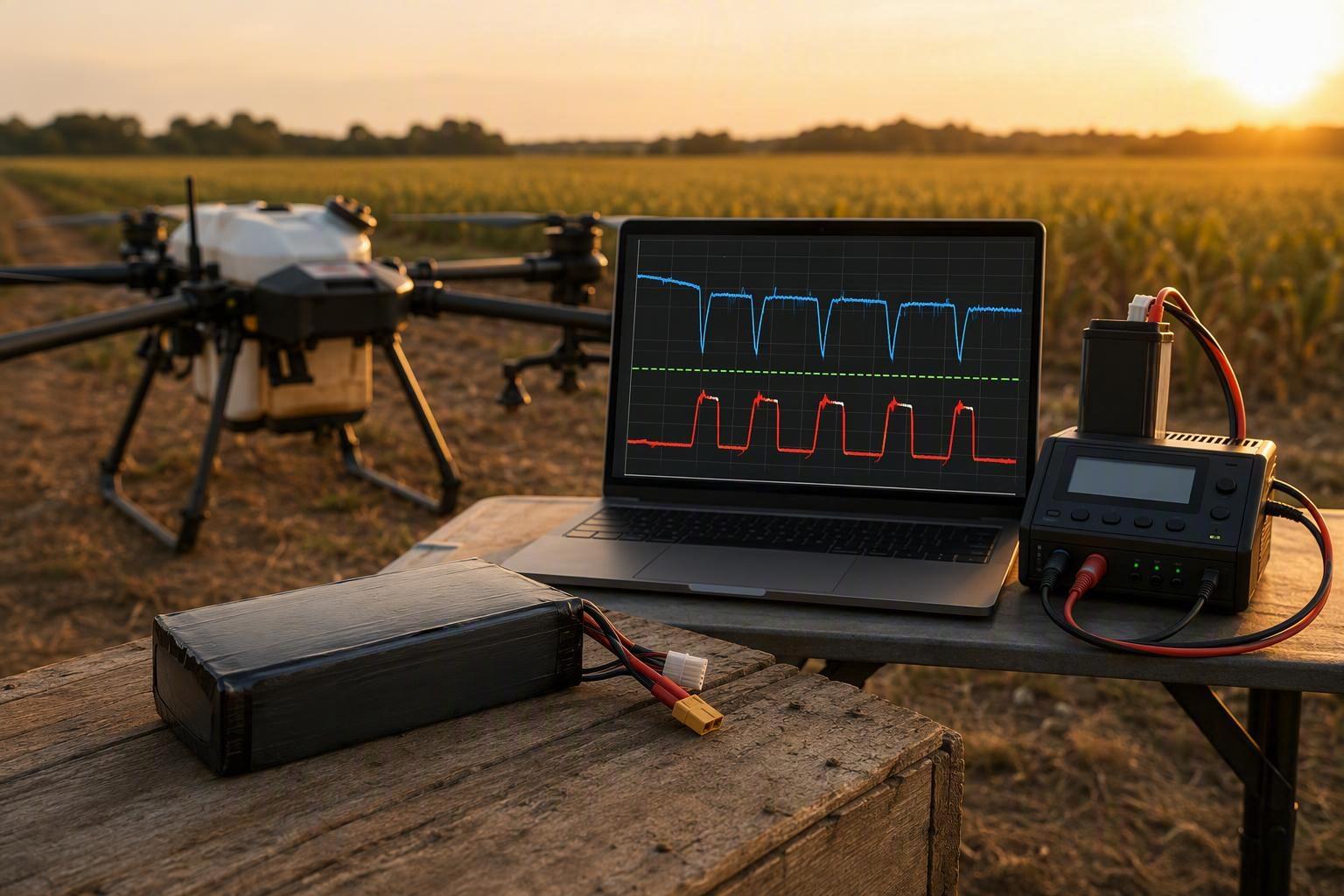
The datasheet is not the validation. A pack that looks strong on the bench can still sag below the aircraft’s low-voltage cutoff on the first hard climb, so the sample has to be run in the actual system before you place a production order.
A practical validation runs across four layers, and you only need to cover each one well:
Physical — dimensions, connector and mounting fit, and whether the pack seats and locks correctly in the airframe.
Electrical — capacity, voltage sag under current pulses, and internal resistance measured on your own hardware.
System — BMS telemetry is compatible with the aircraft or charger interface, where required, and the charger behaves as expected across the swap cycle.
Mission — flight time, payload carried, worst-case ambient and turnaround behavior under real operating conditions.
Beyond the flight test, watch for the physical failure modes operators actually report: swelling and puffing, cell imbalance, capacity fade with rising internal resistance and premature low-voltage cutoff, thermal events up to thermal runaway, and connector or BMS faults including broken sampling wires and balance-control faults.
Write the acceptance criteria before the sample arrives: minimum endurance at worst-case ambient, maximum voltage sag at each current pulse, allowed cell imbalance, and a pass/fail threshold for every inspection item. Criteria set after the data arrives are not criteria.
The result is a pass/fail decision recorded in data, not an impression from a demo flight.
If the sample fails, treat it as a requirements problem until the cause is isolated. Voltage sag under load can point to insufficient cell capability, internal resistance, temperature or pack configuration; thermal limits can reflect cell characteristics, pack layout, cooling and operating conditions. Send the supplier your test conditions, the measured curve and the aircraft configuration, and let the data drive the next step — either the specification changes or the supplier does. No verbal fix counts without a re-tested sample.
Step 8: Plan the Lifecycle, Storage and Second Source
Procurement does not end at the purchase order. Three lifecycle questions shape the battery program after qualification.
When does the battery need replacement?
Many battery lifecycle comparisons use 80% remaining capacity as an end-of-life criterion, so it is a useful illustrative retirement point, but the trigger that matters is yours: a capacity floor or an internal-resistance ceiling measured against your own flight-time tolerance at your duty cycle. Get both from a supplier test report, or from your own sample cycling.
How should qualified packs be stored?
Store at the supplier’s specified storage state of charge, in a cool, dry, climate-controlled location, with periodic voltage and condition checks according to the manufacturer’s storage procedure. Storage voltage and temperature belong in your written lifecycle plan, not in someone’s memory.
What happens if your primary supplier cannot deliver?
This is why you qualify a second source early. Cycle life should be evaluated as part of lifecycle cost, because a lower-cost pack may become more expensive if it requires significantly more frequent replacement — the further reading at the end of this guide covers the cost-per-acre model.
Common Mistakes That Cost Fleets Money
Buying from a datasheet without a duty-cycle discharge curve.
A headline capacity figure says nothing about how voltage holds up under the aircraft’s actual mission load. Ask for the discharge curve at your own current draw and ambient temperature, then compare it against your minimum ESC input voltage.
Accepting a UN 38.3 report that covers a different model or configuration.
A test summary applies to the exact cell and pack build it names. Check that the model and version on the report match what you are buying — a report for a sibling pack is not evidence for yours.
Treating a C-rate rating as a continuous rating.
Peak and continuous limits are different numbers, and a pack operated near its peak rating throughout a flight may experience substantially more stress than a cycle count alone reveals. Confirm which figure the supplier means, and at what temperature.
Fast-charging warm packs.
Charging immediately after a flight pushes cell cores hotter than a rested pack would reach, and elevated temperature is a major driver of battery aging. Let packs cool to ambient before they go on the charger.
Storing at full charge.
Leaving qualified packs at 100% for weeks between jobs costs you capacity you paid for. Confirm the supplier’s storage voltage in writing and put it in the lifecycle plan, then let the plan run it.
Single-sourcing a qualified pack.
Custom packs can take weeks from order to delivery, so one supplier is one disruption away from grounded aircraft. Qualify a second source before you need it.
Skipping the swap and connector-wear test.
Cycle the pack in and out of the airframe and inspect the connector contacts. Wear shows up here long before it shows up in flight.
What Success Looks Like
You know the process worked when you hold five documents, not a feeling that the supplier seemed credible.
The documents you should now hold
A written requirement set: voltage, capacity, continuous and peak discharge, charge rate, mass ceiling, connector and BMS interface, all traced back to the aircraft’s mission profile.
A supplier evidence pack whose test reports, certification scope and drawings match the exact shipping model, not a catalogue sibling.
A validation log from the sample flight, with acceptance criteria recorded before the test and the measured results recorded after it.
A supplier comparison against the framework above, including a named second source that has quoted the same specification.
A lifecycle plan covering storage voltage and temperature, charge cadence, and the replacement trigger.
Five controlled documents, and a decision you can defend in writing.
FAQ
How long does a qualified pack take to arrive?
For a customized, qualified pack, lead time can extend to several weeks or more, depending on cell allocation, qualification and production scheduling. Stock samples move in days; a pack built to your specification and backed by the documentation procurement needs sits in the longer window (Step 6). Book the cell allocation and start the paperwork in parallel.
Can LiFePO4 replace LiPo on a spraying platform?
Sometimes, and the mass budget decides it. LiFePO4 trades energy density for cycle life, so equivalent usable capacity weighs more (chemistry trade-offs for industrial drones). On a spraying platform that mass comes out of payload or flight time. Short, frequent cycles favor it; a payload constraint usually does not.
What information should I give a UAV battery supplier?
Give them the aircraft-side requirement set, not a request for a price. That means airframe type and payload class, the mission profile, target flight time, worst-case ambient, turnaround model, voltage window, continuous and peak current, mass ceiling, connector type, and BMS or communication interface. Handing over one worksheet written in aircraft terms lets suppliers quote against your system instead of guessing from a catalog number.
How do I choose the right UAV battery capacity?
Work backwards from usable energy. Start with the flight time and payload you need, account for the reserve you will not fly below, then convert that into watt-hours and select a capacity that delivers it without breaking your mass ceiling. Capacity in Ah alone tells you nothing until it is multiplied by nominal voltage and checked against the aircraft’s weight budget. Validate the resulting capacity with a duty-cycle discharge curve, not a headline amp-hour figure.
What certification documents should I ask for in a US UAV battery procurement?
Requirements vary by application and procurement contract, so treat this as a starting point rather than a fixed list. In general, ask for cell-level and pack-level safety certificates plus transport documentation, with the standard named for each level (Step 5 lists the common ones). Check that each certificate names the exact cell and pack model you are buying, not a generic family.
A UAV battery buying guide is really a requirements exercise: match the pack to the aircraft, match the supplier’s evidence to your shipping model, validate a sample in the system, and name a second source before you commit volume. The result is a documented basis for volume procurement — one that does not depend on a supplier’s marketing and survives a change of vendor.
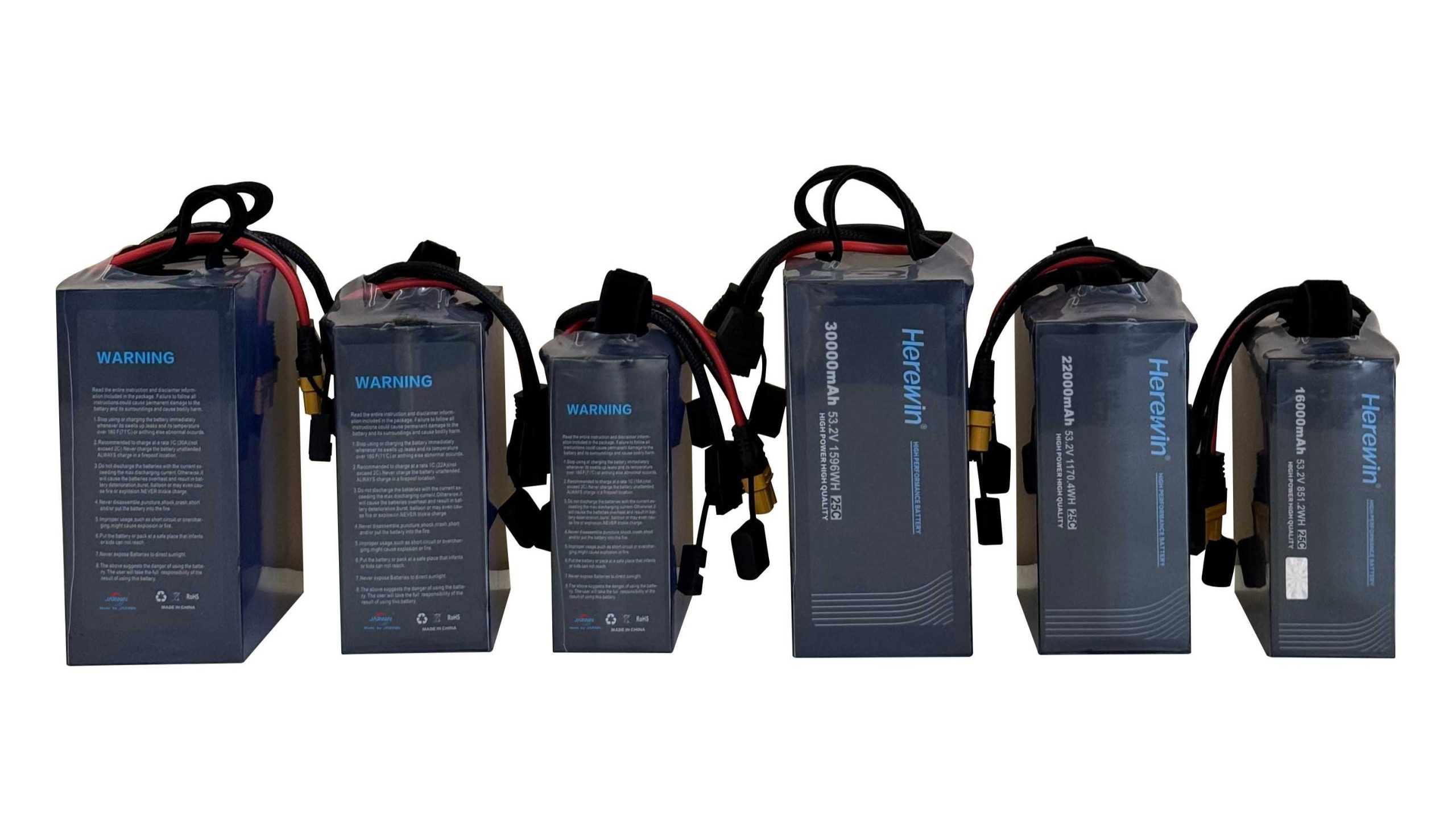
If you would rather not build the specification alone, Herewin can work through the requirement set with you, from cell and pack development to BMS integration and production support. Bring your aircraft type, payload, target flight time, voltage, current, dimensions, connector, and BMS or communication requirements, and talk through your UAV battery requirements with our team to turn them into a defined pack specification.
Further Reading
LiPo vs LiFePO4 vs solid-state: a cell-level chemistry comparison and selection guide — comparing cell chemistries at the cell level.
Industrial drone battery compliance guide — certification scope across UN 38.3, IEC and UL standards.
High-temperature UAV battery management: a fleet operator’s guide to TCO optimization — the cost-per-acre model and lifecycle cost formulas.

 Deutsch
  English
  Español
  한국어
한국어  Français
  日本語
日本語  Русский
  Bahasa Indonesia
  ไทย
ไทย  العربية
  Português do Brasil
  Italiano
  Nederlands