




The hard part of urban drone delivery is no longer simply getting a drone from the warehouse to the neighborhood. It is making the entire delivery process work reliably at the destination.
That distinction matters because the U.S. market has already demonstrated that drones can deliver packages commercially under defined operating conditions. Commercial drone package delivery is already operating in the U.S. under Part 135, with operators receiving the certificates, exemptions, and authorizations required for their specific operations. In July 2026, the FAA also established a programmatic federal environmental pathway for qualifying Part 135 package-delivery operations, while leaving room for project-specific review.
Those regulatory and certification requirements remain necessary, but they are no longer the only bottlenecks. Once an operator has a workable authorization, the next challenge is making the physical delivery process repeatable. What remains is the question every operator eventually hits: what prevents a successful flight from becoming a reliable delivery operation?
Why Multi-Unit Housing Is Harder to Standardize
At the planning level, a delivery destination may be represented largely as a coordinate. The physical reality of a residential block is a variable environment that changes hour to hour.
The distinction sharpens once you look at how today’s consumer flows actually define a delivery point. Wing’s checkout process, for example, prompts the customer to select a precise delivery location on their property — typically a driveway or a backyard — once the app confirms the address and order are eligible. That model is easier to manage when a single household controls a clearly defined private area.
Multi-unit housing changes the shape of that problem. There is often no driveway or backyard for a single household to designate, and the same sidewalk, stairwell, or courtyard is shared by dozens of residents with different schedules. The problem shifts from locating the unit to deciding which shared patch of space can be treated as safe, by whom, and at what time — and that is a standardization problem, not merely a coordinates problem.
During the final approach to a dense residential destination, the drone may encounter balconies, courtyards, awnings, parked vehicles, overhanging vegetation, street furniture, pedestrians, pets, and a tangle of utility and communications lines. The drone is not looking for a location. It is looking for a clear patch of space that is verifiably safe at the specific moment of release — and those are different problems.
GPS can identify a location, but it cannot by itself verify whether the delivery area is clear at the moment of release. That requires onboard sensing and real-time perception.
Amazon’s Prime Air illustrates the layered approach the problem demands. According to AWS’s description of the Prime Air data pipeline, the system processes LiDAR point clouds, aerial imagery, and geospatial vector data to identify and score candidate safe delivery points before a flight is dispatched. That is a planning-layer answer. The execution layer is separate: Amazon reports that the MK30 drone detects descent-phase obstacles such as trampolines and clotheslines that were not captured in the satellite imagery used for route planning.
That gap creates a specific delivery risk: a delivery point that was acceptable during planning may no longer be usable when the drone arrives. A mapped delivery point can still change before arrival: a vehicle can enter the area, a temporary object can appear, or a previously unmapped obstacle can become relevant. An operator that relies too heavily on static mapping may discover the problem at the worst possible moment — close to property and people.
Why Thin Obstacles Are Disproportionately Difficult
Among the obstacles a delivery drone must resolve near the delivery point, thin horizontal lines are a particularly difficult class of obstacle to detect and avoid. Power conductors, communications cables, and clotheslines present very little surface area for LiDAR return and tend to be visually ambiguous against the cluttered residential backgrounds behind them.
The failure mode is not hypothetical. In November 2025 a Prime Air MK30 drone struck a thin overhead internet cable while ascending from a customer’s yard in Waco, Texas, after completing a delivery. The aircraft became entangled with the line and then performed a safe contingent landing. No one was injured and no widespread outage followed, and the FAA opened an investigation.
That incident is instructive for anyone specifying a delivery fleet. It highlights a distinct risk window around the delivery point, where the aircraft transitions between flight and the customer’s immediate surroundings — an environment whose obstacles differ from those encountered in cruise.
Why Safe Drop-Off Space Is Hard to Scale
Prime Air’s operational model requires each customer to enroll and agree to maintain a clear delivery area. Amazon’s Prime Air delivery consent document requires people, animals, and objects to remain outside a defined safety area around the delivery point during the delivery operation.
That requirement shows that delivery safety depends on conditions at each individual drop-off point. It also means each delivery point has to satisfy its own safety conditions at the time of delivery. In low-density residential areas, that is easier to manage. In dense multi-unit environments, the same physical space may serve multiple residents and purposes, making standardization harder — and the requirement to keep a defined zone clear at an unpredictable arrival time becomes a genuine constraint on how many customers can be served from the same type of shared space.
The recurring problem is not reaching the neighborhood. It is proving that one small patch of space is safe at the moment of release — a per-delivery task that dense destinations make expensive.
Weather Reduces Available Windows, Not Just Individual Flights
Weather is frequently described as a drone delivery limitation. That framing understates it. Weather does not just affect individual flights; it can reduce the number of delivery windows available to the network, regardless of whether the route remains legally authorized to operate.
Amazon’s implementation shows what a mature response looks like. Amazon states that the MK30 can operate in light rain, and that when conditions such as heavy rain, high winds, or poor visibility fall outside the aircraft’s operating envelope, drone delivery simply does not appear as a selectable fulfillment option — live weather signals are built into the service flow rather than handled as an exception. A route may have regulatory permission to operate, but its actual delivery availability still depends on whether weather conditions allow the aircraft to fly.
Treat weather-driven availability as a design input to your service-level commitments, not as an exception clause. An operator who promises a delivery window the aircraft cannot fly in most weeks has an SLA problem disguised as a weather problem.
Drone Delivery Still Needs Infrastructure on Both Ends
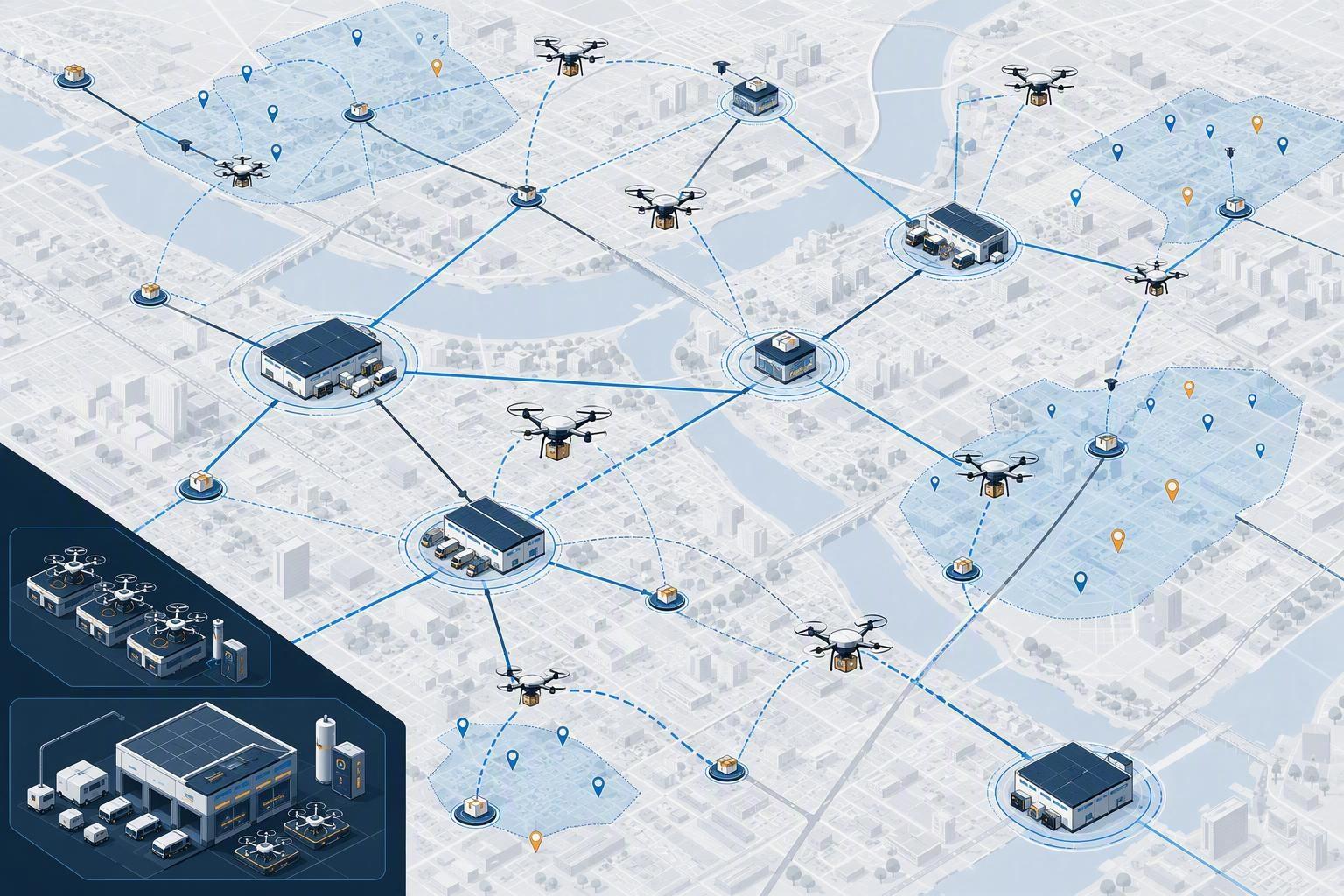
Infrastructure for drone delivery is usually discussed as a hub problem, but the operation actually depends on two distinct infrastructure layers — one at the origin, one at the destination — and each has its own constraints.
At the origin, a network needs launch and recovery sites, charging and battery management, package loading and staging, and the operating area the aircraft occupies when it departs. This is the hub layer, and it is where regulatory approval and practical deployment can diverge most sharply.
At the destination, the network needs something just as concrete: a defined drop-off location, a verified judgment that the area is safe at delivery time, a way to keep that space clear, and a path for the customer to actually retrieve the package. The destination layer is easier to overlook because it usually has no building and no address of its own — but it is the layer that decides whether a given neighborhood can be served repeatedly.
The FAA’s Desk Reference for UAS Environmental Review states plainly that the siting of drone hubs and package delivery infrastructure must comply with applicable state and local land use and zoning requirements. The nationwide programmatic environmental assessment signed in July 2026 streamlined the federal layer of that review. It did not touch the local layer.
The July 2026 national PEA and its associated FONSI/ROD show how the federal framework addresses this infrastructure. The assessment was written specifically around Part 135 package delivery, and it addresses hub infrastructure, noise, and operating areas directly. FAA project records illustrate what that looks like on the ground. Amazon’s Prime Air drone delivery center (PADDC) sites, for example, are generally placed adjacent to an existing warehouse and given a defined operating area, with an expected number of daily operations noted during review — so the studied envelope and the realized operation are not the same number.
This is where the distinction between aviation approval and site approval becomes important. Federal authority to fly does not confer local authority to build. A hub is a land use: it occupies a parcel, generates noise at specific times of day, and sits within some distance of residences. Because the programmatic review rests on assumptions about hub placement, noise-sensitive land uses, and modeled delivery volumes per site, an operator whose proposed site or operating profile falls outside those assumptions may need additional project-specific environmental review. As networks expand, operators may need additional approvals, amendments, or site-specific reviews rather than assuming that every new location is automatically covered.
Dense urban areas are the hardest case for exactly this reason. Suburban retail areas and warehouse margins may offer parcels with existing commercial or logistics uses, more available space, and greater separation from nearby residences. A dense urban block offers rooftops with structural and access constraints, ground-level parcels competing with residential and retail uses, and a much tighter tolerance for noise at delivery hours. For fixed-hub models, dense urban deployment can become a real-estate and permitting problem as much as an aviation problem.
Not every operator uses the same hub model, but alternative architectures shift rather than eliminate the destination-side requirements.
The takeaway for operators is straightforward: treat a federal airspace authorization and a local siting approval as two separate gates, and secure both before committing a route to customers.
What Happens When the Drone Cannot Complete the Drop-Off?
A commercial delivery network cannot assume that every arrival will end in a successful drop. A delivery area may be occupied, weather may deteriorate, or the system may detect an obstacle that was not present during planning. These are not exceptional scenarios that a commercial network can simply ignore.
That means the operator needs a defined fallback. Depending on the operating model, the fallback may involve a return and retry, a rescheduled delivery, or a handoff to another delivery method. What matters for commercial viability is not which fallback is chosen, but that one exists and is accounted for before the route is promised to a customer.
At scale, the important metric is not just successful flights, but successful deliveries — and how efficiently failed attempts are recovered. A network that completes its flights but cannot reliably finish its drop-offs is not yet an operation, regardless of how well the aircraft performs.
Why Flight Performance Alone Is Not Enough
The same pattern appears across all of these constraints: a delivery can fail even when the aircraft itself is functioning normally. The destination may be unavailable, weather may close the operating window, a hub may face local siting constraints, or the customer handoff may require a fallback. Commercial scale therefore depends on managing the entire delivery chain, not optimizing flight performance alone.
Five Questions Before a Route Becomes Routine
Before a route moves from pilot to routine operation, operators need clear answers to five questions:
Can the delivery point be verified at arrival?
Can weather conditions support the promised service window?
Can the required hub and delivery infrastructure be legally and practically operated?
Is there a defined fallback when the drone cannot complete the drop?
Can the entire process be repeated at the required delivery volume?
From Successful Flights to Repeatable Deliveries
The ability to complete the flight is no longer enough to define whether the delivery model works. A commercial delivery drone with the right authorization can serve defined residential and commercial areas within U.S. metro markets, and the federal environmental pathway for qualifying Part 135 package-delivery operations is more clearly defined.
What is not settled is whether those individual controls can work together consistently enough to support a repeatable delivery service. Better flight control alone cannot answer that.
For operators and OEMs, that shift changes what “ready” means. A platform that performs well in controlled conditions but has no answer for destination variance, weather availability, or failed deliveries is a demonstration, not an operation. The next open question follows naturally: if fixed delivery infrastructure remains difficult to deploy across dense urban areas, does the infrastructure itself need to move?
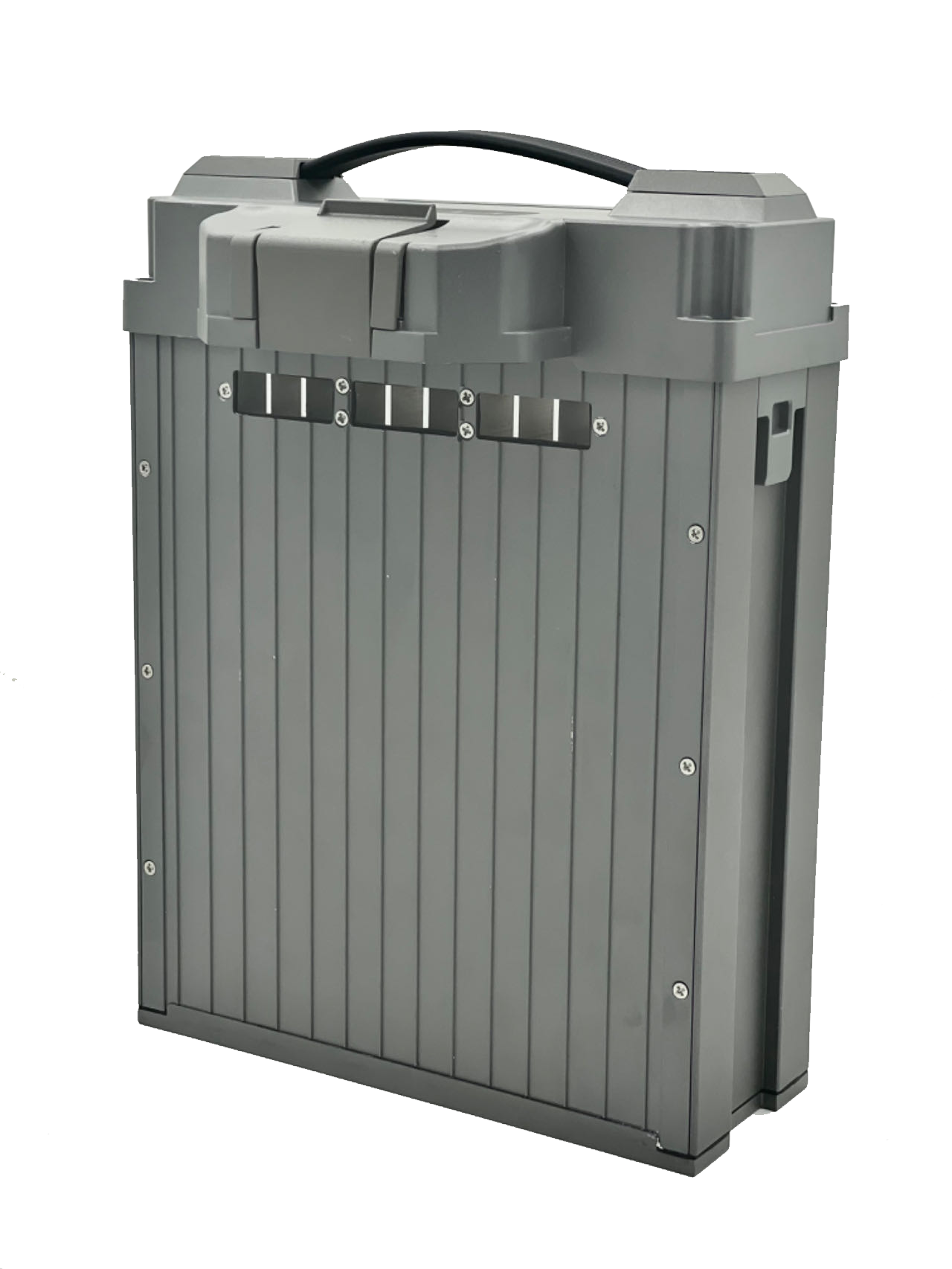
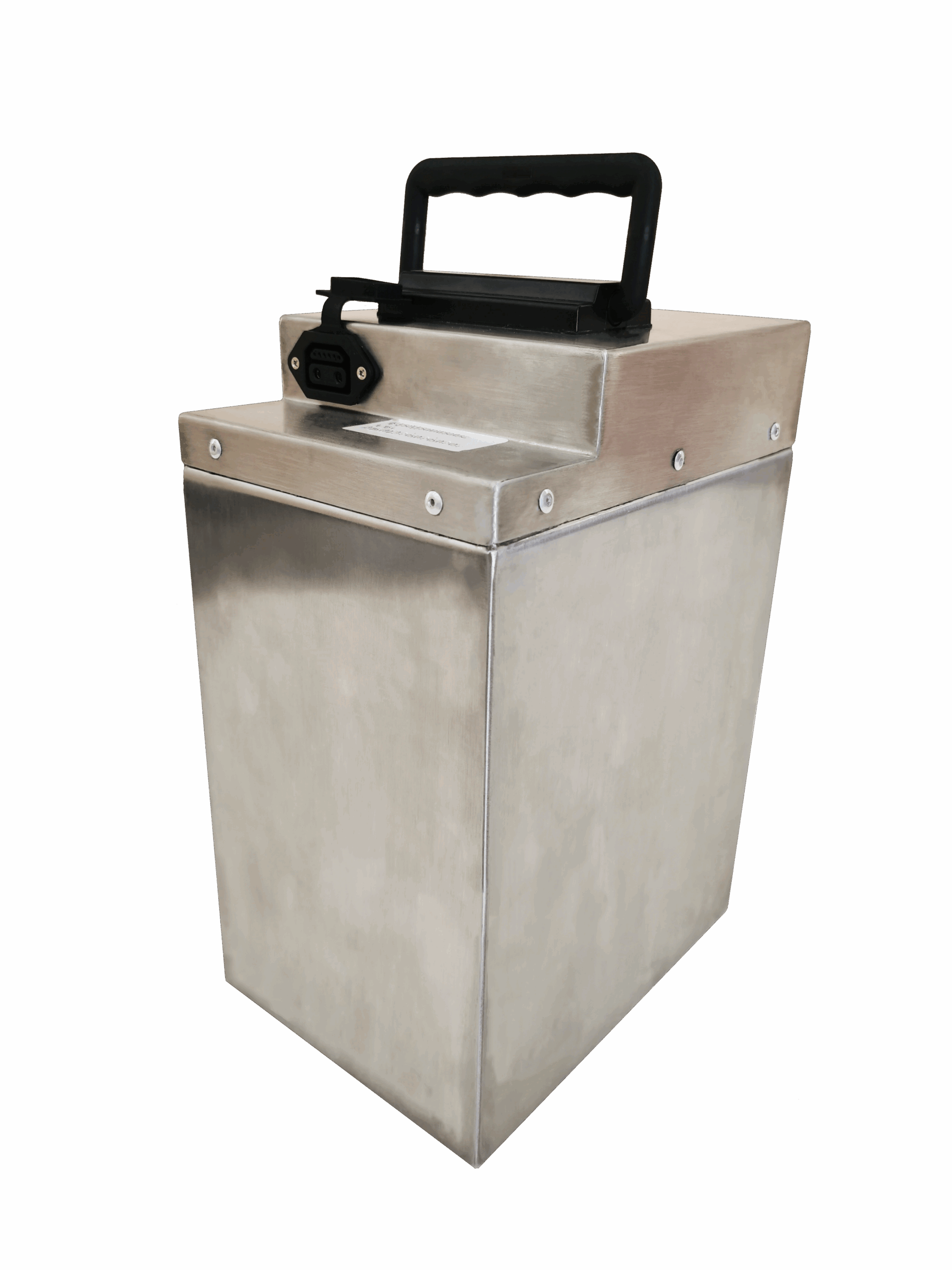
Herewin works with UAV OEMs and fleet operators on custom drone battery systems built around real operating requirements — from platform integration to ODM/OEM production. If battery performance and integration are part of your next delivery-platform decision, our team can help review the requirements.
This analysis draws on public FAA filings and Amazon and Wing operational documentation, alongside Herewin’s work with UAV manufacturers and fleet operators on commercial drone platforms.



 Deutsch
  English
  Español
  한국어
한국어  Français
  日本語
日本語  Русский
  Bahasa Indonesia
  ไทย
ไทย  العربية
  Português do Brasil
  Italiano
  Nederlands