










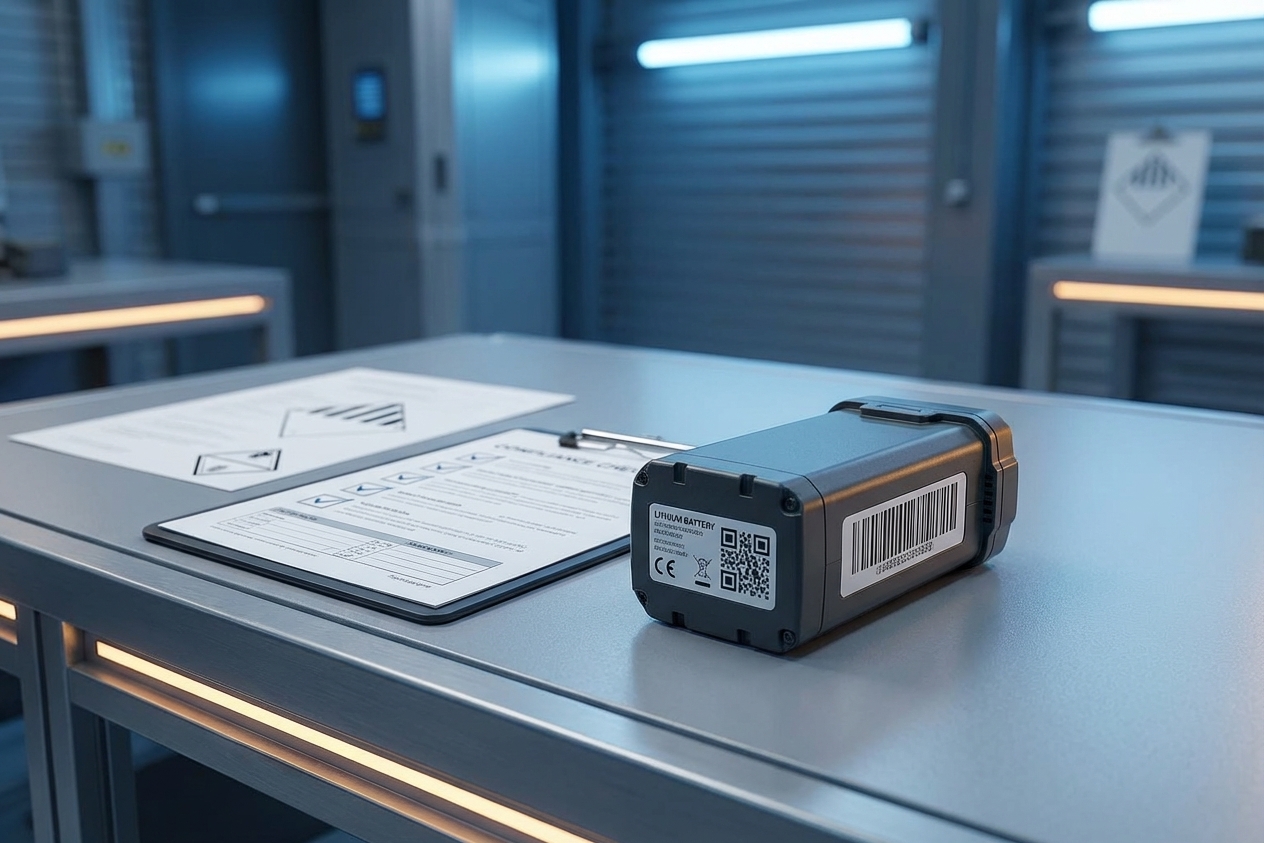
In the complex landscape of cross-border trade, treating a battery as a mere sub-component of an aircraft’s CE/UKCA file is a strategic risk. High-stakes audits view the battery as a separate ‘evidence trail.’ Without precise documentation, your program faces immediate threats: from customs detention and demurrage costs to rejected incoming inspections.
Success hinges on understanding one distinction: EN 62619 is the industrial standard the market demands, while EN 62133 is a consumer-grade compromise. This guide frames battery compliance as a pillar of technical due diligence—ensuring your deployment is protected against liability and fully aligned with global safety expectations.
EN 62619 vs EN 62133: the engineering anchor for industrial UAS
Industrial UAS fly high‑rate missions in broad temperature ranges, with maintenance regimes closer to industrial motive power than to portable gadgets. That’s why test labs and competent buyers typically evaluate these packs against EN/IEC 62619 (industrial) rather than EN/IEC 62133‑2 (portable), while still keeping UN38.3 transport and system‑level CE/EMC obligations in view.
IEC states that IEC 62133‑2:2017 covers “portable sealed secondary lithium cells and batteries” under intended and reasonably foreseeable misuse. See scope on the official page from the standards body in 2017/2021 CSV editions: IEC 62133‑2 scope and details.
IEC states that IEC 62619:2022 covers “secondary lithium cells and batteries for industrial applications.” See the official scope: IEC 62619:2022 scope and consolidated information: IEC 62619 consolidated details.
What this means operationally: if your pack is engineered for sustained high discharge, rigorous BMS protections, mechanical/thermal robustness, and field maintenance, 62619 is the natural baseline buyers and labs expect. Using only 62133‑2 evidence for such a pack creates a jarring mismatch during due diligence.
Standards emphasis at a glance
Focus area | EN 62133‑2 (portable) | EN 62619 (industrial) |
|---|---|---|
Typical use context | Consumer/portable rechargeable devices | Industrial applications (stationary + motive) |
Abuse/safety lens | Reasonably foreseeable misuse | Industrial duty + field service assumptions |
Rate/thermal expectations | Moderate rates, narrower temp profiles | Higher rates, broader temp envelopes |
Documentation expectations | Safety test evidence for portable cells/packs | Safety test evidence aligned to industrial pack risks |
Fit for industrial UAS | Often insufficient alone | Typical baseline for acceptance by labs/buyers |
Note: UAS are not explicitly listed as an example category in 62619 scope pages; positioning here reflects widely observed industry practice in lab assessments and buyer audits. System‑level CE/EMC/GPSR assessments still occur at the aircraft level.
Global Compliance Architecture: Navigating the Four Critical Pillars
Think of compliance as a matrix you manage—not a certificate you “add.” Four pillars dominate most industrial drone battery programs.
UN38.3 transport compliance
Global air and sea carriers will not accept lithium packs that lack a verifiable UN38.3 evidence trail. Per the UN Manual (Part III, Section 38.3), this mandate requires successful completion of the T.1–T.8 test series and the availability of a formal “Test Summary” (as defined in Sub‑section 38.3.5).
To ensure your documentation is audit-ready, you can access the official standards and latest revision files through the UN Manual Section 38.3 Overview and the UN Rev.8 Files Portal.
While IATA’s Lithium Battery Guidance Document confirms there is no official regulatory expiry date for these tests, carriers frequently apply “recency practices” in their operations—often requiring reports issued within the last 12–24 months to clear safety screenings.
Practical actions that speed clearance:
Ensure the test summary is accessible via URL/QR and exactly matches model/version identifiers on shipping docs and labels.
Keep a design‑unchanged attestation when relying on an existing test.
Align packing instructions (e.g., PI 965/966/967), state of charge requirements, and Class 9 labels; retain photo evidence.
CE/UKCA technical file thinking
The European Commission explains that CE marking relies on establishing technical documentation and issuing a Declaration of Conformity before affixing CE. See the Commission’s manufacturer guidance and the CE portal: Manufacturers’ CE process and CE marking portal. In a UAS program, the aircraft system earns CE/UKCA conformity at system level (LVD/EMC/GPSR as applicable). The battery is a component that must supply auditable evidence into that file, and—separately—must meet obligations under the EU Battery Regulation.Ensure the file covers the LVD (via EN 62619), EMC, and RoHS directives as a baseline for the pack’s individual compliance.
EU Battery Regulation (EU) 2023/1542 obligations in 2026
The new horizontal regulation for batteries adds sustainability, labeling, due diligence, and information requirements. Always verify Article 60 (application dates) for your battery category. The official text is on EUR‑Lex: Regulation (EU) 2023/1542. By 2026, many rechargeable packs require updated labeling and certain categories require carbon‑footprint declarations and due‑diligence documentation; digital battery passport milestones follow in later phases. Maintain a dated matrix in your technical file so auditors see exactly which clauses you’ve applied, when, and why.
FCC for smart BMS and radios (US market context)
US buyers often add an extra layer of gatekeeping that isn’t about customs at all: procurement and product‑liability expectations. In many enterprise, public‑sector, and infrastructure RFPs, UL 1642 (cell safety) and UL 2054 (battery pack safety) show up as common screening criteria or “preferred” evidence because they fit internal safety policies and insurer questionnaires. They may not be legally required for import clearance, but lacking them can still slow vendor onboarding, contract award, or site acceptance—so treat UL evidence as part of your due‑diligence package when the U.S. is in scope.
If your BMS integrates a radio (BLE, Wi‑Fi, LoRa), it’s usually an intentional radiator subject to FCC Part 15 certification. The modular approval policy in KDB 996369 outlines how pre‑certified modules can be integrated into a host, with host responsibilities for labeling and RF exposure. See accessible TCB summaries referencing KDB 996369 and Part 15 overviews: ACB US wireless compliance summary (KDB 996369) and FCC Part 15 certification primer. If there is no radio, unintentional radiation may fall under Part 15B SDoC within system EMC.
For EU/UK, radio functions trigger RED at the aircraft/system level; integrate module documentation accordingly in the system file.
Technical audit playbook: how buyers actually check your battery evidence
Auditors look for crisp mapping between what you ship and what you claim. The following flow mirrors typical acceptance testing.
Verify the lab and body. Use the EU’s NANDO portal to confirm Notified Body IDs and scopes for any EU certificates; for US radio approvals, verify TCB identities. Official NB gateway: NANDO portal.
Match model → report. Cross‑check battery model/SKU and electrical ratings against each cited report and certificate (EN 62619 CB Test Report/Certificate, CE file references, UN38.3 test summary, SDS, REACH statements). Reject any report where the model string, photos, or ratings don’t match the shipped hardware.
Control the technical file. Keep a controlled Technical Construction File (TCF) with versioned indexes, change logs, and a DoC that clearly lists applied legislation/standards and references to evidence.
Prove serialization and batch consistency. Maintain shipment‑level mapping of serial numbers to report editions and production records. Retain photos of labels/cartons and a redacted copy of the UN38.3 summary URL/QR.
Confirm shipping alignment. Ensure packing instructions, Class 9 labels, lithium battery marks, and SoC requirements are met and photographed before dispatch.
Tip: Keep paragraphs of rationale next to each index entry—auditors appreciate the reasoning that links a requirement to an attached document.
Customs and shipping hygiene: common rejection patterns and how to avoid them
Even when the lab work is solid, documentation missteps can stall or reverse a shipment.
Anonymous rejection pattern observed: shipment detained because the DoC referenced RoHS in general terms without clearly pointing to the currently applicable scope, and the UN38.3 test summary model ID did not match the carton label. Typical impacts: demurrage and detention charges, rework on documents/labels, forwarder re‑screening, and schedule slippage on downstream acceptance tests. Corrective action: reissue a DoC that cites the correct legislation and align the exact‑match UN38.3 test summary URL/QR with the labels; provide photo evidence that identifiers now match. Result: shipment released in the following audit window.
Practical reminder from IATA LBGD: the test summary must be made available; adding a QR/URL on the packaging and packing list speeds spot checks. The guidance document link is above; keep a copy in your TCF.
For deeper background on documentation hygiene and shipping readiness, see our contextual explainer on UN38.3 and packing documentation in the industrial drone context: Industrial Drone Battery Buying Guide — UN38.3 and documentation basics.
Build a Complete Compliance Pack
A “Complete Compliance Pack” is not a flashy binder; it’s a precise mapping between identifiers. Think of it like a switchboard: every SKU jack has a cable that clicks directly into a report number, a DoC clause, and a shipment ID. When this mapping is crisp, audits move fast.
Minimal viable mapping table (example layout)
Battery SKU/Model | Evidence (Safety/Transport) | System/Regulatory References | Shipment Mapping |
|---|---|---|---|
UAS‑BP‑6200‑HV‑14S | EN 62619 CB Test Report + Certificate (lab name, dated), UN38.3 test summary (URL/QR), SDS, REACH | CE system file refs (LVD/EMC/GPSR as applicable), EU Battery Regulation 2023/1542 labeling/due diligence entries | Sales order, packing list line, carton label photo, serial range 2403xxxx–2403yyyy |
How this looks in practice: A qualified industrial partner provides an audit-ready dossier where the EN 62619 CB report and the UN38.3 test summary perfectly align with the model identifiers displayed on your packaging and Declaration of Conformity (DoC). Your team then integrates these identifiers into the system’s technical file and shipment records, allowing a buyer or auditor to verify the entire compliance chain in a single pass. This level of traceability is what separates professional-grade operations from high-risk procurement.
For additional operational context on BMS features intersecting with compliance documentation, see: Last‑Mile Drone Battery ROI: Quick‑Swap & BMS.
Frequently misinterpreted points
Does UN38.3 have a 24‑month expiry?
UN 38.3 itself and IATA’s Lithium Battery Guidance focus on availability and model/version match of the test summary, not a universal expiry date. In practice, some forwarders and carriers apply a “recency” screen (often around 12–24 months) as an operational policy. Plan for either periodic refresh testing or a design‑unchanged attestation plus strong traceability so you can clear those checks without arguing about definitions.
Do I need an FCC ID for a smart BMS?
If the BMS includes a radio, that radio typically needs FCC Part 15 certification (intentional radiator). Prefer a pre‑certified module and follow KDB 996369 host‑integration conditions; if there is no radio, consider Part 15B SDoC within system EMC. See the ACB/KDB resources linked above.
Should the battery have CE on its own?
Treat the battery primarily as a component feeding evidence into the aircraft’s CE/UKCA technical file. Separately, comply with the EU Battery Regulation 2023/1542 labeling and documentation milestones that apply to your battery category and date. See the EC CE portals and EUR‑Lex link above.
Next Steps: Strategic Compliance Realignment
If you’re currently holding portable‑grade evidence (62133‑2) for an industrial UAS pack, prioritize a 62619 pathway and rebuild your mapping so each shipment’s identifiers align. Maintain a dated matrix of EU Battery Regulation 2023/1542 clauses applied in 2026, and keep the UN38.3 test summary accessible via URL/QR with exact model/version matches.
Want to pressure‑test your internal audit flow before you commit budget and lead time? Request a redacted Sample Complete Compliance Pack: an EU Declaration of Conformity, a controlled report index with number mapping (EN 62619 CB report/certificate, UN38.3 test summary, SDS, REACH), and short verification notes showing how identifiers connect from SKU → report → shipment labels. Use it as a due‑diligence artifact to validate your supplier’s traceability and reduce downstream liability/insurance friction.
For extended reading on customs documentation specifics and shipping hygiene in drone programs, see: Lithium Batteries for Logistics/Transport Drones.
References
IEC — 62133‑2:2017 scope overview (portable): IEC 62133‑2 scope and details
IEC — 62619:2022 scope overview (industrial): IEC 62619:2022 scope and IEC 62619 consolidated details
UNECE — UN Manual Section 38.3 resources: Section 38.3 overview and Rev.8 files portal
IATA — Lithium Battery Guidance Document (latest edition): IATA LBGD PDF
European Commission — CE for manufacturers and CE portal: Manufacturers’ CE process and CE marking portal
EUR‑Lex — Regulation (EU) 2023/1542 (batteries): Official consolidated text
ACB/TCB resources — FCC/KDB summaries: US Wireless compliance (KDB 996369) and FCC Part 15 overview
EU NANDO portal — Notified Bodies: NANDO gateway







 English
  Español
  한국어
한국어  Deutsch
  Français
  日本語
日本語  Русский
  Bahasa Indonesia
  ไทย
ไทย  العربية
  Português do Brasil
  Italiano
  Nederlands