
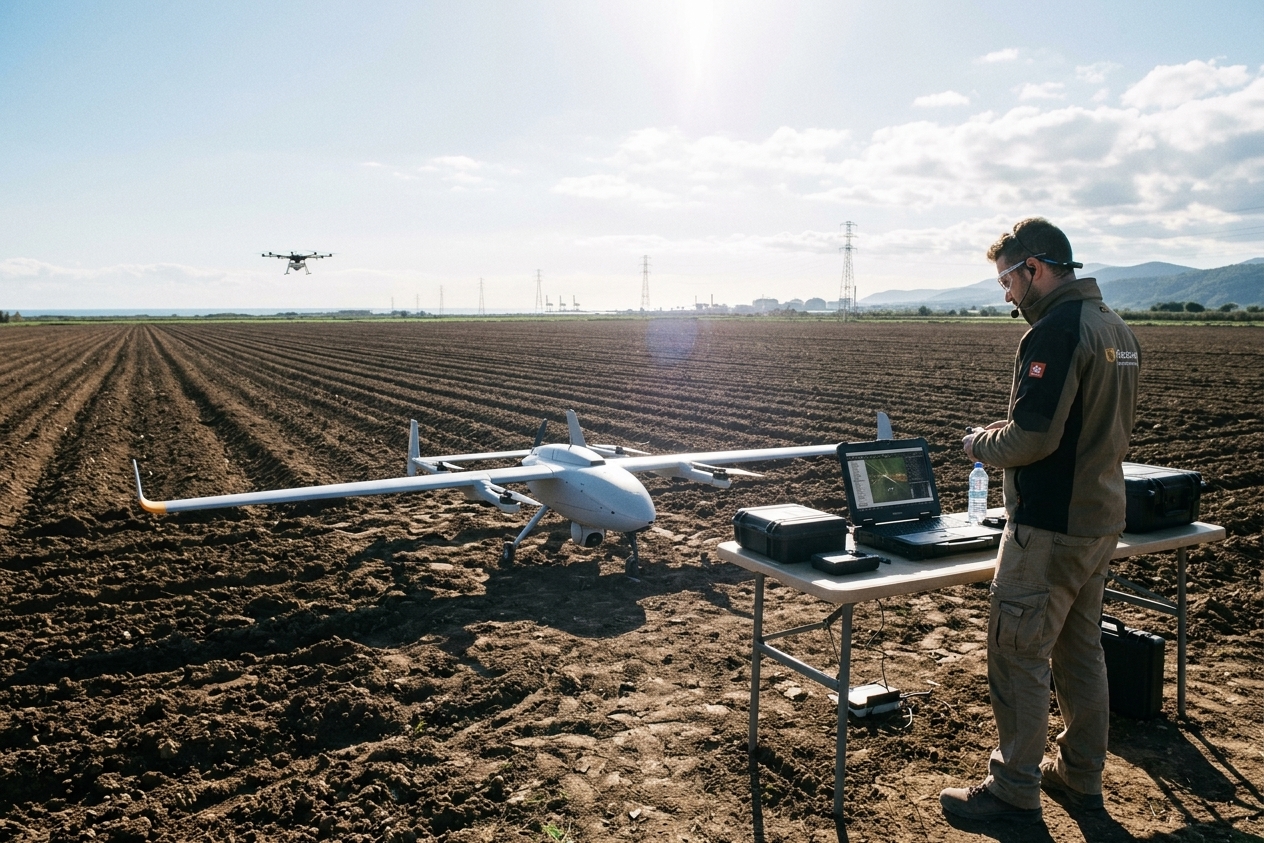
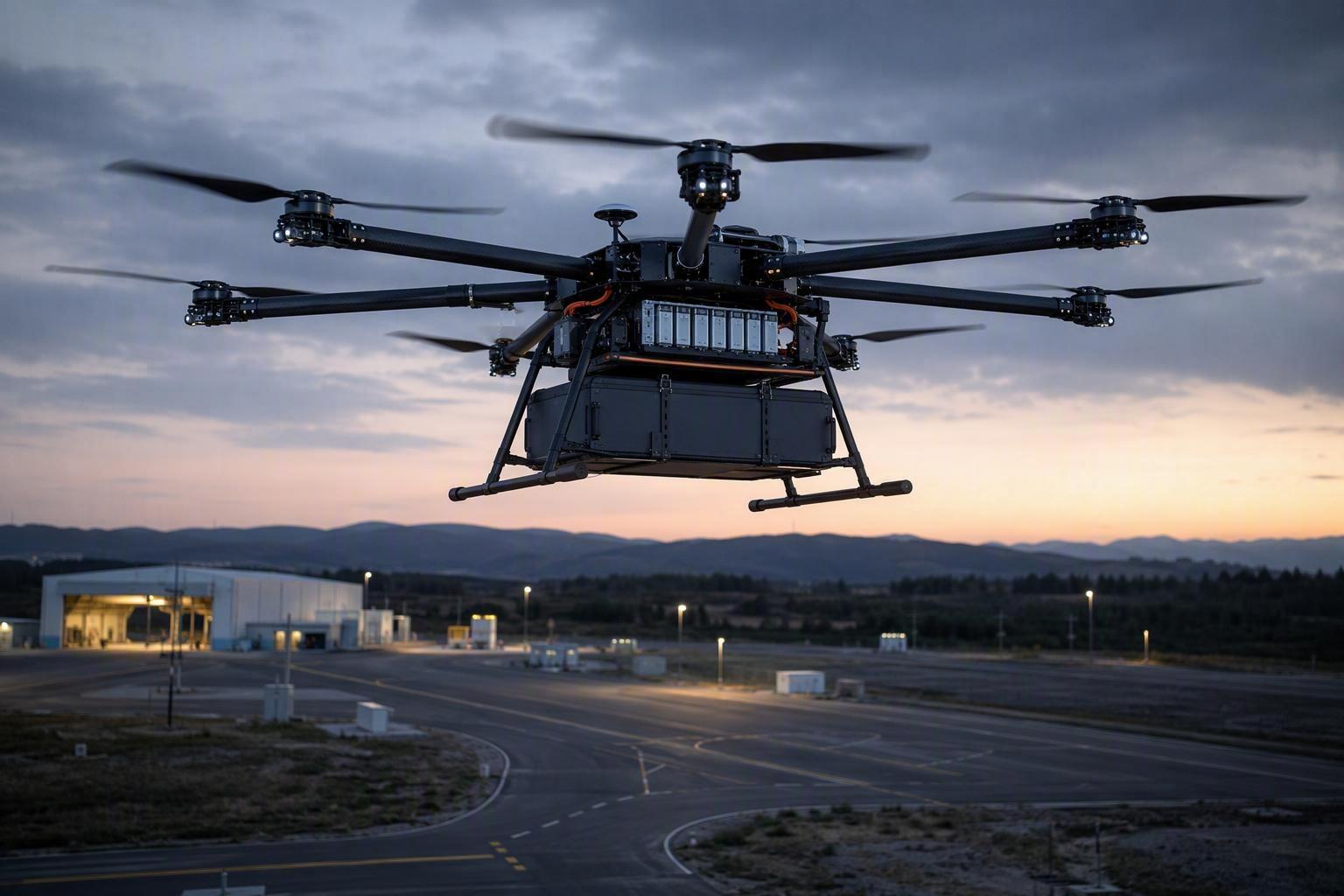
Commercial drones are staying in the air longer, and as a battery manufacturer that supplies packs to UAV platforms, we watch this shift closely and work inside it every day.
More minutes per flight only matter when they become more productive work per deployment: more hectares mapped, more assets inspected, or more sorties completed in a workday. Long endurance, read that way, is a mission-productivity question — not a stopwatch competition.
Where we add a point of view, it comes from the power-system side: how battery-electric, hybrid and cargo architectures each place different demands on pack design, peak power, thermal behavior and turnaround. That lens runs through every entry below.
One clarification before the list: this is not an independent operator test or a buyer’s ranking. The figures are compiled from manufacturers’ published specifications for consistent comparison, and they have not been flight-tested by our team. Weigh them accordingly.
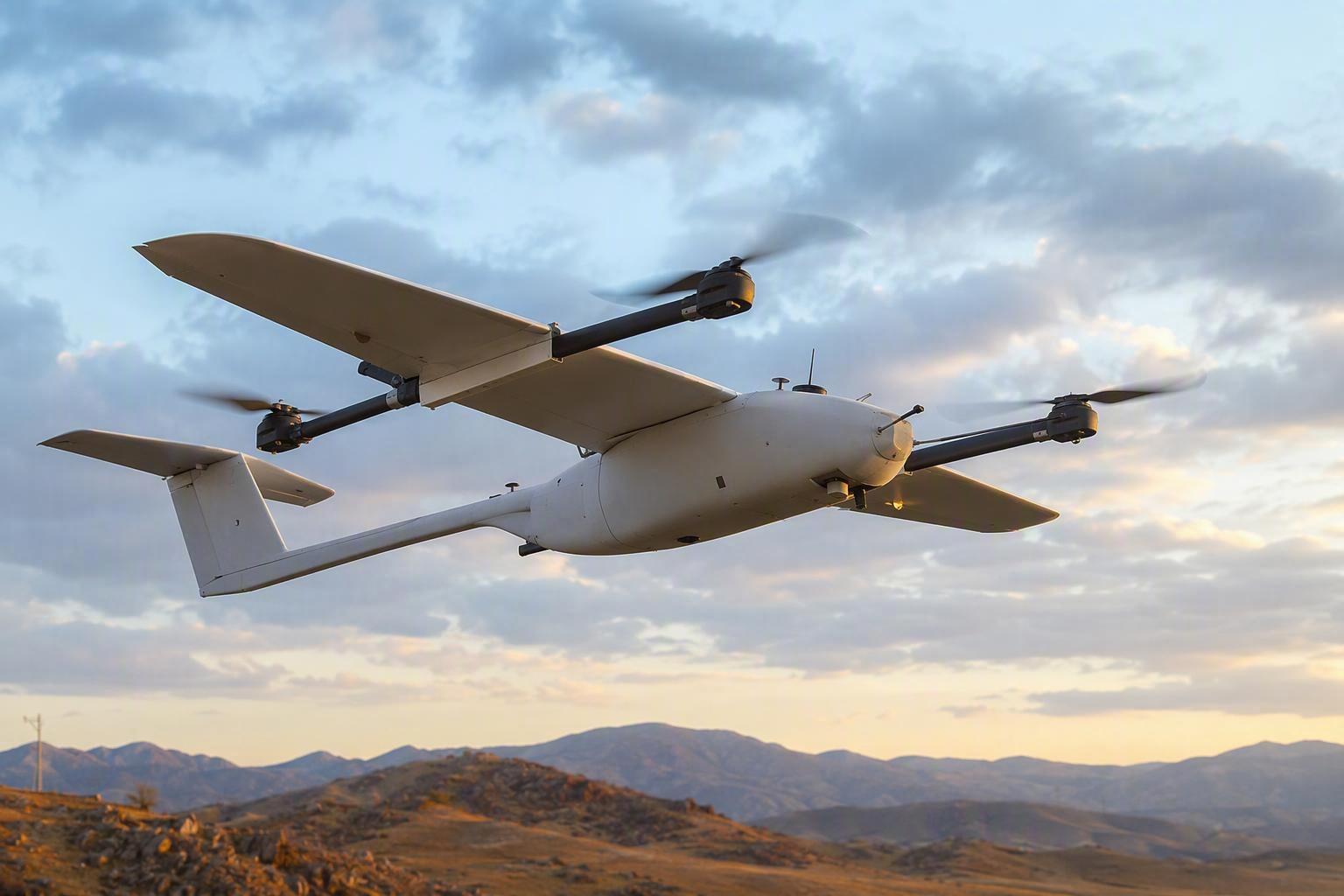
The ten platforms are chosen as a spread of architectures: battery-electric VTOL, hybrid VTOL, hybrid multirotor, dedicated survey aircraft, and autonomous cargo platforms. Together they show how different aircraft are turning endurance into useful industrial operating time in 2026.
Ten Long-Endurance Platforms, Read Through a Power-System Lens
1. Skyfront Perimeter 8 / 8+
Representative platform: Perimeter 8 and 8+
Endurance: Around 5 hours with no payload; roughly 3 hours at 5 kg and 1 hour near full payload
Payload: Up to 7.5–10 kg, depending on the variant
Focus: Hybrid long-endurance multirotor for surveying, ISR and inspection
Skyfront’s Perimeter is a hybrid gas-electric multirotor, and that powertrain decision is the reason it can hold hours in the air at all. Its published product endurance sits around five hours empty and about an hour with a full load, which is what a real mission profile uses, not a payload-free extreme.
The platform is worth watching because hybrid endurance changes the geometry of field work: one platform can linger over a corridor, cover a big survey in a single deployment, or hold station for persistent monitoring in ways a battery-only multirotor cannot. The widely cited multi-hour record is a tested extreme, not the everyday specification.
From a power-system standpoint, a hybrid multirotor like this still leans on its battery for the hard parts: high-current bursts on takeoff and climb, plus stable voltage while the generator and pack share the load. That makes the pack a peak-power and load-sharing component, not just an energy tank — a design point that separates hybrid UAV packs from their all-electric counterparts.
2. DeltaQuad Evo
Representative platform: DeltaQuad Evo
Endurance: Up to roughly 4.5 hours
Range: Up to about 272 km with a light payload
Payload: Up to about 3 kg
Focus: Long-range VTOL for inspection, mapping and reconnaissance
The DeltaQuad Evo takes a different route to endurance: an all-electric VTOL that trades the mechanical simplicity of the category against genuinely long range. Its published product endurance is around 4.5 hours with a light sensor, with a dual-payload bay that lets operators fly several mission types in one sortie.
It earns its place here as a reminder to read endurance claims carefully. A separate test flight with an experimental solid-state battery pushed the Evo past eight hours, but that was a research record on a modified energy system, not the stock product rating. Separating tested endurance records from published product endurance is exactly the discipline a commercial buyer needs.
3. JOUAV CW-30E
Representative platform: CW-30E
Endurance: Up to roughly 8 hours
Payload: Up to 8 kg
Focus: Hybrid industrial VTOL for mapping, inspection and surveillance
Aimed squarely at large-area, long-duration industrial work, the JOUAV CW-30E is a hybrid gasoline-and-battery VTOL. Published figures put it near 8 hours of endurance, with a payload capacity of up to 8 kg and a control link reaching about 200 km, which points at persistent regional coverage rather than short local sorties.
The CW-30E is persuasive because of how its architecture maps to the mission. Hybrid endurance plus wing-borne cruise lets a single aircraft cover a wide network of sites in one flight, cutting the number of takeoffs, landings and crew handoffs that normally eat into a survey or inspection day.
That architecture also sets a specific brief for the battery. It has to deliver repeatable high-power output for vertical launch and climb every cycle, then tolerate long, low-draw cruise phases — often within the same pack. On hybrid platforms, the engineering effort sits in sizing for that dual duty cycle rather than for raw capacity.
4. Autel Robotics Dragonfish-25
Representative platform: Dragonfish-25
Endurance: Around 3.5 hours with payload
Payload: Up to about 10 kg
Focus: Multi-mission eVTOL for mapping, inspection and public safety
Autel’s Dragonfish-25 combines vertical-takeoff convenience with winged cruise in a battery-electric eVTOL. Its published figures put flight time with payload near 3.5 hours and flight mileage around 220 km, with a reported 10-minute rapid-deployment setup.
Its case for a spot on this list is structural: a pure battery-electric VTOL can still hold multi-hour endurance without a hybrid or fuel system, which keeps propulsion simpler and charging integration straightforward. For operators that want hours in the air and do not want engine maintenance, that trade matters.
For the pack, that simplicity comes with a stricter energy-density budget: every extra kilogram competes directly with flight time, so the design leans on high specific energy and stable output rather than on reserve capacity. It is the clearest case on this list of a battery being the primary endurance lever.
5. Harris Aerial Carrier H6 Hybrid EFI
Representative platform: Carrier H6 Hybrid EFI
Endurance: Up to roughly 4 hours with no payload; about 1.7 hours at its 5 kg maximum payload
Payload: About 5 kg
Focus: Modular hybrid multirotor for precision agriculture, LiDAR and inspection
The Carrier H6 Hybrid EFI is a modular heavy-lift hexacopter from Harris Aerial. It runs on a fuel-injected generator when it needs hours of endurance, and can also be configured for fully electric operation when the mission is shorter. Published figures put it near 4 hours empty and about 1.7 hours carrying its 5 kg maximum load.
Configurability is the whole proposition. The same airframe can carry different power systems and sensor mounts, which means an operator can tune the platform to the endurance and payload profile of a specific job rather than accepting a one-shot design. It also illustrates how payload weight moves endurance more than the no-payload number suggests.
That flexibility is only as good as the pack behind it. Swapping between generator and all-electric operation means the battery has to work across two very different duty profiles inside one airframe, so connector design, mounting and thermal paths have to be standardized before the platform can genuinely be reconfigured in the field.
6. Delair DT46
Representative platform: DT46
Endurance: Up to roughly 6.5 hours in fixed-wing mode, around 3.5 hours in VTOL mode
Payload: Up to about 5 kg
Focus: Long-endurance industrial UAV for mapping, security and logistics
The Delair DT46 can run in two configurations, and that choice is the point. In VTOL mode it launches vertically from a confined site, while in fixed-wing mode it extends toward six and a half hours of flight for wide-area coverage, with up to 5 kg of usable payload.
The DT46 makes that point directly: here, endurance follows the configuration you choose rather than a single locked number. An operator that mostly needs flexible, local vertical operations gets one profile; a crew covering long linear infrastructure gets another. The published 100 km communication range reinforces its large-area intent.
For a battery designer, the two-mode architecture is a useful reminder that the VTOL phase, not cruise, usually sets the peak-power requirement. Since the same platform runs both profiles, the pack has to meet the vertical-launch demand without over-sizing the energy it carries into a long, efficient cruise leg.
7. Quantum Systems Trinity Pro
Representative platform: Trinity Pro
Endurance: Up to 90 minutes
Payload: About 1 kg
Focus: Survey and mapping eVTOL
Quantum Systems’ Trinity Pro earns its place for what a single sortie accomplishes, not for the headline minutes. Manufacturers state that around 700 hectares or 100 km of corridor can be covered in one flight, with a compact ~1 kg sensor payload and a takeoff weight near 5.75 kg. That endurance level is useful because it turns a full topographic survey or a long linear-infrastructure sweep into a single deployment rather than a chain of staged flights.
What matters here is that the platform does not compete on raw endurance — it converts its roughly 1.5 hours of air time into mission output: whole-area coverage finished before the crew needs to reposition, relaunch, or stitch data together. For survey teams, the decisive metric is hectares per flight and how quickly the result is ready, not the flight-time number on a spec sheet.
This is also the clearest illustration of why a smaller, well-matched pack can outperform a larger one. When a platform wins on coverage per sortie rather than flight minutes, the battery’s job shifts toward keeping the sensor running at stable voltage and keeping weight low enough not to erode that coverage.
8. WingtraRAY
Representative platform: WingtraRAY
Endurance: Up to about 1 hour (RGB and multispectral), roughly 0.75 hours with LiDAR
Payload: About 1.25 kg
Focus: High-productivity mapping VTOL
For WingtraRAY, flight time is not the headline; what matters is how much ground one sortie can clear. Its value comes from the area it can cover in a single flight and the reduction in field setup and mission segments. With up to about 1 hour of flight time and up to 550 hectares of stated coverage under specified conditions, per Wingtra’s WingtraRAY mapping spec, it is designed around survey productivity rather than endurance as a standalone number.
That framing is exactly how commercial operators should read any long-endurance platform in this category. The real output is usable survey data per deployment, delivered at the accuracy a project needs, and the flight time only matters insofar as it widens that area.
On the power side, this is the type of aircraft where battery weight discipline matters most: with a small airframe and a ~1.25 kg payload, shaving mass off the pack translates almost directly into more area surveyed. It is a good example of why a pack sized to the mission can beat one sized to a generic capacity target.
9. Elroy Air Chaparral
Representative platform: Chaparral
Range: Up to about 450 miles
Payload: Up to about 500 lb (roughly 227 kg)
Focus: Autonomous hybrid-electric cargo VTOL
Elroy Air’s Chaparral approaches long endurance from the cargo side. It is an autonomous hybrid-electric VTOL designed to carry substantial loads over region-scale range without runway or ground infrastructure at the delivery point, using a swappable cargo pod.
What distinguishes Chaparral is the logistics direction it points toward: persistent, crewless freight work carried at range. The platform is moving toward production and routine commercial service, so its published range and payload figures should still be read in the context of an emerging commercial program. But the direction is clear: long-endurance vertical flight doing useful freight work autonomously is central to where the commercial market is heading.
10. Dronamics Black Swan
Representative platform: Black Swan
Range: On the order of about 2,500 km per mission
Payload: Up to about 350 kg
Focus: Long-range cargo UAV for middle-mile logistics
Dronamics’ Black Swan is a fixed-wing cargo UAV closer in scale to a small aircraft than a drone, designed to carry about 350 kg across roughly 2,500 km from short, unpaved strips.
Its inclusion here widens the definition of commercial endurance. Where most of this list measures endurance in minutes to a few hours, Black Swan shifts the discussion toward how far a heavy cargo load can move without conventional aviation infrastructure. The real headline is not a flight-time count in the hundreds of minutes but the roughly 350 kg it can carry across about 2,500 km. It is still working its way toward routine commercial service, but it shows how the definition of commercial endurance can shift from flight time to the amount of cargo moved per mission.
That shift changes the pack brief as well. A long-range cargo platform optimizes for energy per kilogram over sustained cruise rather than for short peak bursts, which usually points toward a different cell chemistry and pack architecture than a multirotor built for vertical power. Same technology family, very different design priorities.
What Makes a Long-Endurance Drone Commercially Useful
Reading the ten platforms above, a pattern emerges: the platforms that earn their keep are not the ones with the biggest single flight-time spec. Commercial usefulness comes from how endurance is converted into work per deployment across a set of operating factors.
1. Flight time under payload. The number that matters is endurance with the real sensor or cargo load on board, not the empty-aircraft figure. A platform quoted at five hours empty may fly far less carrying its actual payload, and that effective figure is what plans daily output.
2. Coverage per flight. For survey and mapping, endurance translates directly into hectares or corridor length per sortie. The more ground one flight covers, the fewer launches, landings and field repositionings a crew performs to finish a job.
3. Turnaround time. Time on the ground between sorties is invisible in a flight-time spec but dominates a workday. Battery swap, charging, refueling, launch, landing and mission preparation all decide how many productive flights one airframe and one crew can actually run.
4. Operational continuity. Long endurance becomes strategic when it enables beyond-visual-line-of-sight work, autonomous operation, remote deployment, drone-in-a-box stations and fleet management. These convert a single long flight into a repeatable, scheduled aerial service rather than a one-off mission. Which architecture wins for a given continuous workload is itself an engineering decision, and the fixed-wing vs VTOL endurance comparison walks through that choice in detail.
Battery-Electric vs. Hybrid: How Long-Endurance UAVs Are Powered
Looking at how these long-endurance platforms reach their numbers, two powertrain families dominate, and each carries distinct trade-offs.
Battery-electric systems keep propulsion simpler, produce lower local emissions, reduce mechanical complexity, and make charging integration easier. Their limits tend to sit on the energy side: energy density, charging time, thermal management, and the weight the batteries add to the airframe.
Hybrid-electric systems extend endurance into the multi-hour range, allow faster refueling, and raise mission persistence. Those gains come with costs: engine and generator complexity, more maintenance, more noise, and harder integration work.
There is no universal best powertrain. The right choice depends on payload, mission duration, turnaround requirements and operating environment. A short, repeatable inspection near a charger favors a simpler electric system; a long, remote corridor survey may justify a hybrid’s added complexity.
What This Looks Like in Practice
In our own pack development work, the most common mistake we see is sizing a battery to a single headline number — cells quoted for peak discharge, or capacity quoted without a duty cycle. The platforms above rarely run one duty cycle. A hybrid VTOL may need a 2–3C burst for vertical launch and then drop to a fraction of that in cruise; a survey aircraft may need a flat, stable voltage for hours while a LiDAR or multispectral sensor runs. A pack built for the burst alone will over-heat or over-size; a pack built for the average will brown out during launch.
The practical answer is usually to define the mission profile first — launch power, cruise draw, sensor load, ambient temperature, recharge window — and then let cell chemistry, pack architecture and thermal design follow from that. That is a different starting point from picking a capacity off a shelf, and it is the one that tends to hold up once the aircraft reaches the field.
Why Battery Efficiency Still Matters in Long-Endurance UAVs
Every kilogram of battery has to earn its place in the aircraft, and that tension is the heart of long-endurance design. More stored energy can extend flight time, but the added mass raises the power the aircraft needs to carry itself — which can cancel out part of the benefit. A larger battery does not automatically produce longer useful endurance.
So the practical levers are energy density, weight, voltage stability under load, thermal behavior, cycle life and charging turnaround. A pack with good energy density lets a designer hold endurance without dragging excess mass. Stable voltage under load protects the power margin through climb and cruise. Thermal behavior and cycle life decide whether the pack still performs late in its life and in hot field conditions. And fast, safe charging keeps a fleet turning over instead of sitting on a charger.
This is why battery selection is becoming an aircraft-level design decision rather than an off-the-shelf accessory choice. The same reasoning makes VTOL battery selection a mission-design decision rather than a capacity pick.
What the 2026 Long-Endurance Market Is Really Showing
Three signals stand out from this market.
1. Endurance is becoming mission-specific. Longer is not automatically better. The useful number depends on the payload, the area or corridor to cover, and the operating profile, so buyers increasingly match endurance to a task rather than chasing a headline figure.
2. Hybrid power is extending the upper end of commercial endurance. Where battery-electric platforms often operate in the tens-of-minutes-to-hours range, hybrid systems can extend individual missions significantly further. Large fixed-wing cargo concepts push that endurance and range trade-off into a different class altogether.
3. Operational efficiency matters as much as flight time. The platforms creating the most real-world value are the ones that convert air time into more work per deployment: more area per sortie, faster turnaround, and greater continuity across a fleet.
Taken together, the market is rewarding more work per deployment, and that reframing puts energy design at the center of the decision.
As commercial UAV missions grow longer, endurance stops being a spec-sheet number and becomes a design problem — and battery selection is where that problem gets solved. Because the usable output of any pack is defined by payload, cruise profile, peak power, temperature, charging strategy and expected cycle life, there is no off-the-shelf answer that fits every airframe.
So the practical takeaway for anyone planning a long-endurance airframe is to define the mission first — and then let a battery that is engineered for it follow.
To be transparent about our position: we are a battery supplier, not a UAV integrator or an independent test lab. We read these platforms through a power-system lens, the specifications cited here come from public manufacturer data, and we have a commercial interest in the battery systems that platforms like these use. If you are evaluating a pack for a new platform, contact our drone technology team — we are ready to walk through your mission profile with you and recommend the right pack.

 Deutsch
  English
  Español
  한국어
한국어  Français
  日本語
日本語  Русский
  Bahasa Indonesia
  ไทย
ไทย  العربية
  Português do Brasil
  Italiano
  Nederlands