


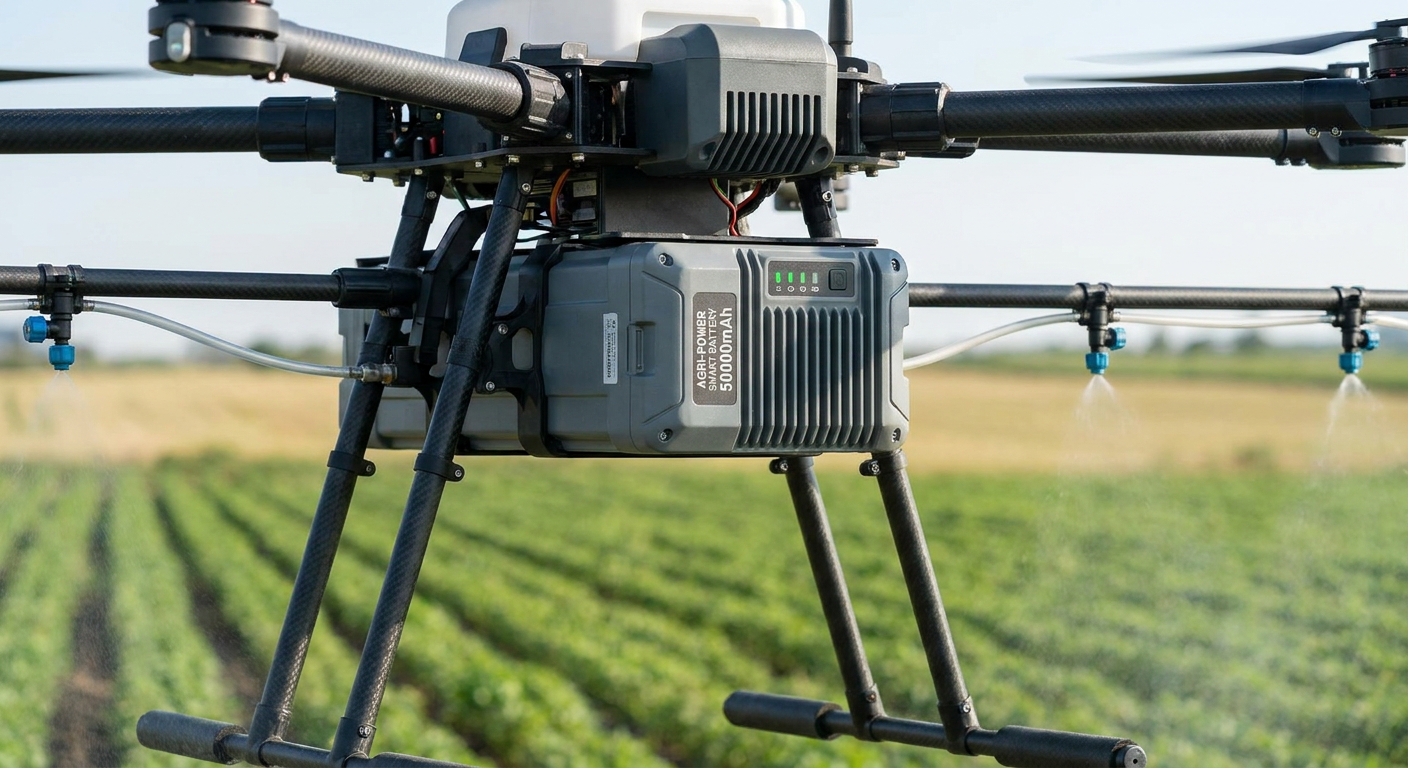
When evaluating lithium power systems for commercial unmanned aerial vehicles (UAVs), procurement managers and engineering leads frequently focus on a single laboratory metric: gravimetric energy density, expressed in watt-hours per kilogram (Wh/kg). On a specification sheet, a higher Wh/kg rating promises longer hover times and extended mission range.
However, field operations tell a different story. In demanding commercial applications—such as agricultural crop spraying, heavy cargo transit, and powerline inspection—relying solely on energy density can lead to operational bottlenecks. Poorly matched battery systems may experience premature voltage sag under full payload acceleration, thermal throttling during back-to-back field sorties, and premature capacity degradation under aggressive commercial duty cycles.
Commercial UAV productivity is not measured by empty hover duration; it is measured by mission completion rate, daily hectare or kilometer coverage, and total lifetime operating cost. Energy density is only one part of UAV battery performance. For commercial operations, the right battery is the one that balances payload capability, power output, thermal stability, cycle life, charging efficiency, safety, and total operating cost.
Why Energy Density Alone Does Not Define UAV Battery Performance
Gravimetric energy density measures how much electrical energy a battery cell stores relative to its mass. While increasing active chemical mass raises theoretical capacity, some high-energy-density designs may involve trade-offs in internal resistance (IR) and sustained high-rate performance.
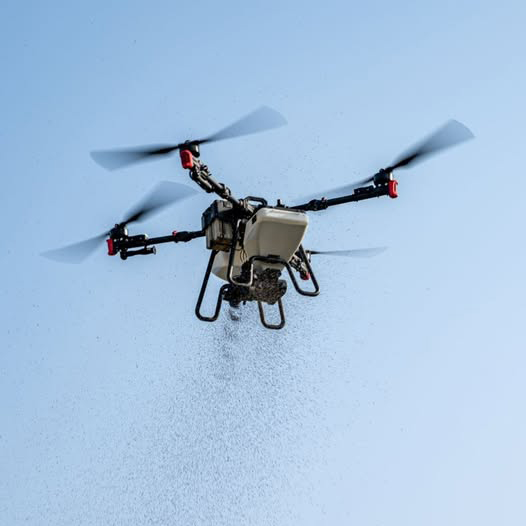
When a commercial drone—such as large agricultural spray drones carrying significant payloads—takes off with a full payload or counters gusty headwinds, the electric speed controllers (ESCs) demand high continuous current. When high continuous current is required, elevated internal resistance causes rapid resistive heating and a severe terminal voltage drop. As a result, the aircraft may suffer from premature voltage sag, triggering early low-voltage Return-to-Launch (RTL) warnings and accelerating chemical degradation long before the mission is complete.
Battery sizing is fundamentally a system optimization challenge. Adding a heavier, high-capacity pack to gain nominal flight time increases the aircraft’s Maximum Takeoff Weight (MTOW). Because rotary thrust power demands scale non-linearly with gross weight, motors must draw substantially more current merely to stay airborne. This reduces the usable energy available during missions and may force operators to return before completing planned operations.
7 Key Factors UAV Buyers Should Compare Beyond Energy Density
To ensure fleet reliability, commercial buyers must look beyond headline Wh/kg figures and evaluate packs across seven integrated engineering dimensions.
1. Energy Density and Payload Efficiency
While Wh/kg measures energy per unit mass, commercial UAV engineers must also account for volumetric energy density (Wh/L) and net payload ratio. A battery pack may offer high gravimetric density, but if its physical volume or weight distribution compromises the aerodynamic profile or center-of-gravity (CG) envelope, total flight efficiency degrades.
For heavy-lift industrial platforms, net payload efficiency is defined by usable mission flight time under full payload, rather than unladen hover time. Buyers should evaluate how effectively a pack balances structural enclosure weight with internal cell packaging density, ensuring that high energy density translates directly into usable mission output.
2. Discharge Capability and Peak Power Output
A battery’s discharge capability is dictated by its continuous and burst C-ratings. C-rating defines how fast a pack can be discharged relative to its maximum capacity. Commercial UAV missions demand sustained power delivery across distinct flight phases, depending on aircraft class and mission profile:
Takeoff and Launch: Full payload launches demand high burst current spikes.
Maneuvering & Wind Holding: Maintaining grid track in strong winds requires continuous thrust adjustments.
Mission Cruise & Spraying: Commercial and agricultural drones require stable continuous discharge throughout the sortie.
If a battery cannot sustain the required C-rate, voltage sag occurs. According to UAV power delivery vs energy density analysis, voltage sag reduces the effective voltage supplied to the ESCs, forcing the system to draw even higher current to maintain motor RPM. This feedback loop accelerates thermal buildup and reduces motor torque efficiency.
3. Thermal Performance in Real Operating Conditions
Thermal management is often the deciding factor in commercial battery survival. In regions like Southeast Asia, Latin America, or the US Sunbelt, ambient field temperatures during peak operational seasons routinely exceed 35°C to 40°C.
During high-rate discharge, internal cell resistance converts electrical energy into heat. If internal core temperatures exceed 60°C:
The solid electrolyte interphase (SEI) layer on the graphite anode begins to decompose.
Gas generation accelerates, causing soft-pack pouch swelling or structural cell distortion.
Electrolyte oxidation reduces ionic conductivity, permanently elevating internal resistance.
Buyers should request thermal test data, including temperature rise curves under representative continuous discharge conditions at elevated ambient temperatures. A high-quality commercial pack should maintain a controlled internal temperature rise without active cooling.
Packs equipped with carbon-coated current collectors, specialized heat-dissipating silicone pads, or internal aluminum heat sinks maintain lower internal resistance across wide temperature windows, mitigating thermal runaway risks.
4. Cycle Life and Capacity Retention
Initial purchase price becomes irrelevant if a pack loses 30% of its capacity after 150 flights. Commercial UAV buyers must evaluate cycle life based on the standard 80% State of Health (SOH) threshold—the point at which a battery retains 80% of its original nominal capacity.
Standard consumer-grade LiPo batteries typically degrade to 80% SOH within 200 to 250 cycles under heavy commercial use. Conversely, industrial-grade UAV battery packs using optimized cell chemistry, electrode design, and battery management strategies achieve 450 to 600+ operational cycles under identical duty loads.
Battery Category | Chemistry / Cell Type | Typical Cycle Life (to 80% SOH) | Operational Context & Performance Impact |
|---|---|---|---|
Standard Consumer Pack | Conventional High-C LiPo / LiHV | 200–250 cycles | High initial power output but faster thermal & capacity degradation under heavy duty cycles. |
Commercial Industrial Pack | Optimized Li-ion / Advanced LiPo | 450–600+ cycles | Engineered with custom BMS, low IR, and thermal management for high-frequency mission stability. |
In an agricultural drone battery field evaluation, extending pack service life from 200 to 500 cycles directly cuts annual battery replacement expenditure by more than 50%, transforming operational margins for fleet operators.
5. Charging Speed and Mission Turnaround
For commercial operators, ground downtime represents lost revenue. In agricultural spraying, crew efficiency depends on keeping the aircraft airborne continuously. This requires a rapid battery swap and charge rotation cycle.
To sustain continuous operation with a three-pack rotation scheme (one in flight, one cooling, one charging), batteries must support field-side fast charging at 2C to 3C rates (fully charging a pack in 15 to 25 minutes).
However, fast charging introduces electrochemistry risks:
Lithium Plating: Charging at high rates when cell temperatures are below 15°C or above 45°C causes metallic lithium to deposit on the anode surface, creating internal micro-short circuits.
Cell Imbalance: High charge currents amplify small capacity variances between series-connected cells, leading to thermal hot spots.
Buyers should verify whether the battery chemistry supports high-rate fast charging without triggering unwanted internal degradation, and whether the pack enclosure integrates robust protection against harsh field environments.
6. Safety Margin and Battery Management System
The Battery Management System (BMS) acts as the central nervous system of a commercial UAV power pack. A basic protection board is insufficient for industrial fleets; commercial packs require a smart BMS with precise telemetry algorithms and robust hardware safeguards.
Key BMS requirements include:
High-Precision SOC & SOH Tracking: Coulomb-counting algorithms combined with open-circuit voltage (OCV) modeling to provide accurate State of Charge under dynamic load conditions.
Active and Passive Balancing: High-current balancing circuits to ensure all cell voltages remain within a 15mV window during both charge and discharge cycles.
Integrated Telemetry Protocols: Support for standardized communication interfaces (CAN bus, SMBus, UART) that transmit real-time cell temperatures, individual cell voltages, current draw, and historical error logs directly to the flight controller (such as ArduPilot or PX4).
Physical Safety Safeguards: Flame-retardant V-0 rated enclosures, anti-vibration potting, and over-current, over-voltage, short-circuit, and thermal cut-off protections.
As noted in commercial drone battery system reliability studies, High-availability commercial fleets require battery systems that minimize unexpected downtime and mission interruptions.
7. Total Cost of Ownership (TCO)
Evaluating a battery only by its upfront purchase price is a common procurement mistake. For commercial UAV operations, the more meaningful metric is the total cost generated throughout the battery’s service life.
The following model (based on 14S 22,000mAh packs, 15-minute average commercial mission profiles, and standard generator field-charging costs) illustrates how different battery characteristics influence lifecycle cost. Actual results vary depending on aircraft configuration, mission profile, climate conditions, and operating practices.
TCO per Flight Hour = (Battery Purchase Cost + Charging Cost) ÷ (Usable Cycle Life × Average Flight Duration)
This calculation helps buyers compare the real operating cost rather than only the initial battery price.
Evaluation Metric | Standard High-Density Pack | Commercial Industrial Pack | Financial & Operational Impact |
|---|---|---|---|
Initial Purchase Price (per pack) | 450 USD | 580 USD | +28.8% upfront capital investment |
Rated Gravimetric Energy Density | 270 Wh/kg | 240 Wh/kg | Standard pack is 12.5% lighter on paper |
Sustained C-Rating (Continuous) | 8C (Voltage sag under load) | 15C (Stable voltage curve) | Industrial pack delivers full torque without early RTL |
Tested Cycle Life (to 80% SOH) | 220 cycles | 550 cycles | +150% longer operational lifespan |
Field Charge Time (2C Rate) | 35 min (Throttles due to heat) | 18 min (Controlled thermal rise) | Cuts ground swap queues by 48% |
Packs Required per Drone per Year | 6.8 packs | 2.7 packs | Standard pack requires ~2.5x more replacements |
Total 2-Year Battery Fleet Cost | 61,200 USD | 31,320 USD | Saves 29,880 USD in fleet OPEX over 2 years |
Effective Battery Cost per Flight Hour | 10.20 USD / hr | 5.22 USD / hr | 48.8% reduction in hourly operating cost |
A Practical Commercial UAV Battery Selection Checklist
When preparing Requests for Proposals (RFPs) or evaluating supplier samples, commercial fleet managers and OEM engineers can use this checklist to audit battery readiness.
Evaluation Area | What Buyers Should Verify |
|---|---|
Energy Density | Does the battery meet required payload and endurance targets without compromising structural balance? |
Power Capability | Can it maintain stable voltage during continuous cruise and peak current demands? |
Thermal Performance | Is thermal test data available under realistic operating and ambient temperatures? |
Zyklus Leben | How well does capacity retention hold up after repeated commercial mission cycles? |
Charging Capability | Can the field-charging speed support required fleet turnaround and swap schedules? |
BMS Integration | Is the telemetry communication compatible with the target flight control architecture? |
Compliance | Are all necessary UN38.3 transport certifications and safety documentations available? |
Choosing the Right UAV Battery Partner for Long-Term Operations
Selecting a commercial UAV battery goes beyond comparing pack specifications; it requires evaluating the engineering capabilities of the manufacturing partner. Battery suppliers vary significantly in their engineering and production standards.
For mission-critical applications, operators require an energy partner with complete internal manufacturing control and custom design capabilities:
Vertical Integration (Cell to Pack): Manufacturers with stronger cell-to-pack engineering capabilities can better optimize battery performance, consistency, and customization.
Turnkey OEM/ODM Engineering: Commercial UAV platforms often require non-standard form factors, integrated structural enclosures, or specialized BMS communication protocols. Working directly with an established engineering team accelerates prototype validation and mass production ramp-up.
Audit-Friendly Compliance & Quality Control: Industrial fleets depend on strict batch-to-batch consistency. Enterprise suppliers maintain comprehensive quality management systems certified to ISO9001, ISO14001, and ISO45001 standards, supported by full UN38.3 transport certification and CE/UL compliance documentation.
For UAV OEMs and commercial operators, battery selection is not only a component decision—it is a system reliability decision. Working with an experienced UAV battery manufacturer can reduce development risks and improve long-term operational performance.



 Deutsch
  English
  Español
  한국어
한국어  Français
  日本語
日本語  Русский
  Bahasa Indonesia
  ไทย
ไทย  العربية
  Português do Brasil
  Italiano
  Nederlands