





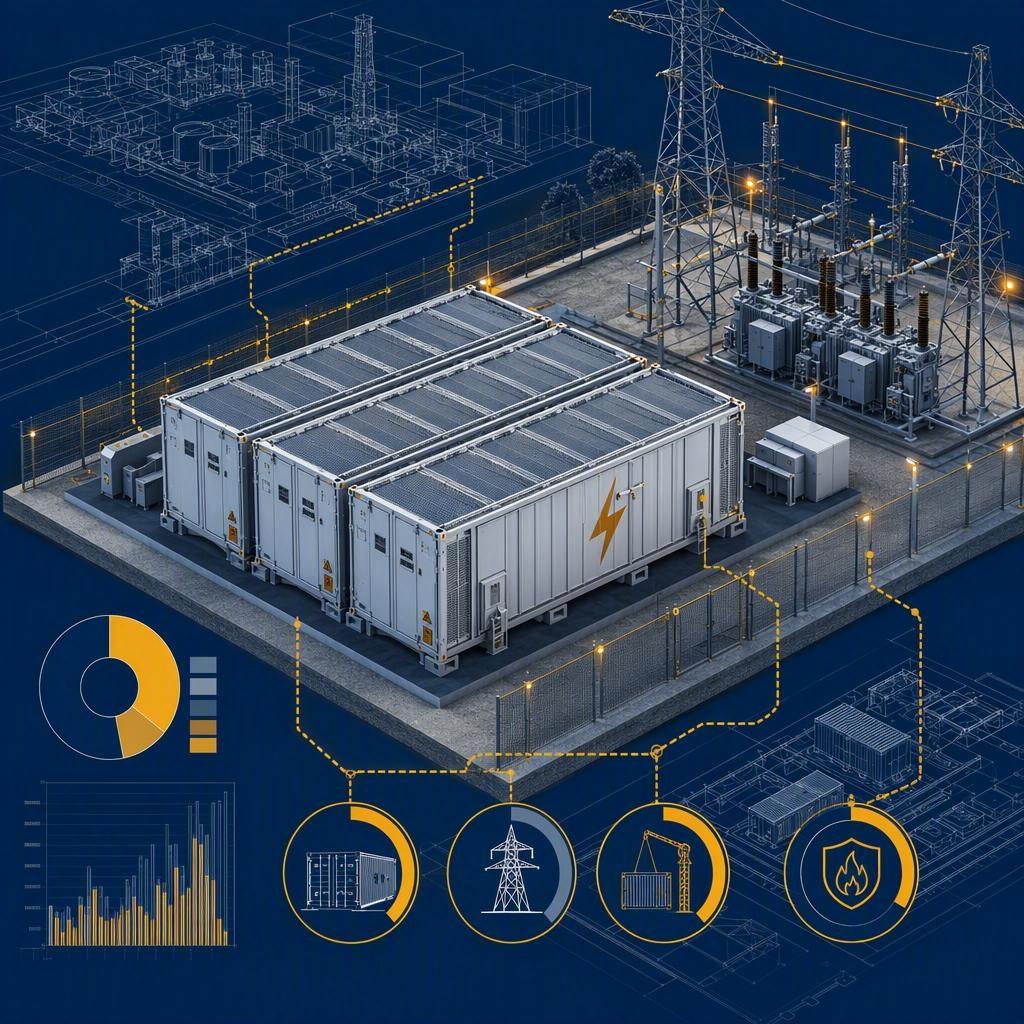
Two commercial energy storage systems can carry the same nameplate capacity and land at similar battery pricing, yet finish the project with very different final costs. That gap is rarely explained by the cells alone. It comes from everything that turns a battery module into a working, permitted, grid-connected asset.
Safety systems, site conditions, grid connection, EPC work, certification, and maintenance all move the number. If you evaluate suppliers on the battery price alone, you are comparing one line of an estimate as if it were the whole budget. This guide explains why quoted hardware price and final project cost diverge, and how to compare ESS suppliers on what actually matters.
Why kWh and Battery Price Are Not Enough
kWh defines the energy capacity of the system, but it does not tell you how much energy is actually usable under your operating conditions. Battery price per kWh describes one part of the equipment cost — the cells, modules, and perhaps the pack that carries them.
Neither figure describes the whole project. A complete commercial battery storage project also pays for power conversion, energy management, thermal control, fire protection, enclosure, site preparation, electrical integration, grid interconnection, engineering, permitting, commissioning, and long-term operation. These add up to what the industry calls soft costs — the non-hardware spend for design, siting, permitting, installation, and interconnection that the U.S. Department of Energy separates from equipment cost.
In practice, soft costs can represent a large share of the budget. The exact percentage depends on the project — its size, location, and grid connection — but the point holds across markets: the battery price covers only part of the total cost. These project-specific costs can have a major impact on the final budget.
When chemistry choice enters the picture, the LFP vs NMC trade-off on TCO and risk is a good example of how equipment selection only starts the conversation.
What Really Affects Commercial ESS Project Cost
Five factors separate a project that installs cleanly from one that quietly expands through change orders and re-engineering. Together they determine the difference between a hardware quote and a realistic total installed cost.
Safety & Thermal Management
System safety depends on how the battery is integrated, monitored, cooled, and protected — not just on its cell chemistry. The difference sits in the design around the cells: the management system that monitors them, the controls that keep them inside their operating window, and the protection that answers an event if one occurs. Those choices affect equipment cost, installation requirements, and project risk, not the cell price alone. Thermal management also needs to match the site’s climate and operating profile, which makes liquid-cooled ESS cabinets relevant for hot-weather sites.
The key buying question is straightforward: does the supplier treat safety as a cell specification or as an integrated system design? The second is what a project actually pays for. A practical C&I BESS selection guide covers how to verify usable capacity, safety layers, and O&M terms before you shortlist.
Site & Grid Requirements
A system with the right capacity may still be wrong for your site. Product match and project match are not the same thing.
Grid connection is usually the first place this shows. A project needs enough available electrical capacity at the point of interconnection, and it may require transformer or switchgear upgrades to get there. Whether you connect at low voltage or medium voltage changes both the scope and the schedule. Utility interconnection studies and fees can take longer — and cost more — than the hardware does.
The physical site matters too. Indoor placement raises ventilation and fire-code demands; outdoor placement adds weather proofing and containment. Available floor space, ambient operating temperature, and the state of the existing electrical infrastructure all shape what has to be built before the system can operate.
Ask a supplier how the system maps to your actual site, not just to your energy target. A product that matches a datasheet but forces a transformer upgrade or a new pad is a different project cost than one that drops into the space you already have.
EPC & Installation
Equipment price is not installation price. This is the most common place that budget estimates come apart.
Site preparation, foundations, cabling, earthing, trenching, crane access, and the labor to set the equipment all add up. Electrical work — connecting the system to the distribution panel, running conductors, installing metering and protection — is separate from the battery hardware entirely. Commissioning, where the system is energized and validated against its performance targets, is another distinct line.
The engineering, procurement, and construction (EPC) scope ties all of this together. When you compare quotes, the question is not what the battery costs but what is included in the installation package. An “installed” quote that excludes site prep, grid connection, and commissioning will look attractive right up to the moment the change orders start.
Certification & Compliance
Certification requirements depend on the target market, system configuration, and the local authority having jurisdiction. There is no single universal list, so it is best raised early rather than discovered late. For a commercial ESS, that commonly means system-level safety listings and fire-test data — examples include UL 9540 and UL 9540A in North America, NFPA 855 guiding installation, and IEC 62619 for industrial lithium batteries. What applies to your project depends on where it is built and how the authority interprets the code.
Compliance affects cost in two ways: proving it is a budget item in itself, and fire-test results shape the required site protection — spacing, barriers, gas detection, ventilation, suppression — which can change the civil scope. Buyers should ask suppliers which certifications and test reports apply to the complete system, not simply the cells, and require them to show the evidence. If they cannot, budget for the uncertainty yourself.
Operation & Maintenance
Project cost does not stop on installation day. It extends across the life of the asset, and O&M is where many projects quietly lose money.
For a buyer, three terms carry most of the weight: the warranty and how capacity loss is measured, the service response that determines how long a fault keeps the system offline, and spare parts availability that protects uptime over ten years or more. Two systems with identical purchase prices can have very different lifetime cost on these points. The question is not whether a warranty exists but what it covers, how degradation is verified, and who responds when the system stops performing.
How to Compare ESS Suppliers Beyond $/kWh
If battery price is not the right lens, the practical question becomes what to ask instead. The table below turns the five factors into a comparison you can run across suppliers. Send the same questions to each one and compare the answers side by side.
Area | What to Ask |
|---|---|
Capacity | What is the usable energy, after depth-of-discharge, temperature, and auxiliaries? |
Sicherheit | How are thermal events detected and mitigated at the system level? |
Installation | What site preparation and electrical work does the project require? |
EPC | What is included vs. excluded in the quotation? |
Compliance | Which certifications apply to this system in your target market? |
O&M | What service, monitoring, and warranty terms are included? |
Kosten | What is the estimated total installed cost for your site? |
Three of these rows matter most: EPC scope, compliance, and total installed cost. The goal is to make sure every supplier is pricing the same project scope, not a looser version that looks cheaper at first glance.
Use the same site inputs for every supplier: voltage level, transformer headroom, interval load data, and fire requirements. When a vendor cannot define what is included or what operational data can be audited, treat that as a signal, not an inconvenience.
Look at Total Installed Cost, Not Just Battery Price
The full project cost is wider than the battery line: Equipment + Site Work + EPC + Compliance + Commissioning + O&M
Every one of those terms can be engineered down or up. A low battery price does not help if the site work, grid connection, compliance, or service cost is high enough to swallow the saving.
What to bring into supplier discussions is simple: the lowest battery price does not always mean the lowest project cost. A supplier that prices the cells aggressively but pushes site risk, certification, and commissioning onto you is shifting cost, not reducing it. A partner that brings a system already engineered for deployability — verified thermal and fire performance, clean grid integration, defined EPC scope, and honest O&M terms — can deliver a lower and more predictable total project cost, even when its cell price is not the lowest.
kWh remains important, but it is only the starting point. It sizes the system; it does not price the project.For commercial energy storage, evaluate safety, site requirements, EPC, compliance, installation, and lifecycle service together — not as footnotes to a battery quote, but as the substance of the cost. Do that, and the comparison stops being about which supplier has the lower price per kWh and becomes about which supplier delivers the lower total installed cost for your site.
If you are evaluating a project, our team can help evaluate battery configuration, system requirements, and project-specific considerations with you.




 Deutsch
  English
  Español
  한국어
한국어  Français
  日本語
日本語  Русский
  Bahasa Indonesia
  ไทย
ไทย  العربية
  Português do Brasil
  Italiano
  Nederlands