


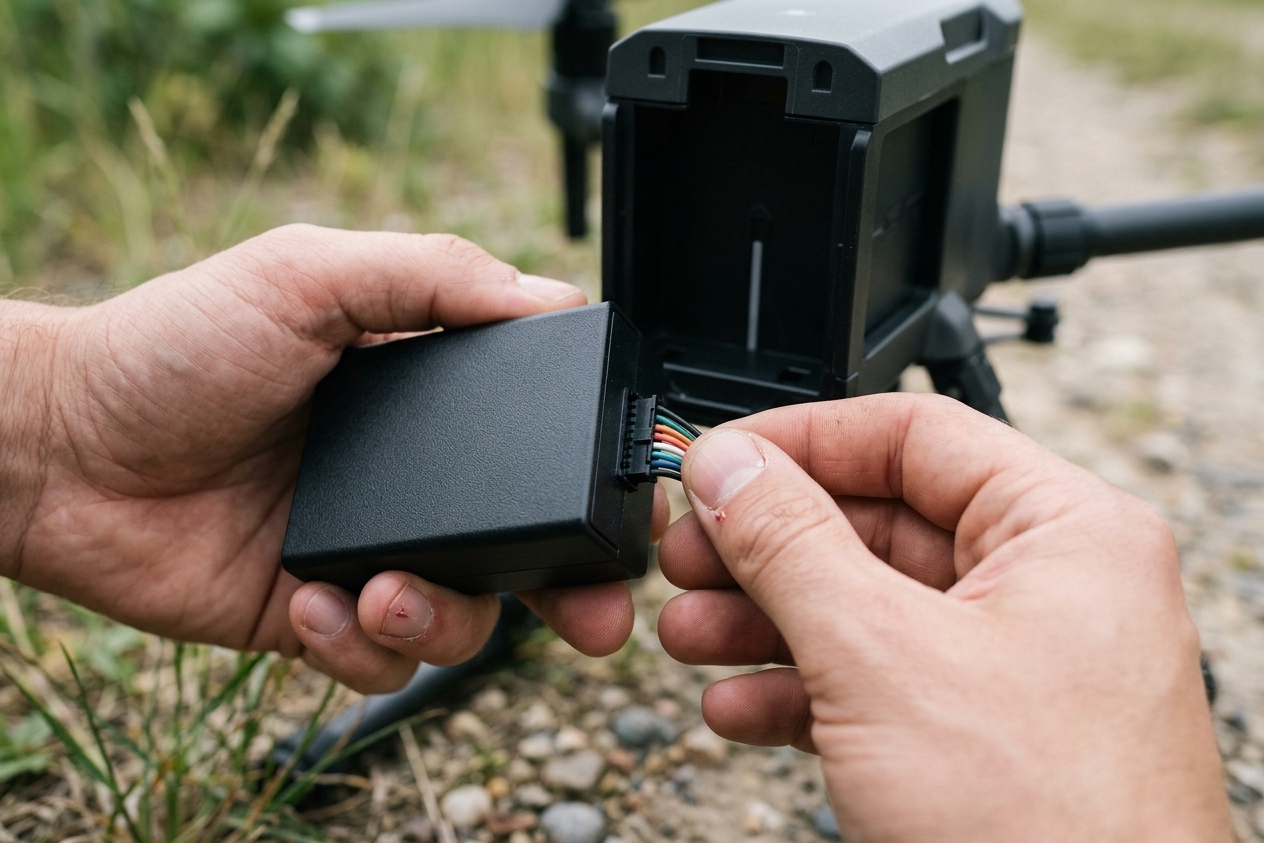
Prototype success is a real milestone: the UAV lifts, climbs, hovers, and completes a full mission profile without brownouts or early low-voltage cutoffs.
But it can also be misleading.
A prototype proves one pack can work. Production proves a distribution can work—across lots, operators, temperatures, and edge-case bursts.
When you scale up, small differences in cell capacity and resistance, joint quality, connector losses, sensing accuracy, and firmware tolerances can stack up until the worst-case packs exceed your flight system’s margins.
This guide explains why prototype UAV batteries can pass validation yet underperform in production, how those gaps show up in flight, and how UAV OEM teams can evaluate whether a battery partner can support reliable scale.
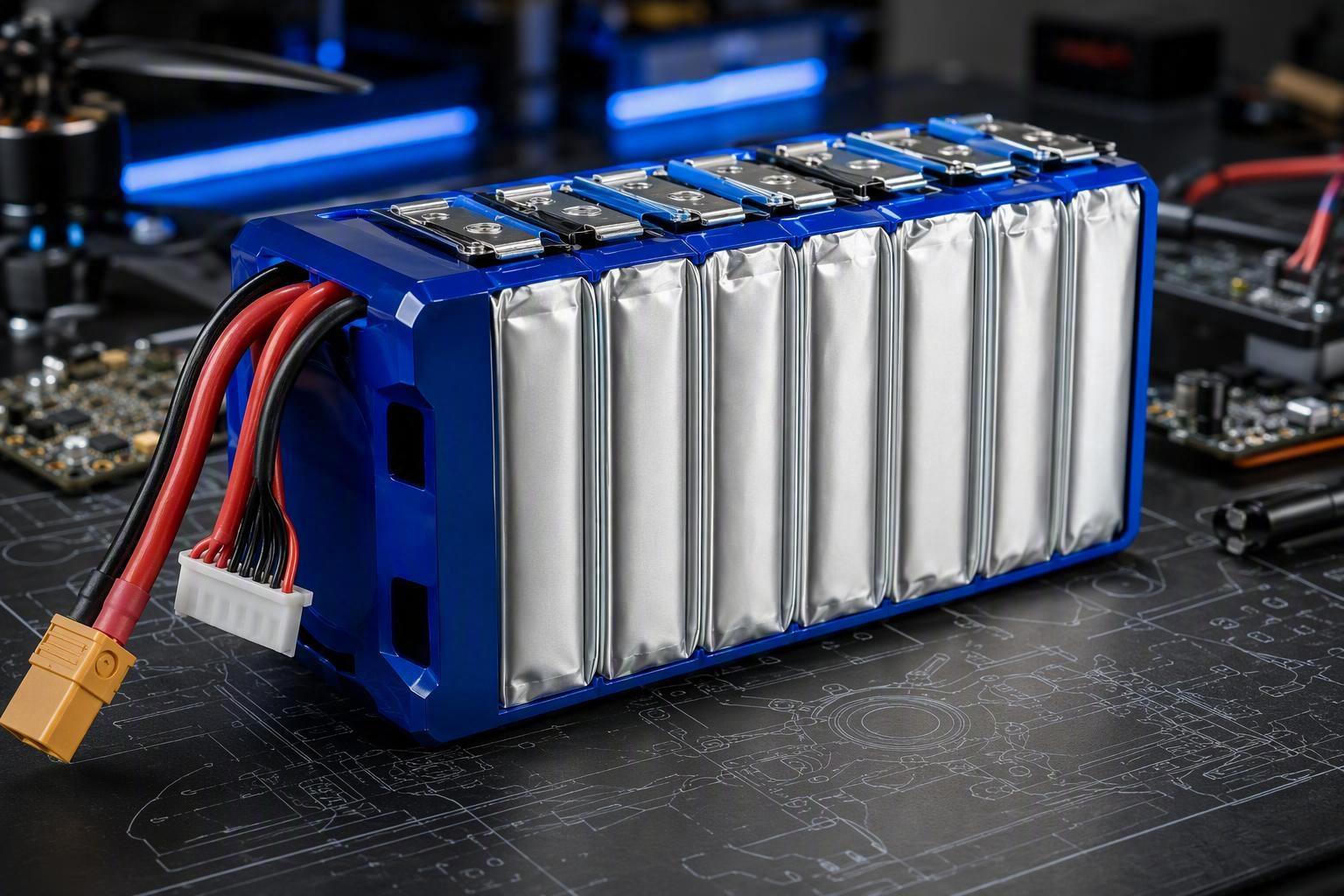
Production-ready UAV batteries are defined by variation control across thousands of units—not just chemistry.
Why prototype battery performance changes in production
A typical prototype build quietly includes “unwritten advantages”:
Cells are hand-selected or tightly matched.
Assembly is done by experienced technicians with extra attention per unit.
The harness and connectors are fresh and pristine.
Test conditions are controlled, repeatable, and often gentler than field reality.
Mass production replaces these advantages with statistical tolerances. Every step has a distribution. The pack’s delivered performance is constrained by the tails of those distributions—especially in high-discharge UAV duty cycles.
Battery programs scale successfully when suppliers can shift averages 그리고 tighten distributions—not just hit a nominal spec on a single build.
1. Cell consistency: the first limit of production performance
When teams say “the same battery model behaves differently,” the root cause is often cell-level spread—capacity, resistance, and aging—amplified by a pack architecture that’s sensitive to outliers.
Cell-to-cell variation exists in every production environment—what matters is whether your pack design and your supplier’s controls keep that variation inside your flight margins.
Capacity variation affects flight time
In a series string, usable energy is capped by the lowest-capacity cell (or the weakest parallel group, depending on architecture). In prototype builds, engineers often match cells tightly enough that this cap is invisible.
In production, wider capacity spread means some packs hit low-voltage limits earlier than expected. The result looks “random” from the outside: a subset of packs shows less reserve margin, more mission aborts, and less predictable endurance.
In practice, the fix is rarely a single spec tweak—it’s lot-to-lot control plus clear acceptance limits on what gets built into packs.
Resistance variation limits power output
UAVs are not gentle loads. Takeoff bursts, rapid climb, gust recovery, and payload transients push high current. Under these conditions, resistance spread is often more damaging than capacity spread.
In a UAV, resistance is a “tax” you pay every time you ask for current. At takeoff current, a few extra milliohms can turn into enough voltage sag to trip low-voltage logic—and enough heat to accelerate drift.
Think of it this way: voltage sag scales with current (ΔV = I × R), and heat rises with the square of current (P = I² × R).
So small resistance differences that are irrelevant in a bench “steady draw” test can become decisive in a dynamic mission profile.
If you’re qualifying a supplier for this pack class, ask for lot-level distributions (not just averages) for capacity and DCIR/ACIR—ideally with histograms, acceptance limits, and a clear plan for handling outliers.
Aging differences reduce fleet reliability
Prototype UAV batteries usually get evaluated on “day-one” behavior.
Production fleets fail in month three.
Even if packs ship within spec, aging can diverge quickly when cell consistency, thermal paths, and current distribution aren’t tightly controlled. The result is a fleet where some packs remain stable while others drift into early cutoffs, higher sag, or thermal derating.
2. Electrical integration: small resistance changes become big power losses
At UAV currents, the electrical path is part of the battery. If your prototype used one harness and one connector set, you validated one instance. Production validates the spread.
Voltage drop under high current loads
The pack’s apparent “battery sag” is the combined drop across:
cell internal resistance
busbars and tabs
weld interfaces
connector contact resistance
cables and crimps
Any extra milliohms become heat and lost voltage at high current.
Similar principles apply in UAV packs, where every milliohm matters during high-current events (see Welding — eMobility Engineering).
How this shows up in field failures:
The first high-current event after takeoff looks fine on the bench, then triggers a sharp sag → the flight controller flags undervoltage → mission abort.
One pack runs noticeably hotter than the rest at the same power.
A pack “passes” a low-current bench test but fails on real bursts.
Connector and assembly variation
Connector and assembly variation comes from practical differences—how joints are welded, how crimps are made, how cables are routed and strain-relieved, and how connectors are installed and verified.
What matters to you is the UAV symptom: a few extra milliohms turn into unexpected sag, heat, and early cutoffs during bursts.
If you’re scaling this design, ask what process controls and records exist for welding and crimping quality (and any torque-controlled joints), and what is traceable per serial number.
Prototype UAV batteries and end-of-line testing: what EOL can and can’t prove
EOL testing is designed to catch clear defects before shipment. It does not prove mission-level behavior under burst loads.
If a supplier says “we do 100% EOL,” ask what is measured, what the acceptance limits are, and how measurement repeatability is validated (see Types of Tests — battery testing in manufacturing production (InfinitaLab, 2022)).
3. BMS and system validation: make behavior predictable
A BMS can’t “fix” bad cells or poor joints, but it determines whether variation becomes a controlled derate—or an unexpected shutdown.
For industrial UAVs, the BMS isn’t only a protection layer—it’s the data bridge between the battery and the flight controller.
When SOC/SOH estimates and safety protections are consistent and well-validated, the aircraft can make smarter decisions instead of reacting to surprises.
There’s one more “silent amplifier” worth mentioning: power integrity and signal integrity. Noise on power rails or communication lines can make measurements look worse than they are—and push a system over the edge during transients.
Accurate monitoring and protection logic
In prototypes, it’s common to tune thresholds on a small sample and call it done.
In production, validate the things that create “random” flight events:
measurement accuracy across temperature (cell voltage + current)
protection behavior during fast transients
balancing behavior across the distribution
If you want to see this before you commit, ask for a validation plan showing accuracy, threshold tolerance corners, and protection behavior across temperature.
Communication and integration testing
For industrial UAVs, the battery is increasingly a data source. If the BMS communicates with the flight controller (CAN / DroneCAN / proprietary), validation must include:
message timing under load
consistent fault reporting
graceful degradation when comms degrade
integration tests with your real flight stack
This is where prototype teams often get fooled: a single “happy path” integration works, while edge cases (thermal derate, low-voltage threshold crossings, sensor noise) aren’t tested against the flight controller’s logic.
Warning: If your flight controller’s low-voltage logic was tuned on prototype packs, scaling up without re-validating against production distributions is a predictable way to create “random” field brownouts.
How UAV OEMs should evaluate a battery partner before scaling production
Use this as a decision checklist. The goal isn’t to “audit” a supplier—it’s to confirm whether they can control variation, document it, and support integration without surprises.
What to verify before you sign off production
Minimum evidence to request:
Cell-lot distributions (capacity + DCIR/ACIR), plus acceptance limits and outlier handling
Pack traceability: which cell lots went into which serial numbers
Electrical build controls: weld/crimp parameters, inspection records, and rework rules
End-of-line testing: what is measured (OCV, impedance, insulation), acceptance limits, and gauge repeatability
Integration validation artifacts: comms tests with your flight stack, fault handling, and temperature corner testing
A good partner can show you not only test results, but also the decision rules behind them—what triggers containment, what triggers a design change, and what triggers a lot hold.
For example, a partner should be able to describe how it supports OEM drone programs end-to-end (cell-to-pack, traceability, and integration).
Also note UL’s manufacturing risk reduction guidance: cleanliness, moisture control, and disciplined process gates reduce latent defects and drift (see UL’s Lithium-ion Manufacturing and Risk Reduction).
If your UAV program needs a custom mechanical envelope, connector, or BMS behavior, Herewin’s team can help you clarify requirements, review flight-load assumptions, and map out a validation plan—before you commit to scale. (Contact our team).
Diagnosing “prototype passes, field fails” quickly
If you are already in the failure state, prioritize separating cell limits from integration losses.
A fast triage sequence:
Measure voltage at the pack terminals under the real burst load (not only at the flight controller).
If sag at terminals is high, suspect cell resistance spread or SoH spread.
If sag at terminals is acceptable but sag at the controller is worse, suspect harness/connectors/weld interfaces.
Compare temperature rise at tabs/connectors across multiple packs—hotspots often reveal the outliers.
This prevents weeks of chasing “chemistry” when the issue is actually distribution tails in assembly or integration.
Treat prototype results as a sample, not proof of scale
If a UAV platform passes prototype testing but fails at production scale, the common mistake is assuming the prototype represents the full production distribution.
Production-ready UAV batteries are defined less by a chemistry label and more by variation control:
tight cell consistency with lot-level evidence
controlled electrical interfaces with recorded process parameters
BMS behavior validated against temperature and tolerance corners
traceability and change control that survive real fleet use
If you share your target voltage range (e.g., 12S/14S/18S), peak current profile (takeoff burst + sustained), and your flight controller’s low-voltage logic, We can help you translate those inputs into clear acceptance criteria and a practical validation approach—so your production scale-up doesn’t get derailed by “random” brownouts or early cutoffs.

 한국어
한국어  English
  Español
  Deutsch
  Français
  日本語
日本語  Русский
  Bahasa Indonesia
  ไทย
ไทย  العربية
  Português do Brasil
  Italiano
  Nederlands