






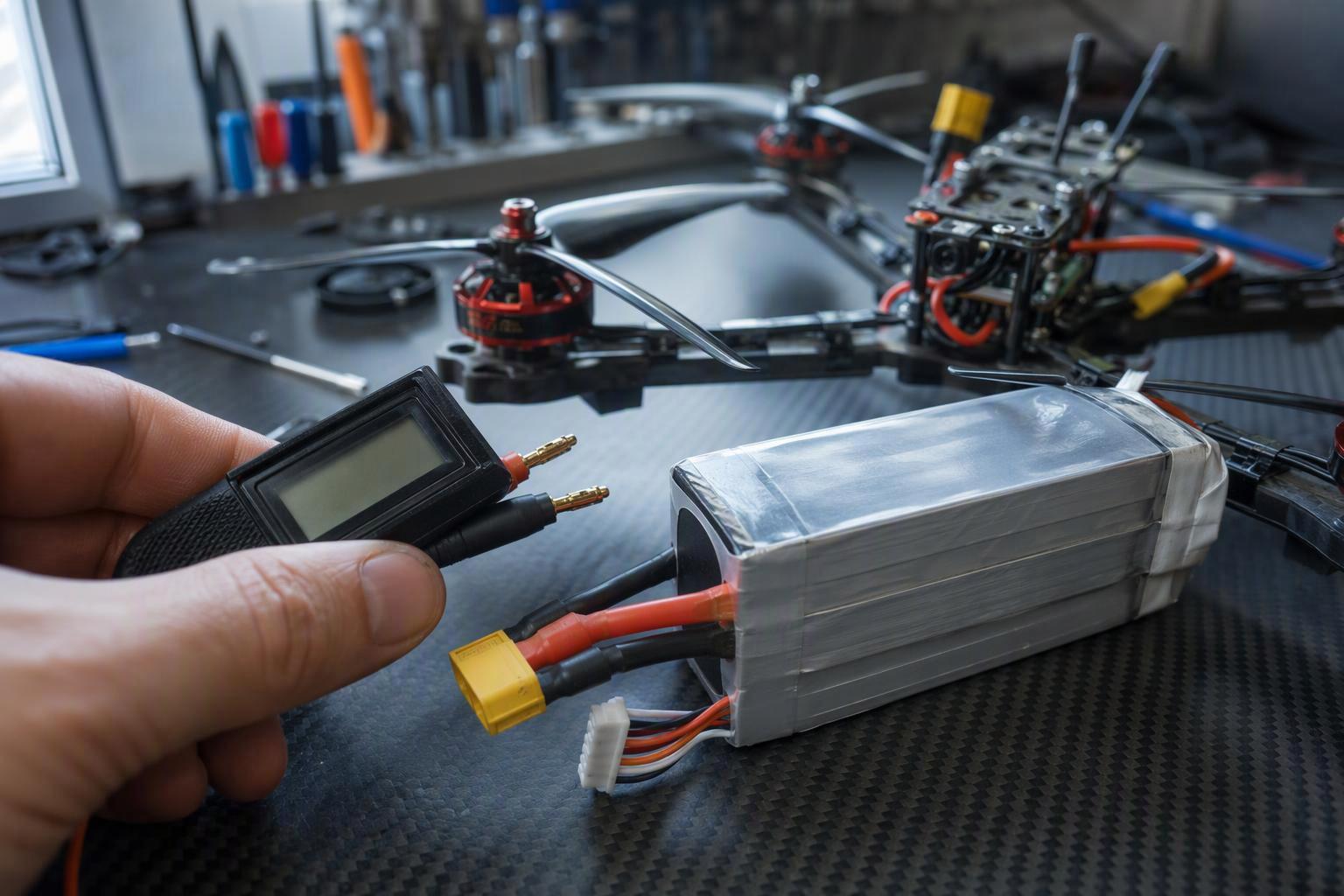
C-rating for drone batteries is the multiplier used to convert a pack’s rated capacity into a rated discharge-current capability, and it becomes useful only after you know how much current the aircraft actually needs. Capacity tells you how much charge the pack stores; C-rating tells you how quickly that rated capacity can be discharged. Together they set the rated current capability. That relationship gives you a single conversion you will use throughout this guide:
Rated current (A) = capacity (Ah) × C-rating
A 2.0 Ah pack rated 30C, for instance, corresponds to a rated 60 A continuous current capability.
That is a rated figure, not a validated one — and that gap is the whole point, because it’s why a high C-rating is not a qualification decision. The rest of this guide turns your aircraft’s current demand into a C-rating you can actually specify, and shows what a datasheet number still leaves unproven.
A datasheet C-rating is rated capability, not validated pack capability. Treat it as an input to your calculation, never as the answer to it.
What Is C-Rating in a Drone Battery?
Think of C-rating as the multiplier behind a battery’s discharge-current capability: it relates a pack’s capacity to the rate at which that capacity can be discharged, not how much energy the pack holds. The “C” stands for capacity, so the number on a datasheet is a rated capability rather than a promise about how the pack will behave in your aircraft. That distinction matters because it separates what the cell is allowed to deliver from what your drone will actually draw.
What 1C, 10C and 20C Mean
A 1C discharge corresponds theoretically to a one-hour discharge rate, 10C to six minutes, and 20C to three minutes. The multiplier means little until you convert it into amps, and that conversion is where most datasheet confusion starts. The same current becomes more demanding as the pulse lasts longer, because heat accumulates and the battery’s voltage response can change with temperature, SOC and internal resistance. A 60 A draw for three seconds and a 60 A draw for three minutes are not the same demand on the pack.
How to Calculate Current From C-Rating
To calculate C-rating in amps, multiply capacity in amp-hours by the C number. The formula also requires a unit conversion that is easy to overlook: 5,000 mAh is 5.0 Ah, not 5,000. A smaller pack with a higher C number can therefore deliver less current than a larger pack with a lower one, which is the first sign that comparing C numbers alone will mislead you.
Continuous vs Peak C-Rating: What Is the Difference?
Continuous vs peak C-rating describes two different current regimes, and supplier datasheets do not always define both with the same level of detail. Continuous and burst ratings describe different operating regimes: continuous discharge refers to a sustained load held within defined limits, while burst discharge refers to a higher load over a defined short-duration window. Which regime a number describes changes what it means for your aircraft.
Continuous Discharge Rating
A continuous rating should be interpreted together with the test conditions and limits used to establish it, which may include current duration, temperature, cutoff voltage, voltage-sag limits and other safety or performance criteria. A datasheet that says “continuous 25C” without naming which limit applied leaves you unable to tell whether the pack is voltage-limited, thermally limited, or simply rated to a test window.
Peak or Burst Discharge Rating
Burst ratings are short by design, and a peak discharge rating is meaningful only when the supplier defines the duration of the burst. That window might be 1 s, 5 s, 10 s, or another specified duration, and a burst rating without a defined time period is hard to use for engineering decisions.
Rule of thumb: Never compare peak C-ratings without comparing the peak duration.
Why Peak Duration Matters
Duration changes how much heat the same current generates, because resistive heating scales with the square of current. The thermal loss model is P loss = I²R, a relationship from basic circuit theory that applies to any resistive element, including a battery pack’s internal impedance. Peak current must be evaluated against the pack’s thermal limits under the relevant operating conditions. That limit depends on the chemistry, the pack design and the manufacturer’s own specification, so treating 50C for 3 seconds as equivalent to 50C for 30 seconds ignores the heating curve entirely.
How Much Current Does Your Drone Actually Need?
Drone battery discharge current is set by the aircraft, not by the pack you happen to own. The battery must support the current demanded by the motors, avionics and other loads at a given moment, and the pack’s job is to hold voltage while doing it.
Aircraft demand comes first. C-rating is the battery-side expression of that demand.
The aircraft creates a current requirement; the battery converts that requirement into a required C-rate. That derived figure is the task C-rate you size against — it is defined in full in the next section, but the idea is simply:
Task C-rate = Required current ÷ Battery capacity
Current demand is only half the picture, though. The voltage that arrives at your motors depends on the pack’s resistance under load, and that resistance covers busbars, wiring, connectors and the BMS — not just the cells. The next sections explain why that gap matters; for now the point is simply that demand and delivery are two different questions.
Takeoff, Climb and Hover
Hover and cruise may represent sustained portions of the mission, while takeoff, climb and maneuvering can introduce higher transient current demand. Hover current is what the pack must hold for minutes at a time, while those transients draw a short, much higher spike. Sizing on hover alone leaves no headroom for the phase that actually pulls the pack down.
Payload and Mission Profile
Adding payload raises the thrust required and can increase current demand across the mission. That means battery sizing should use the current profile of the actual payload configuration, not an unloaded aircraft.
Average Current vs Peak Current
Average current helps define the mission’s sustained energy and thermal demand, while peak current determines whether the battery can support the most demanding phases of the mission. A 10-minute flight might average 40 A and still spike past 150 A during a hard climb-out. Averages are useful for estimating sustained demand, but they should not replace the peak-current requirement when sizing the battery.
How to Calculate the C-Rating Your Drone Battery Needs
Calculating the C-rating a drone battery needs means working backwards from your aircraft’s measured current, not forwards from a datasheet number. You need two figures and one duration: the continuous current the airframe draws in steady flight, the peak current it draws in the worst transient, and how long that transient lasts. Divide each current by the pack’s capacity in amp-hours, and you have the continuous and peak C-rates your mission actually demands.
What Is the Task C-Rate?
Task C-rate is the C-rate implied by the aircraft’s actual current demand at the selected battery capacity. It is a property of the mission and the pack you pair it with, not of a datasheet. Two figures define it:
Continuous Task C-rate = continuous current ÷ capacity
Peak Task C-rate = peak current ÷ capacity
Worked through: an airframe that holds 90 A in steady flight and spikes to 180 A needs 18C continuous and 36C peak on a 5 Ah pack, but only 9C continuous and 18C peak on a 10 Ah pack. The aircraft’s demand is fixed; the capacity you choose sets the C-rate you have to meet.
Calculate the Continuous C-Rate
Take the highest sustained current your aircraft pulls in normal flight, then divide by pack capacity in amp-hours. This is the same formula used above, just run in the opposite direction.
Read a rated pack: a 5 Ah pack rated 30C is rated for 5 × 30 = 150 A continuously.
Size a real mission: if your aircraft sustains 90 A during the highest-current operating phase, then 90 ÷ 5 = 18C is the continuous task requirement on that same 5 Ah pack.
The final specification should account for temperature, battery aging, voltage-sag limits and other application-specific operating margins, not just the nominal figure.
Calculate the Peak C-Rate
A peak C-rate is only useful when its duration is specified. A burst figure is defined over a specific window set by the supplier, and a pack that holds 50C for 3 s may not hold it for 30 s. State the window when you write the requirement: “120 A for 8 s at 45 °C pack temperature.”
Turn Aircraft Current Requirements Into a Battery Specification
A C-rate becomes a specification only once you attach the conditions it has to hold under: capacity, continuous C-rate, peak C-rate, peak duration, operating temperature and cutoff voltage, stated together. The worked example below shows why that matters.
Worked UAV Example
Put the whole method on one aircraft. Suppose the airframe draws 120 A continuous and spikes to 180 A for 8 s at the worst transient, and you are considering a 12 Ah pack.
Step 1 — Continuous task C-rate: 120 A ÷ 12 Ah = 10C continuous.
Step 2 — Peak task C-rate: 180 A ÷ 12 Ah = 15C peak, and the peak must hold for 8 s.
Step 3 — A supplier quotes back 20C continuous / 40C peak. On paper, that clears both numbers.
Step 4 — The supplier’s peak test window is only 3 s. Your aircraft needs 8 s.
Step 5 — The headline C-rating alone does not settle the question. 40C for 3 s and 40C for 8 s are not the same pack, and the 20C/40C figure does not tell you whether the pack holds voltage for the full transient.
Step 6 — Request the evidence: an 8 s load test at the operating temperature, the cutoff voltage it was held to, the voltage sag under load, and the BMS continuous and peak current limits.
The fix is not a bigger C number. It is a pack that meets the 10C/15C task C-rate with a validated 8 s peak window at your operating conditions.
Why C-Rating Alone Does Not Prove Battery Performance
A datasheet C-rating describes a rated discharge capability under specified conditions. It does not tell you what the assembled pack will deliver in your aircraft. A high C-rating is often read as a proxy for mission reliability when it is not, and four mechanisms explain the gap.
Voltage Sag Under High Load
Terminal voltage falls below open-circuit voltage in proportion to the current drawn, so the drop is roughly proportional to current. A pack can meet its nominal rating and still sag past your cutoff, and the sag your aircraft actually sees depends on the pack’s resistance under the load, temperature and state of charge it faces in flight.
Heat and Internal Resistance
Resistive heating scales with the square of current, P loss = I²R, so doubling current quadruples the heat. Resistance is where the heat comes from, and lower resistance generally reduces voltage sag and resistive heat at a given current. That is why a pack’s resistance, measured under relevant conditions, tells you more about its real usable C-rate than a headline figure does.
Cell Consistency and Battery Aging
Series cells all carry the same current, so the weakest cell sags first and ends the discharge early. As a battery ages, internal resistance generally increases, which can increase voltage sag and heat generation at the same current.
BMS and Pack-Level Current Limits
Sag is a system property, not a cell property. Effective resistance includes busbars, wiring, connectors and the BMS, so the current your aircraft actually sees is set by the whole path. A cell rated far above your demand can still be capped by a BMS current limit or an undersized harness.
How to Compare Drone Battery C-Ratings From Different Suppliers
Supplier A quotes 30C, Supplier B quotes 50C, and neither figure tells you which pack your aircraft can actually use. A C-rating only means something when you know the conditions it was measured under, so compare against a checklist instead of the headline figure.
Checklist item | What to ask for | Why it decides the comparison |
|---|---|---|
Capacity | Nominal Ah and Wh | C-rating converts to amps only through capacity |
Continuous vs peak | Both figures, stated separately | One number for both regimes is not a specification |
Peak duration | The burst window in seconds | 50C for 3 s and 50C for 30 s are different packs |
Test temperature | Ambient temperature during the test | Internal resistance, and therefore sag, moves with temperature |
Cutoff voltage | The voltage the rating was held to | The cutoff condition affects the reported discharge capability |
Cell-level vs pack-level | Which one the number describes | Cells, busbars, wiring and connectors all add resistance |
BMS current limit | Continuous and peak limits in amps | A BMS can cap current below what the cells allow |
Sag and thermal data | Voltage under a stated load, temperature rise | The most useful supplier evidence of pack-level behavior under load |
Check Continuous vs Peak, and the Test Conditions Behind Each
Ask which regime each figure describes, then confirm the burst window: is the peak rating specified for 1 s, 5 s, 10 s, or another duration? A burst figure without a defined window is not comparable to anything, and ambient temperature and cutoff voltage shift the result too.
Check Cell-Level vs Pack-Level, and Ask for Load Data
The current the aircraft sees is set by the whole path, not by the cells alone: cell matching, busbars, wiring, connectors and the BMS all sit between the cell and the load. Before purchase, request voltage under a stated load and the temperature rise at that load, at your expected operating temperature and peak duration. Supplier load-test data is evidence of pack-level behavior, not proof of aircraft-level performance.
Is a Higher C-Rating Better for a Drone?
Higher discharge capability can come with trade-offs in energy density, weight, cost and cycle life, depending on the cell chemistry and pack design. Whether the trade is worth it depends on one question: does your mission actually draw the current the higher rating is there to deliver?
When Higher C-Rating Helps
Higher C-rating helps when the aircraft’s peak current demand is real and recurring: aggressive takeoff, rapid acceleration, evasive maneuvers, or lifting a heavy payload. A cell with high resistance will not deliver its nominal rating at the pack terminals under load, which is why the higher figure only helps if the pack can actually hold voltage during those peaks.
When Energy Density Matters More
Energy density matters more when the mission is endurance-driven and the current draw is moderate. In that case the power-versus-energy trade-off makes a higher C-rating a cost as well as a benefit: increasing discharge capability can involve trade-offs in energy density, weight, cost and cycle life, depending on the cell chemistry and pack design. For an endurance-driven mission, specify the minimum discharge capability the aircraft actually requires rather than selecting a higher C-rating simply because it is available.
Balancing Discharge Capability and Flight Endurance
The appropriate C-rating is the one that supports the aircraft’s actual current profile without adding unnecessary weight, cost or other trade-offs. The cell and pack design choices used to achieve higher discharge capability can involve trade-offs in cycle life, depending on the chemistry and operating conditions, so the decision should follow the mission rather than the datasheet.
When Does C-Rating Become a Custom Pack Problem?
Once you have a task C-rate, the question stops being “which pack has the highest C-rating” and becomes “can any standard pack satisfy this requirement as a system?” The C-rating requirement exposes the system constraint: voltage, current, capacity, weight, connector and BMS all have to hold at the same time. If an off-the-shelf pack meets the aircraft’s continuous and peak current demand, mass budget, mechanical interfaces and communication requirements, a standard pack may be sufficient. Custom engineering becomes justified when those requirements cannot be met simultaneously by a standard pack.
When Current, Weight and Energy Requirements Conflict
These requirements often involve trade-offs in cell selection, pack architecture, weight and cost. Increasing discharge capability can involve trade-offs in gravimetric energy density and cycle life, depending on the cell chemistry and pack design. A pack sized for a 15-minute high-current inspection flight and a pack sized for a 55-minute survey are different products, even if their nominal capacities are identical.
When Standard Packs Cannot Meet Integration Requirements
Integration is where “almost fits” packs fail. The current the aircraft actually sees is set by the whole path, not the cell: busbars, wiring, connectors and the BMS all add resistance and each can cap the pack below its cell rating. A standard pack with a 100 A connector and a 120 A BMS limit cannot deliver a 150 A climb demand no matter what its label claims. When voltage, capacity, weight, connector and BMS cannot all be satisfied at once, the C-rating requirement has become a pack-design problem, and the pack has to be specified rather than selected.
What to Give a UAV Battery Supplier
A UAV battery specification is the document that turns your calculations into something a supplier can quote against. Without it, every reply you get is a guess at what you meant, and no two quotes are comparable. The checklist below covers the inputs that change the answer.
Electrical Requirements
State the continuous and peak currents in amps, not just a C-rating, and give the duration of each. A complete electrical section for an RFQ lists: nominal voltage, operating voltage range, capacity in Ah, continuous current in amps, peak current in amps, peak duration in seconds, cutoff voltage, and the maximum acceptable voltage sag under peak load.
Cutoff deserves its own line because it bounds the usable current window. Specify the under-load cutoff voltage used by your aircraft or battery system, so the supplier quotes against the same limit your flight controller enforces. If relevant, specify the state-of-charge range in which the current requirement must be supported, because a given current near low SOC can produce a different voltage response than the same current at high SOC.
Mission and Environmental Requirements
Specify the ambient temperature range you operate in, not just the storage range. Cold is the input most often left out: cold temperatures can significantly increase internal resistance and reduce the battery’s ability to sustain high current, so state the operating temperature range the pack must support, especially if the aircraft will operate in cold environments. Also state any maximum cell or pack temperature limit that the application requires, the mission duration, cycle life expected before replacement, and any certification the pack must carry.
Mechanical and Communication Requirements
Give the connector type, mounting pattern, enclosure dimensions, maximum mass, and the BMS communication protocol the flight controller expects. Include the current-carrying rating of your harness and connectors, because the current the aircraft sees is set by the whole path, not the cells alone.
The C-Rating Decision Path
Everything above collapses into one sequence you can walk through for any candidate pack:
Know your aircraft current. Measure continuous and peak current, and the peak duration.
Calculate the task C-rate. Continuous current ÷ capacity and peak current ÷ capacity.
Compare it with the supplier rating. Does the quoted figure cover both task C-rates in amps?
Check continuous vs peak. Confirm both regimes are stated separately, not as one number.
Check peak duration. Match the supplier’s burst window to your transient length.
Check voltage and thermal conditions. Ask for sag and temperature rise at that current and duration.
Check pack-level constraints. Verify the connector, harness and BMS do not cap the pack below its cell rating.
Decide whether the specification is validated. Only then can the C-rating be treated as part of a validated battery specification rather than as a standalone datasheet number.
If you already have those inputs for your aircraft, the next step is to have them reviewed against real pack constraints.




 한국어
한국어  English
  Español
  Deutsch
  Français
  日本語
日本語  Русский
  Bahasa Indonesia
  ไทย
ไทย  العربية
  Português do Brasil
  Italiano
  Nederlands