


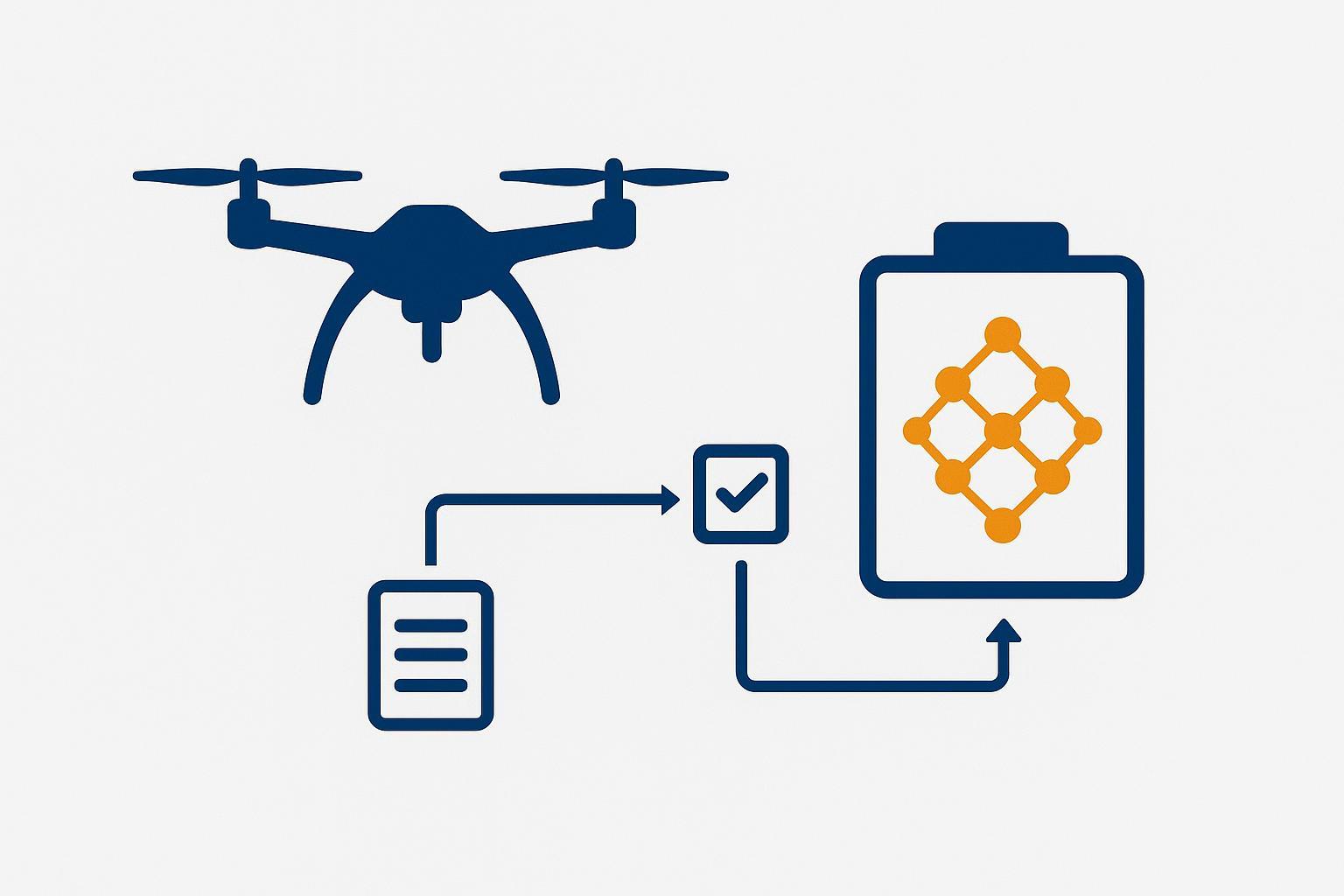
Every time a new battery breakthrough makes headlines, the conversation usually starts with the same question: how much longer will the drone fly?
That’s understandable.
But for most commercial UAV fleets, flight time is only part of the story.
When you buy batteries for a program, you’re really buying operational capacity: predictable sorties per day, payload consistency, and how much downtime the workflow can absorb.
In other words, you’re buying a daily workflow—not a single endurance number.
This article takes an operator’s lens on what to watch—and what to ask—so you can evaluate claims in procurement with fewer surprises later.
Why UAV buyers should care
The wrong assumption: “longer flight time”
Most buyers hear higher Wh/kg and immediately translate it to “the drone stays up longer.” Sometimes it will.
But in real operations, endurance is rarely the only—or even the primary—bottleneck.
If you manage a fleet, the harder question is usually more practical than technical:
How many mission-ready battery cycles can you reliably execute in a day?
How much ground time does each sortie create?
How many packs, chargers, and handling steps do you add just to keep aircraft available?
Endurance is a component metric.
In practice, most buyers end up optimizing for throughput and predictability.
What changes when batteries stop setting the pace
Treat 400 Wh/kg as a conditional benchmark—often discussed at the cell level and highly dependent on chemistry, test methods, and operating window—not as a guarantee of what you can buy tomorrow.
Even so, if a higher-energy architecture becomes reliably deployable in your mission profile, the shift isn’t “a better battery.”
It’s a change in operating logic: batteries stop setting the tempo for the day.
And when the tempo changes, the buying criteria shifts with it. Use this as a decision lens: stop optimizing for a single flight, and start optimizing for repeatable output.
What actually limits UAV operations today
Most spec sheets miss a simple constraint:
Battery logistics is the hidden constraint—not airframe capability.
Many teams discover this the hard way. Aircraft are available. Pilots are available. Missions are waiting. Yet output stalls because packs are charging, cooling, moving between sites, or simply waiting for the next rotation slot.
At that point, the limiting factor isn’t the aircraft. It’s the battery workflow supporting it.
When charging, cooling, and swapping can’t keep up with your cadence, you don’t just “lose time”—you lose predictable sorties per day.
A quick compliance reminder that shows why this is operational (not administrative): lithium batteries offered for transport must meet UN 38.3 test requirements and are tied to documentation expectations in the shipping chain (including a test summary). See the UNECE UN Manual of Tests and Criteria, Section 38.3 and the U.S. DOT’s PHMSA guidance on transporting lithium batteries.
If battery logistics is the hidden constraint today, the obvious question becomes: what changes when you can bring more usable energy into the same workflow—without adding more handling complexity?
What changes with 400Wh/kg silicon batteries in real operations
Treat 400 Wh/kg as a conditional, roadmap-style benchmark.
What matters is what gets easier if higher energy density becomes dependable in your operating window.
More energy doesn’t automatically create value
Higher Wh/kg gives you more room to work with, but it doesn’t remove the trade-offs that shape real missions.
In practice, fleets tend to cash that extra energy in one of two ways.
Some push farther and build more margin against wind, temperature, and reserve rules—reducing forced returns.
Others hold mission duration roughly steady and spend the energy on capability: heavier sensors, more stabilization, or more application payload.
The battery doesn’t decide which path matters.
The business model does.
That’s why the 400 Wh/kg discussion is interesting for buyers: it’s less about a spec sheet win and more about whether your operation can become less battery-paced.
Fewer batteries, simpler field operations
If you can do the same work with fewer packs in rotation, you reduce complexity everywhere: fewer swaps, fewer charging slots, less transport burden, less inventory trapped in “spares,” and fewer surprises from pack-to-pack variance.
This is the under-discussed win: operational simplification. Higher energy density matters when it lets you redesign the workflow around fewer moving parts.
From battery-driven operations to mission-driven operations
For many commercial UAV programs, the day is still organized around batteries. Charging windows shape dispatch decisions. Pack availability shapes mission planning. Rotation cycles shape staffing.
That’s why higher usable energy matters. Not because it changes a spec sheet, but because it can change who sets the schedule.
When energy stops dictating the schedule, missions start dictating the schedule.
If that becomes true in your operating window, the win isn’t just endurance. It’s an operational rewrite: planning shifts toward mission windows, staffing shifts toward sorties, and scale starts to follow dispatch rules rather than pack availability.
What doesn’t change and why buyers should be careful
Higher energy density doesn’t remove the hard constraints—and it can raise the cost of getting them wrong.
Does higher energy density introduce new operational risks?
More energy in the same mass means less room for error.
For most teams, the right posture is simple: assume the risk exists, then demand evidence that it’s controlled in your operating window.
If you only ask three things, ask for the pack’s charge/discharge temperature limits, proof of pack-level thermal containment, and realistic expectations for durability drift under your duty cycle.
Why a better battery doesn’t automatically improve operations
Even if the pack improves, you still need operational control: charging approach, trustworthy BMS telemetry, and a rotation/storage SOP that doesn’t destroy consistency.
Now you can evaluate the idea on its merits: does it reduce operational friction, or does it simply move the bottleneck somewhere else?
How UAV buyers should evaluate 400Wh/kg batteries
If you’re evaluating 400 Wh/kg claims, a simple framework tends to beat a long checklist.
What should buyers evaluate besides Wh/kg?
The goal isn’t to “buy Wh/kg.” It’s to buy predictable mission output.
Energy density is an input. What you’re evaluating is the full system: aircraft + payload + mission profile + charging method + safety margins + environment.
Which KPIs actually show up in real output?
If you track only three KPIs, these are usually the ones that show up in real output:
Mission completion reliability — the percent of missions finished without energy-related aborts
Sorties per day — the metric that converts battery capability into throughput
Operational downtime — time lost to charging waits, cooling/handling, and compliance delays
How do you know whether the upgrade creates value?
The pack that reduces buffers is usually the pack that scales.
A simple check that forces clarity:
If packs-in-rotation drops by 20% in your schedule model, do labor, charger slots, and spares inventory drop with it—or do other bottlenecks simply appear?
How 400Wh/kg reshapes UAV business models
Where does higher usable energy change the business case first?
As energy constraints loosen (even partially), segmentation becomes sharper. Some teams win by running short-range, high-frequency work where turnaround dominates. Others win by increasing payload capability and value per flight. And BVLOS-style programs still live or die by predictability and compliance gates—not just endurance.
The fleet that wins isn’t always the one with the longest flights. It’s the one with the most predictable mission throughput.
Competitive advantage shifts to system integration
When the core constraint is operational, advantage shifts toward teams that treat the battery, charging infrastructure, BMS telemetry, operating procedures, and compliance documentation as one integrated system.
This is where integration across the energy system starts to matter. The advantage goes to teams that can make the system testable, supportable, and scalable.
The real change is in fleet economics, not flight performance
If higher Wh/kg becomes reliable in your use case, the biggest win is rarely a brag-worthy endurance number.
It’s fewer operational moving parts—and fewer buffers.
A more useful question for UAV buyers isn’t just how far a drone can fly, but how consistently a fleet can operate.
A simple way to close the loop
If you take one idea from the 400 Wh/kg debate, make it this: energy density only matters when it reduces the friction in your battery workflow.
So when you’re reviewing suppliers, translate every headline spec into three operational questions: What does it do to packs-in-rotation? What does it do to downtime between sorties? And what evidence exists at the pack level under your temperature window and duty cycle?
If you can’t answer those three, you’re not ready to buy a new chemistry—you’re only ready to run a controlled trial. Quick reminder: treat 400 Wh/kg as a cell-level, test-method-dependent figure unless a supplier can show pack-level data under your mission profile.
Further reading
PNAS (2024): μ-Si full-cell fast-charging study
Pacific Northwest National Laboratory (PNNL-31881): Silicon-anode commercialization overview

 日本語
日本語  English
  Español
  한국어
한국어  Deutsch
  Français
  Русский
  Bahasa Indonesia
  ไทย
ไทย  العربية
  Português do Brasil
  Italiano
  Nederlands