



If you manage a commercial UAV fleet, you’ve probably seen this pattern:
The airframes barely flew this season.
The batteries were “stored safely.”
And yet—months later—usable capacity is down, internal resistance is up, and at least a few packs are now operational liabilities.
When the next project starts, several packs fail pre-flight checks—while others deliver noticeably shorter flight time than expected.
That’s the first misconception this article is here to break.
For many industrial fleets, battery life is not limited by how often you fly. It’s limited by how you store.
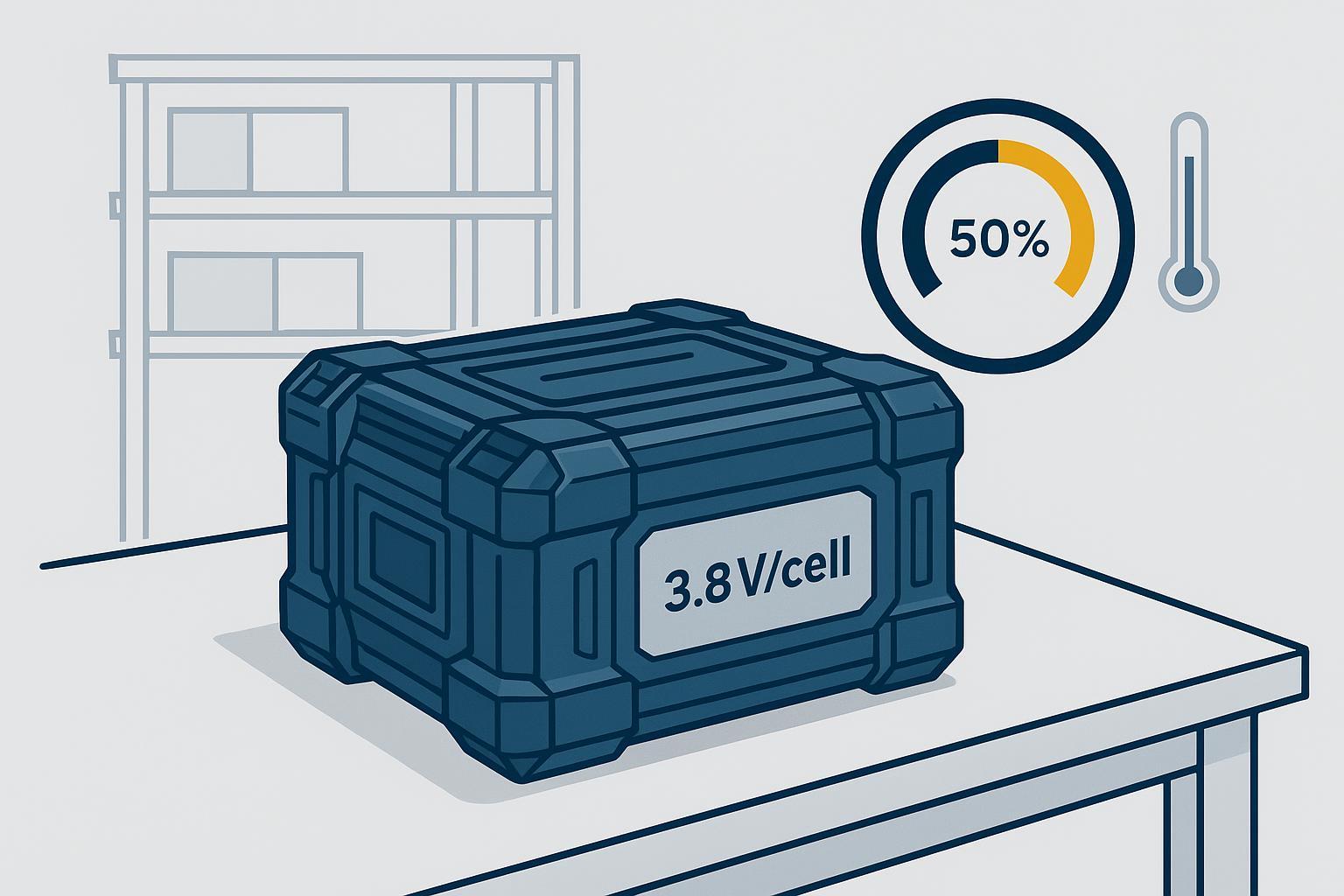
Improper storage is one of the biggest hidden drivers of UAV battery aging. For many LiPo-based drone packs, storing at roughly 30–60% state of charge (SOC)—often around 3.8V per cell—reduces chemical stress, preserves usable capacity, and extends service life.
Why UAV Batteries Lose Capacity Even When They Aren’t Being Used
Most fleets budget battery replacements based on “how many cycles we did.” That logic works in high-utilization operations. It fails in seasonal or intermittent operations.
Storage Aging vs. Cycle Aging: Which Damages UAV Batteries More?
Two aging modes matter—and which one dominates depends on how your fleet operates:
High-utilization fleets often see cycle aging as the main driver.
Seasonal inspection, agriculture, and emergency-response fleets often see calendar (storage) aging become the bigger source of degradation.
Definitions:
Cycle aging: wear caused by charge/discharge cycles (especially deep cycles, high C-rate, and high heat).
Storage aging (calendar aging): wear that happens while the pack sits—even if it’s never connected to an aircraft.
In low-flight-frequency fleets, storage aging can dominate because the battery spends far more time parked than flying.
Why Batteries Continue Aging During Storage
A lithium battery isn’t chemically “paused” at rest. Side reactions continue inside the cell, gradually consuming active lithium and increasing resistance.
Peer-reviewed work on storage conditions repeatedly shows the same pattern: storage temperature and storage SOC are primary drivers of this calendar-aging rate. For example, a 2025 long-term storage study hosted on PubMed Central discusses how temperature and SOC accelerate parasitic reactions and interfacial growth that lead to capacity fade and rising impedance over time (see Impact of temperature and state-of-charge on long-term storage (2025)).
Translated into fleet language:
A battery can be “unused” and still lose capacity.
The storage state you leave it in determines how fast that happens.
Why Both Fully Charged and Deeply Discharged Storage Shorten Battery Life
Once you accept that storage aging is real, the next question is operational:
What storage state causes the least damage?
The answer is not “full, so it’s ready” and not “empty, so it’s safe.” Both extremes create failure pathways.
Why Storing a LiPo Battery at 100% SOC Accelerates Aging
Storing at 100% SOC means storing at high cell voltage. High voltage raises chemical stress at the electrodes and increases the rate of parasitic reactions.
Even outside academia, practical battery-care guides for drone/RC LiPo packs converge on the same warning: don’t leave packs fully charged for extended periods. Oscar Liang’s widely referenced FPV LiPo guide explicitly recommends using storage charge around 3.80–3.85V per cell and avoiding long-term full-charge storage (see LiPo battery guide — storage charge 3.80–3.85V per cell).
From a fleet-risk perspective, storing full charge increases exposure to:
Faster capacity fade (you lose usable Wh that you paid for)
Higher internal resistance (worse voltage sag under load)
Higher chance of swelling over time—especially when combined with heat
Why Low-SOC Storage Can Permanently Damage Cells
Low-SOC storage sounds conservative until you track what happens over weeks:
Packs self-discharge.
Cells drift out of balance.
A weak cell can drop below minimum voltage first.
Once any cell crosses undervoltage thresholds, you’re no longer “storing”—you’re over-discharging, which can cause irreversible damage and safety risk.
This is one of the reasons serious fleets avoid “store it near empty” as a policy. It’s too easy for a pack to fall off a cliff quietly.
Warning: Low SOC + long storage + no inspection cadence is a predictable way to create surprise failures. The pack looks fine—until a cell is permanently damaged.
Why 30–60% SOC (Around 3.8V per Cell) Is the Industry Standard
This isn’t “because one brand says so.” It’s where practice and electrochemistry align.
What SOC Actually Means (In One Practical Definition)
For fleet work, SOC is simply:
How much usable charge remains, expressed as a percentage of the pack’s rated capacity.
You don’t need a textbook definition—you need a storage rule you can enforce.
Why 3.8V Per Cell Represents a More Stable Storage State
For many LiPo-based UAV packs, around 3.8V per cell (often roughly 3.75–3.85V per cell at rest) corresponds to a mid-SOC region (commonly ~40–60%, depending on chemistry, pack design, temperature, and how SOC is estimated).
In practical terms:
You’re far enough from high-voltage stress (full charge).
You’re far enough from undervoltage risk (deep discharge).
You preserve a buffer against self-discharge and imbalance drift.
That’s why “storage charge” functions on chargers typically target this zone.
Put simply:
High SOC accelerates aging.
Low SOC increases the risk of irreversible damage.
30–60% becomes the practical storage window.
The remaining multiplier is temperature.
This “storage window” is also consistent with manufacturer maintenance guidance in the field. DJI, for example, advises discharging its Intelligent Flight Batteries to 40–65% if they won’t be used for more than 10 days (see DJI Support search results for “Battery Routine Maintenance Guide”).
Think of storage aging as being driven by two knobs you can actually control:
State of charge (SOC): higher voltage = higher chemical stress
Temperature: higher heat = faster side reactions
Mid-SOC storage (roughly 30–60% SOC, often around 3.8V per cell for LiPo-based UAV packs) reduces voltage stress. But if packs are stored hot—inside a vehicle, a shipping container, or a non-climate-controlled room—aging can accelerate even when SOC is “correct.”
That’s why a defensible storage policy treats SOC + temperature as a pair, not separate tips.
In practice, these are also the two variables operators can standardize across every site.
Build a Practical UAV Battery Storage SOP
If you want this to be enforceable across technicians, sites, and seasons, write it as a simple, repeatable process.
Situation | Recommended storage SOC | Action |
|---|---|---|
Fly again within 24 hours | 60–80% | Leave as is; don’t top to 100% unless the mission needs it |
Idle for 2 weeks | 30–60% | Use storage mode; log the date |
Idle over 3 months | 35–45% | Add monthly voltage checks; adjust back to storage SOC if needed |
Hot climate or hot storage room | 40–50% | Tighten inspection cadence; improve temperature control |
Step 1 — Return Packs to Storage Charge
Target:
30–60% SOC (commonly ~3.8V per cell for LiPo)
How to execute:
Use charger storage mode whenever possible.
Confirm basic balance (cell-to-cell) before you put the pack away.
Step 2 — Cool Before Storage
A common failure pattern is packing a warm battery into a closed case right after flight or after a fast charge.
Controls:
Let packs cool to near room temperature before sealing them into a box.
Avoid stacking packs tightly when they’re still warm.
Step 3 — Control the Storage Environment
SOC is the setting. Environment is the multiplier.
A conservative baseline:
Cool, stable temperature (avoid heat spikes)
Dry storage (humidity control; desiccant where appropriate)
Fire-resistant containment (rated battery box or equivalent)
No compression or mechanical stress on packs
From the degradation literature, higher temperature and higher SOC together accelerate aging more than either alone. The DLR calendar-aging work (testing multiple SOC levels across temperatures) is one example showing why this interaction matters for real-life storage policies (see the DLR calendar aging model PDF).
Step 4 — Schedule Periodic Health Checks
Long idle periods (off-season, project delays, spare-pack reserves) require an inspection cadence.
Recommended controls:
Record the date when packs are set to storage charge.
Define a fixed inspection interval based on storage duration, climate, and mission criticality. Many commercial fleets use monthly checks in hot/variable environments and quarterly checks in stable, climate-controlled storage.
Check per-cell voltage on that interval.
Re-adjust back to storage SOC if drift occurs.
Quarantine packs showing swelling, abnormal drift, or persistent imbalance.
How Poor Storage Quietly Increases Fleet Operating Cost
Storage mistakes rarely fail fast. They fail quietly—until the fleet feels it.
Here’s the typical cost chain:
High SOC or hot storage accelerates calendar aging.
Calendar aging shows up as capacity fade and rising internal resistance.
Packs hit your performance threshold sooner, so you replace earlier.
Earlier replacement means more spare inventory, more procurement cycles, and more downtime risk.
Use a simple table like this to keep operations and procurement aligned on what to measure.
Operating-cost driver | What to measure | Why it matters |
|---|---|---|
Packs in inventory | Count by SKU / voltage class | Sets the scale of exposure |
Average months in storage per year | % of fleet time “parked” | Predicts calendar-aging share |
Storage SOC compliance | % packs stored at 30–60% SOC | Process maturity indicator |
Storage temperature range | Min/avg/max in storage room | Heat multiplies aging rate |
Retirement threshold | Retire at X% usable capacity or Y% IR rise | Defines “end of service” |
Mission impact cost | $/hour downtime or missed sortie | Converts fade into real operating cost |
If your pack logs include internal resistance (IR) or impedance trends, treat it as an early warning metric. Operations often feels IR first (voltage sag) before “capacity” looks dramatic.
Common UAV Battery Storage Mistakes (And What to Do Instead)
Does Auto-Discharge Replace Proper Storage Preparation?
No. Auto-discharge helps reduce the time a pack sits at full charge, but it doesn’t replace an SOP. You still need:
a storage SOC target
an inspection cadence
environment controls
Should Storage Practices Change in Hot Climates?
Yes, you need tighter process control.
In hot regions, the risk is not only faster aging—it’s that heat events can push packs into swelling/failure pathways faster. In those environments:
enforce mid-SOC storage more strictly
improve ventilation/temperature control
increase inspection cadence
What Should You Do If a Battery Starts Swelling?
Treat swelling as a safety and reliability issue, not a “maybe it still works.”
Quarantine the pack, follow your safety disposal procedures, and investigate root causes:
chronic high SOC storage
heat exposure
repeated high-stress operation
imbalance and over-discharge events
For a practical troubleshooting flow, reference Herewin’s Drone LiPo Battery Troubleshooting: A Comprehensive Guide to Maintenance and Safety.
Final Take: The Easiest Battery-Life Gain Usually Isn’t Flying Less
In many commercial fleets, what happens after the last landing matters as much as what happens in the air.
If you want one storage-voltage rule that’s easy to train and easy to audit, build your routine around three controls:
Store packs at 30–60% SOC (often ~3.8V per cell for LiPo)
Keep the storage area cool and temperature-stable
Set an inspection cadence (per-cell voltage checks and rebalance as needed)
The simplest high-impact change is this: don’t leave packs sitting at full charge “just in case.” Put them into storage mode after operations, and you’ll usually see fewer surprise failures and more consistent flight-time performance when the next job starts.
If you’d like a site-ready SOP tailored to your pack chemistry and operating environment—storage targets, check intervals, and pass/fail criteria—ヘレウィン can share engineering guidance to help your team store and maintain UAV batteries the same way, every time.







 日本語
日本語  English
  Español
  한국어
한국어  Deutsch
  Français
  Русский
  Bahasa Indonesia
  ไทย
ไทย  العربية
  Português do Brasil
  Italiano
  Nederlands