




Operational uptime in 2026 depends on more than just “fitting” a battery; it requires navigating a minefield of new safety standards and platform fragmentation.This guide provides a manufacturer-grade framework to future-proof your e-moped fleet. We anchor on the rigorous GB 38031—2025 safety baseline to simplify global compliance for your 2026 deployments, deliver a 3-step engineering match (Voltage, ROI, and Power), and reveal how universal-voltage (48–76V) batteries are helping reduce SKU sprawl in modern swapping networks.
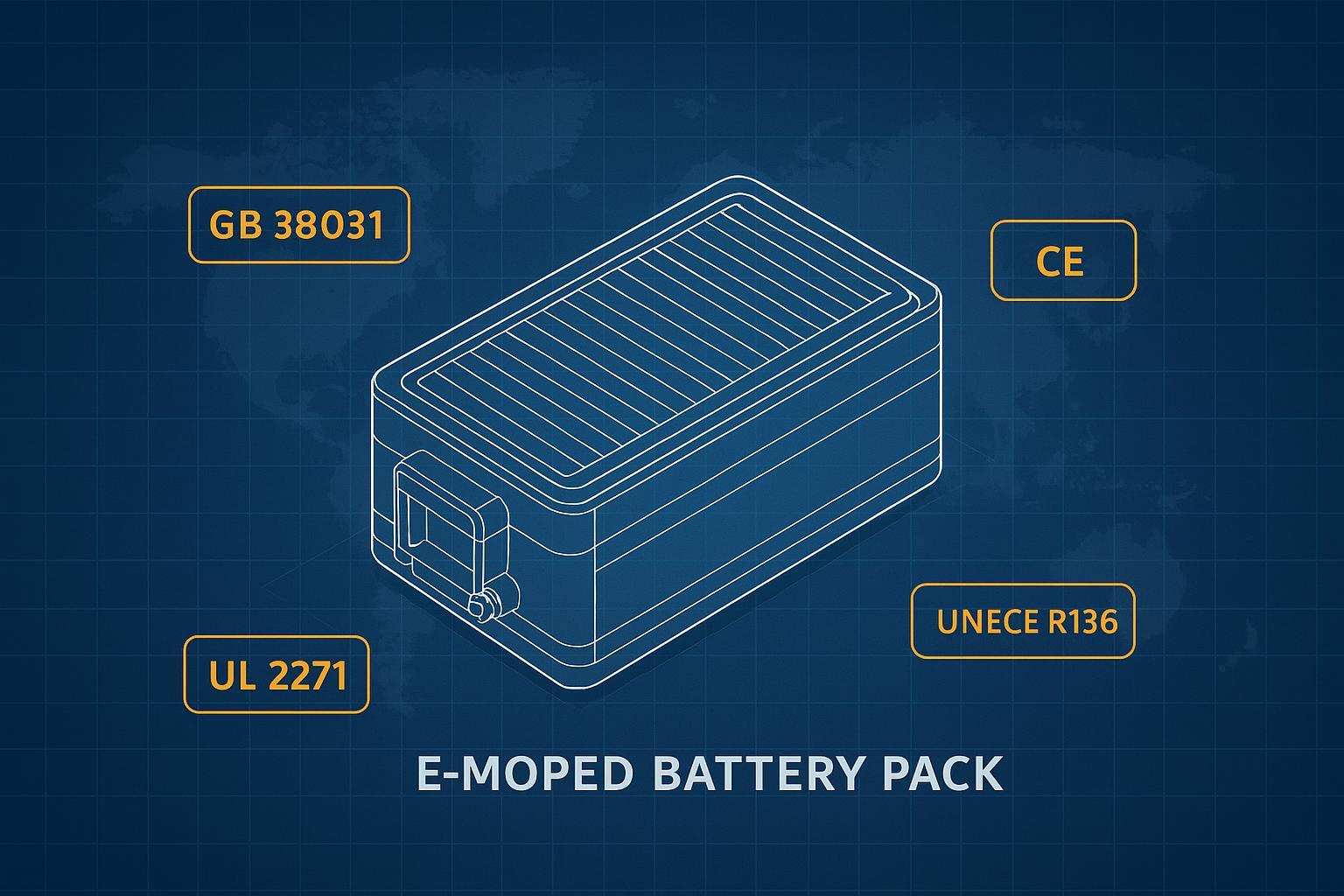
Global Safety Standards: Anchoring on GB 38031—2025
GB 38031—China’s traction battery safety standard—makes a strong pack‑level safety anchor for fleets because it forces engineering teams to design for abuse that actually happens in swapping networks: thermal events, underside strikes, and repeated high‑rate charging.
In our 2026 compliance lab workflow, we treat GB 38031—2025 as a baseline set of must‑pass outcomes and validate the pack the same way a fleet will use it: high swap cadence, rough roads, and frequent fast charging.
Deciphering the 150J Impact and Thermal Rigor
-
Thermal propagation safety: Outcome‑based criteria—no fire and no explosion during triggered thermal events at the pack/system level—paired with early‑warning expectations. For fleets, this means BMS fault handling, enclosure design, and isolation time margins.
-
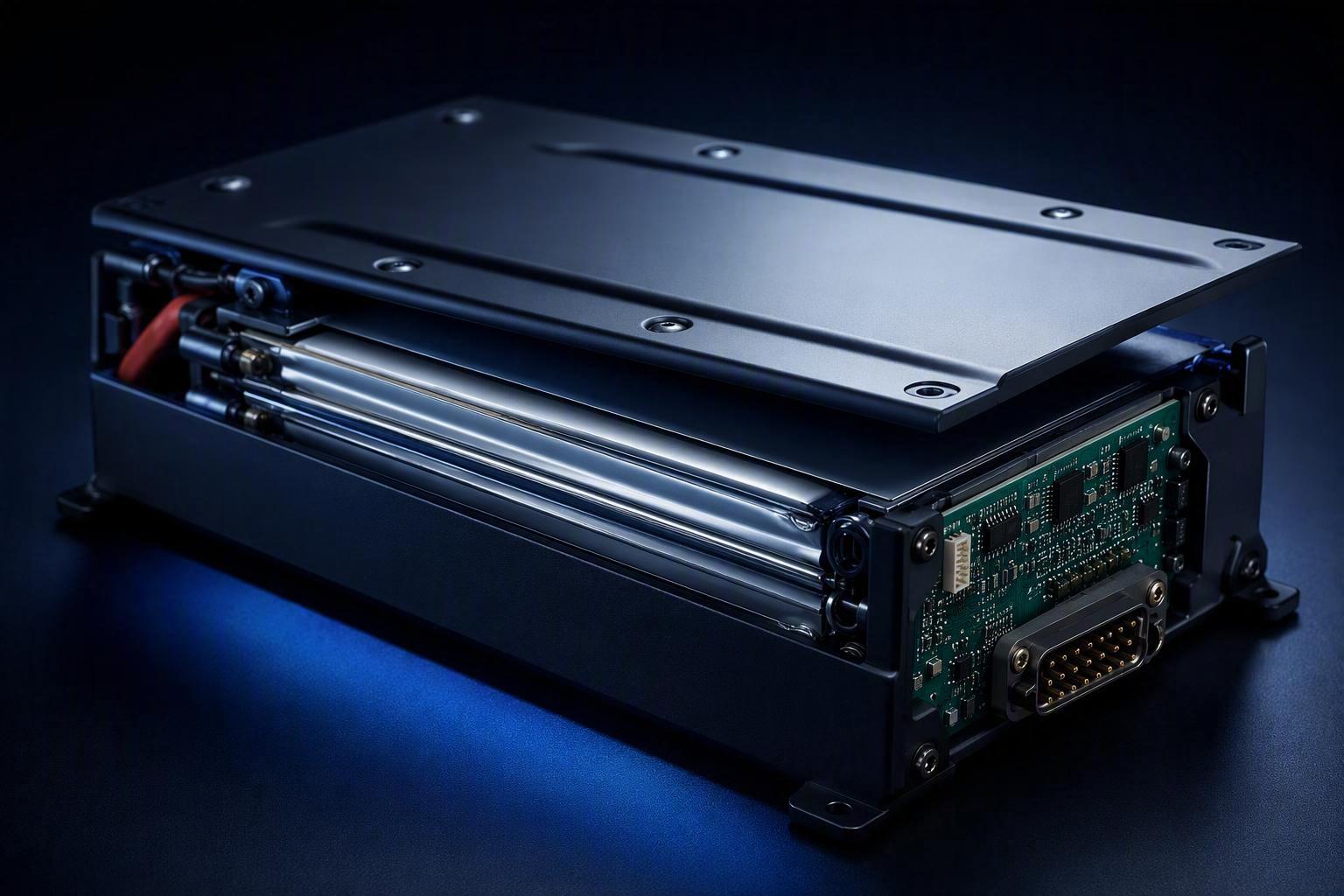
Bottom impact resilience (150 J visual hook): An underside mechanical assessment targeting debris strikes and curb hits. In our internal validation, we use a 30 mm steel ball and 150 J impact energy, with pass/fail outcomes defined as no leakage, no housing breach, and insulation resistance maintained.
-
High‑frequency fast‑charge durability: Safety after stress matters more than nominal cycle count. We run repeated high‑rate charging cycles and then perform an immediate external short‑circuit safety check, with the target outcome remaining no fire, no explosion.
Together, these elements make GB 38031 a pragmatic anchor if you want one engineering playbook that travels well across markets.
Strategic Mapping to EU/US Regulatory Frameworks
For placement on EU roads, L-category vehicles typically require UNECE R136 type approval for the electric powertrain and REESS (Rechargeable Energy Storage System).
In parallel, the EU Batteries Regulation 2023/1542 introduces lifecycle obligations, including labeling, durability classifications, and carbon-footprint disclosure.
Additional directives such as EMC and substance restrictions (RoHS/REACH) also apply to battery electronics.
-
The main REESS safety test families under UNECE R136 include short-circuit protection, overcharge tolerance, vibration durability, mechanical impact resistance, and fire safety validation.
-
The EU Batteries Regulation (EU) 2023/1542 introduces lifecycle obligations including labeling, performance and durability classes, and carbon-footprint disclosure. Implementation timelines and methodology guidance have been discussed in industry analyses by UL Insights そして JRC technical reports on battery carbon-footprint methodology.
-
In North America, UL 2271 is widely used as the system-level safety standard for light electric vehicle (LEV) battery packs, while UL 2580 applies to larger electric-vehicle battery systems. Certification pathways and recent updates are frequently discussed in industry guidance from organizations such as UL Solutions and Intertek.
Practical Compliance Red Flags (Immediate Disqualification)
Fleet operators and procurement teams should treat the following issues as critical risks:
-
Unbranded or refurbished packs with no traceable UN 38.3 test summary, mismatched Declarations of Conformity, or missing CE technical files. Authoritative UK guidance warns of significant fire risk from unsafe or counterfeit LEV batteries and kits: UK OPSS statutory guidelines on lithium‑ion battery safety for e‑bikes. UL also cautions brands about hazards of uncertified products: UL guidance on lithium‑ion battery safety concerns
Regulatory crosswalk (anchor on GB, then map to EU/US):
|
Domain |
China (Anchor) |
European Union |
UNECE (Type Approval) |
North America |
|---|---|---|---|---|
|
Traction battery safety (L-category / LEV focus) |
GB 38031‑2025 (thermal propagation, bottom impact, cycling durability) |
Regulation (EU) 2023/1542 adds lifecycle obligations (labels, performance/durability classes, carbon footprint); safety interfaces with hENs |
R136 REESS safety families (electrical, mechanical, thermal) |
UL 2271 (LEV packs/systems); UL 2580 (EV context) |
|
EMC (BMS/pack electronics) |
System-integrated (e.g., GB/T 18384 series at vehicle level) |
EMC Directive 2014/30/EU |
— |
FCC Part 15 (where applicable) + system EMC per integration |
|
Hazardous substances |
China RoHS (SJ/T 11364 marking + GB/T 26572 substance limits) |
RoHS 2011/65/EU; REACH duties |
— |
State/federal analogues |
|
Transport |
UN 38.3 test summary |
UN 38.3 |
UN 38.3 |
UN 38.3 |
While the standards have different names (R136 vs. UL 2271), the physics of safety remain constant. By anchoring your design on GB 38031—2025, you effectively cover the most rigorous thermal and mechanical requirements of the EU and US. We recommend maintaining a “Single Source Technical File” that maps these tests to minimize friction during regional certification.
Keep an “audit pack” ready—applicable legislation list, risk assessment, schematics/BOM, EMC reports, RoHS/REACH evidence, UN 38.3 test summary, user instructions, and traceability. If you use a supplier catalog as a starting point, ensure their certifications and test summaries are centralized and current; for example, many suppliers publish certification overviews you can reference when assembling documentation. Embedding this practice strengthens e‑moped battery compliance when audits arrive unexpectedly.
Compliance is your license to operate; however, how these safe cycles translate into your bottom line depends on precise engineering matching.
The 3-Step Engineering Match Framework
A proven, field-validated approach designed to improve uptime and ensure safer deployments. It is intentionally simple: first synchronize voltage, then size capacity for ROI, and finally align power with longevity.
Voltage Synchronization & The ±1V Guardrail
Match your pack’s nominal platform with the controller/motor rating and the charger profile. Mixing platforms (e.g., a 48V pack into a 60V system) invites controller faults, BMS trips, and warranty headaches.
Treat ±1 V as a hard hardware requirement, not a rule of thumb. In real fleets, this threshold is dictated by controller and charger specifications (end‑of‑charge voltage accuracy, cutoffs, and protection setpoints). When you violate it, you’re no longer “slightly off”—you’re in the failure zone where you can trigger protective shutdowns, permanent damage, or catastrophic hardware failure (controller or motor drive stage).
Verify alignment across four points:
-
BMS HVC/LVC thresholds vs. controller cut‑offs (avoid fighting setpoints).
-
Charger CC/CV parameters vs. the pack’s chemistry and cell configuration.
-
Peak current windows vs. connector/cable ratings (with thermal derating).
-
Regenerative braking voltage spikes vs. BMS over‑voltage handling.
Two real‑world checks save trouble, confirm charger accuracy on the bench (end‑of‑charge voltage and current taper), and log pack/system voltage sag at peak acceleration to catch undersized wiring or aged cells.
If you’re tired of managing three “voltage silos” (48/60/72V) across swap cabinets, this is exactly where universal‑voltage (48–76V) changes the operating model.
Scientific Capacity Planning for Maximum ROI
Don’t size batteries by range alone. For fleets, ROI depends on three key factors: energy consumption per km (Wh/km), swap frequency, and cycle life at your target depth of discharge (DoD).
A lighter pack swapped more often can outperform a heavier pack with fewer swaps—especially when downtime per swap is short and predictable.
Key insights:
-
Target 60–80% DoD for LFP packs to maximize total energy over the battery’s life; deep cycling to 100% reduces cycle life.
-
Swap cabinet throughput and availability can significantly impact ROI.
-
Right-sized packs reduce stress on cells and BMS, improving reliability and safety margins under real-world conditions.
Core formula (for reference):
Range (km) ≈ Usable energy (Wh) / Energy per km (Wh/km)
This simple calculation helps estimate pack range without unnecessary complexity.
Balancing capacity, swap cadence, and DoD ensures fleets achieve maximum uptime, lower cost per km, and safer battery operation.
Power Output & Battery Longevity
Align continuous discharge rating with the motor’s continuous power—not its marketing peak. Then add 10–20% headroom so the pack isn’t run at the cliff during hills, heat, or heavy payloads. Sustained operation near max current accelerates heat, voltage sag, and cell imbalance, nudging you toward early capacity loss and BMS trips.
Quick sizing:
I_cont (A) ≈ P_cont (W) / V_nom (V)
I_rating (A) ≈ I_cont (A) * (1.1 to 1.2) (headroom)
Also confirm:
-
peak current windows for sprints;
-
cable/connector gauge (with ambient derating);
-
regenerative braking acceptance (brief current spikes).
If your telemetry shows frequent thermal throttling or voltage sag under 10% SoC, revisit headroom or cooling.Proper current headroom not only protects cells but also preserves the ROI benefits achieved through smart capacity planning.
Scenario‑Specific Selection: LFP, Sodium‑Ion, or Lead‑Acid?
Battery chemistry is where engineering meets operating climate and business model. Think in scenarios, not brand slogans.
LiFePO4 (LFP): The High-Frequency Gold Standard
LFP has earned its place as the mainstream choice for swap networks due to its superior safety and longevity.
-
パフォーマンス: Delivers a lifecycle of 1,000 – 2,000 cycles, providing a service life of 5–8 years for high-cadence delivery fleets.
-
Fleet Fit: Best for daily routes ≥ 30km (e.g., food delivery and express logistics) where predictable thermal stability and high swap efficiency are required.
Sodium‑Ion: The Cold‑Climate Specialist
Sodium-ion is the strategic solution for regions where winter downtime is a critical KPI killer.
-
The Winter Edge: sodium cells can maintain significantly higher capacity retention in sub-zero temperatures compared with conventional lithium batteries, helping reduce the common problem of winter range loss in cold-climate regions.
-
Operational Impact: While its cycle life (500–1,500 cycles) is lower than LFP, its safety and cold-start reliability make it the preferred anchor for sub-zero deployments.
Lead‑Acid: The Legacy Constraint
Lead-acid remains a budget-driven choice for short-range, low-frequency commuting.
-
The Trade-offs: With a low energy density and a short cycle life of 300–500 cycles, it suffers from significant weight penalties (15–20kg per pack), complicating the swap experience.
-
Fleet Fit: Strictly for daily distances ≤20km where upfront CAPEX is the primary constraint.
Solving SKU Sprawl with Universal‑Voltage (48–76V)
The Hardware Advantage: Self-Adaptive Logic
Universal-voltage units are engineered to bridge the gap between legacy fleets and future-proof expansion.
-
±1V Guardrail Compliance: Our adaptive BMS automatically aligns with the moped’s controller (48V/60V/72V), strictly respecting the ±1V error threshold to prevent hardware burnout.
-
Interoperability: One SKU serves multiple platforms, ensuring that no battery sits idle because it belongs to a “minority platform”.
Strategic Impact on Swap ROI
-
Inventory Efficiency: Reduces “dead stock” in cabinets by allowing packs to be used interchangeably across mixed vehicle fleets.
-
Lower Management Costs: Standardizing on a 48V–76V range simplifies procurement, reduces training errors for swap staff, and lowers the long-term cost of asset replacement.
-
Scalability: For fleets that may upgrade from lightweight 48V commuters to 72V long-range models, universal packs eliminate the need for complete battery re-procurement.
Conclusion & Strategic Recommendation Matrix
Use GB 38031 as the design and validation anchor. Then prove conformity for each target market: R136 for EU L‑category type-approval, 2023/1542 for lifecycle obligations, and UL 2271 for North America. Include EMC, RoHS, and REACH requirements where applicable.
Engineer for uptime using the 3-step match:
-
Synchronize voltage
-
Optimize capacity for ROI
-
Size power with 10–20% headroom
Then select battery chemistry according to climate and duty cycle. Universal-voltage packs are promising but still emerging; near-term gains come from standardizing platforms and documentation. Strong e‑moped battery compliance is a daily operational habit, not a one-time certificate.
Recommendation Matrix (Scenario → Primary Choice)
|
Scenario |
Chemistry / Voltage Strategy |
Notes |
|---|---|---|
|
High-frequency commercial delivery (urban, hot climates) |
LFP on native platform (48/60/72V); 60–80% DoD; 10–20% current headroom |
Prioritize cabinet throughput. Verify fast-charge cycling safety according to GB 38031 updates. |
|
Extreme cold regions (severe winters) |
Pilot sodium‑ion on native platform; compare against heated-LFP baseline |
Treat sub-zero performance as manufacturer-reported until independent fleet data are available. |
|
Budget-limited, short-range commuting |
Lead-acid on native platform; segregate routes ≤ 20 km/day |
Accept higher mass and shorter life. Avoid high-frequency swapping windows. |
|
Maximum fleet flexibility across legacy SKUs |
Explore universal-voltage (48–76V) architectures; or standardize within each platform |
Expect re-testing per mode. Document operational limits clearly. Standardize connectors and enclosures. |
Next Steps
-
Align your engineering test plan with GB 38031’s revised focus areas.
-
Map obligations to your EU and North American targets.
-
Assemble a living “audit pack” of files and certificates.
Review publicly available supplier certification summaries to see how documents are organized for audit readiness. Use these examples to inform the structure of your own centralized documentation hub.
References
-
EU Batteries Regulation: the European Commission’s overview of the new batteries law for more sustainable and safe batteries
-
UNECE R136 scope: UNECE GRSP presentation on R136
-
North America: UL’s explainer on e-bike and micromobility device safety and certification
-
Risk guidance on unsafe packs: UK government OPSS statutory guidelines on lithium‑ion battery safety for e‑bikes






 日本語
日本語  English
  Español
  한국어
한국어  Deutsch
  Français
  Русский
  Bahasa Indonesia
  ไทย
ไทย  العربية
  Português do Brasil
  Italiano
  Nederlands