







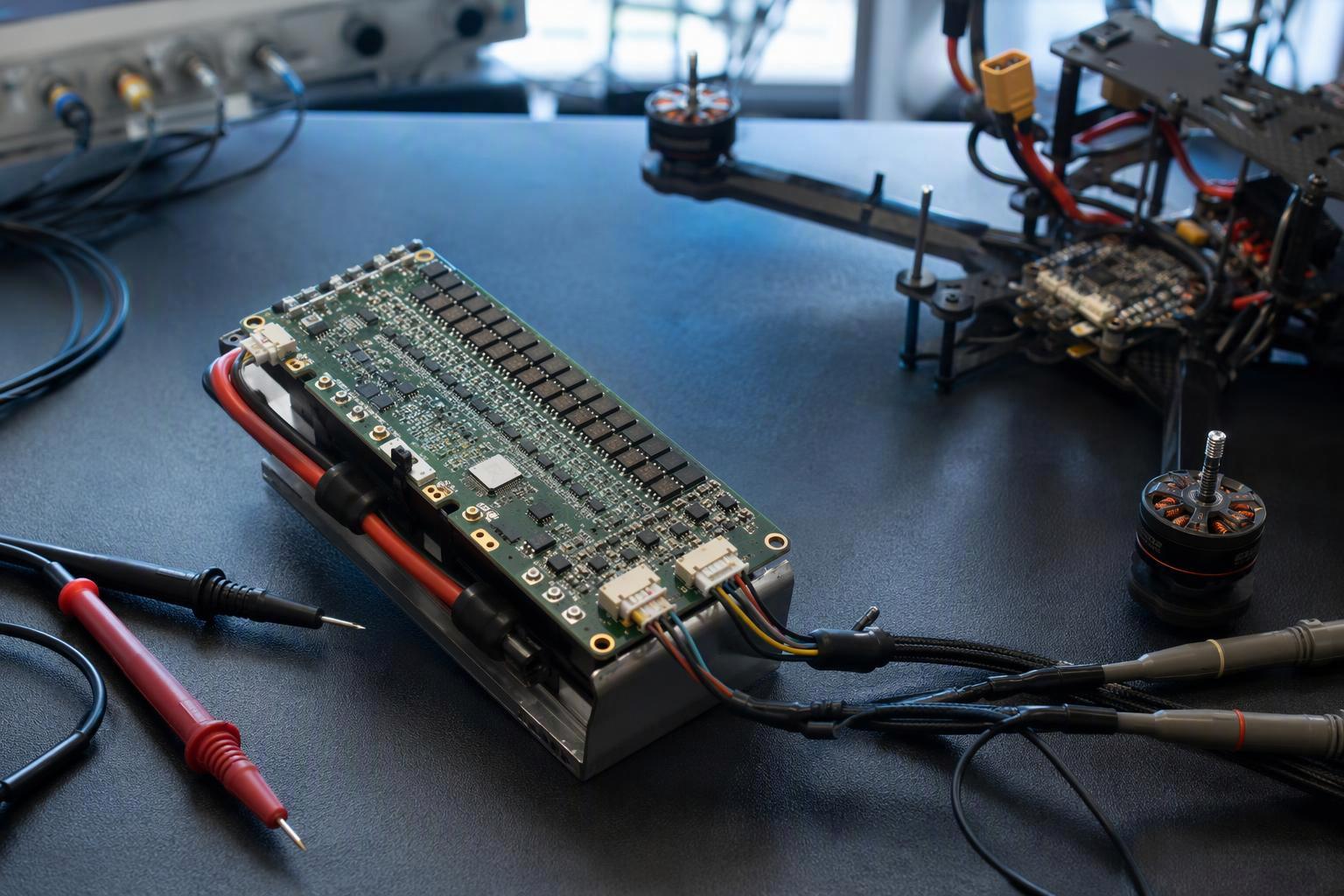
A drone BMS gives the aircraft access to battery data. But one specification question decides whether that data is actually usable: which protocol does the battery use, and what exactly does it send? The battery-to-flight-controller link is more than a physical connection. The battery system measures and estimates its condition, the BMS makes that information available over the communication interface, and the flight controller uses it for limits, failsafes and logging.
That is why this guide treats drone battery communication as a specification task, starting with the interfaces and ending with a requirement you can hand to a supplier. One idea runs through the whole topic: protocol support alone never settles an integration question. Two batteries can both list CAN and still fail to interoperate, because the data contract is a separate decision from the transport.
Why Does a Drone Battery Need BMS Communication?
A drone BMS communicates so the aircraft can respond to battery conditions while it is in flight. Pack voltage gives the aircraft one indication of battery condition, but it does not describe the battery’s full operating state or whether the remaining energy can still be delivered safely under the current load. Drone battery communication gives the aircraft access to battery measurements, estimates and protection status, so it can apply limits, trigger failsafes, log flight data and support maintenance decisions.
Battery Data Beyond Voltage and Capacity
Because voltage changes with load, a pack can show a normal voltage at rest but experience a much larger voltage drop under high current demand. A smart battery can provide additional information such as current, individual-cell voltage, temperature and its own estimate of SOC. The aircraft can use this information to trigger warnings, apply configured power limits or take other failsafe actions before a battery limit is reached.
What the BMS Can Report
A typical smart battery reports data across several areas:
State of charge (SOC) for estimating remaining battery energy
State of health (SOH) for capacity fade and replacement planning
Voltage, pack and per-cell
Current, charge and discharge
Temperature at the sensing points
Protection and fault status, including over-current, over-temperature and cell imbalance flags
The exact data set depends on the battery design and the aircraft’s requirements.
A useful battery interface specification should define not only the data fields, but also their units, update rate and validity status. A value without its validity flag is hard to trust.
CAN, SMBus and UART: What Is the Difference?
CAN, SMBus and UART are three interfaces commonly encountered in smart battery communication, but they are not interchangeable. Each has a different communication model, and the right choice depends on the aircraft architecture, existing interfaces and data requirements. Use this comparison for initial selection; detailed implementation should follow the relevant protocol specification and the aircraft’s interface requirements.
Protocol | Typical Use | Communication | What to Confirm |
|---|---|---|---|
CAN | UAV system communication | Two-way, multi-node | Bit rate, IDs, message map, termination |
SMBus | Smart battery data | Host-controlled | Address, commands, polling, data format |
UART | Serial communication | Point-to-point | Baud rate, framing, message format |
Agreeing on the bus is only the starting point; what travels over it still has to be defined.
CAN for UAV Battery Communication
CAN supports multi-node communication, which can be useful in UAV architectures where several compatible devices share a communication bus. A CAN-based battery can share a bus with other compatible UAV components, reducing the need for a separate point-to-point communication link for every device.
The specification should therefore cover the bus configuration and message map, not just the physical connection.
SMBus for Smart Battery Data
SMBus is a short-range, host-controlled interface commonly used for smart battery data. Its bus speeds run at 100 kHz, 400 kHz and 1 MHz.
In an SMBus-based design, the host typically initiates transactions and reads the battery through the defined command structure. The aircraft therefore needs to implement the host-side communication behavior required by the battery specification.
UART for UAV Battery Communication
UART is point-to-point between two endpoints. The critical distinction for UART battery communication is that “UART supported” describes the byte-level transport, not the battery application protocol. Interoperability requires agreement on electrical levels, baud rate and framing, message protocol, packet structure and behavioural rules such as allowed commands and fault behaviour (Rohde & Schwarz, Understanding UART).
What Battery Data Should You Specify?
For procurement, the important question is how those battery fields need to be defined so the supplier can implement them correctly. Smart-battery specifications commonly define fields such as state of charge, state of health, voltage, current, temperature, cycle count and alarm or fault status (TI smart-battery gauge literature, retrieved 2026).
Don’t specify only the field name. Define the unit, scaling, resolution and validity condition for each field so the aircraft can interpret the value correctly.
Battery Status
Start with the basic operating values: pack voltage, current, SOC and SOH. Specify each as a unit, a scaling factor and a validity flag, not as a label alone.
Battery Health and Temperature
Depending on the application, you may also need cell and pack temperature, individual cell voltages, imbalance information and cycle count. If individual-cell monitoring is required, specify cell voltage and imbalance information explicitly.
Protection and Fault Status
Over-voltage, under-voltage, over-current, over-temperature and imbalance should be requested as discrete flags with their trigger conditions. This allows the aircraft to distinguish a warning condition from a protection or shutdown event.
How Does a Smart UAV Battery Communicate With the Aircraft?
A drone battery does not talk to the aircraft directly. The cells feed the BMS, the BMS drives a communication interface, and that interface connects to the flight controller or power system. The two communication paths discussed here are the battery-to-flight-controller link and the battery-to-charger link.
Battery → Flight Controller
The path is typically battery → BMS → communication interface → flight controller. Checking whether the flight controller supports CAN, SMBus or UART is only the first step. It also needs to understand the battery’s application-level messages. For example, a flight controller may expect a defined battery message structure rather than arbitrary CAN frames.
The battery therefore needs to publish the message structure expected by the flight controller, not simply expose a compatible transport interface.
Battery → Charger
In some smart-charging architectures, the BMS and charger exchange battery status and charging parameters so that charging limits can be applied according to the battery’s condition.
The exact control architecture should therefore be defined as part of the charging requirement rather than assumed from the battery’s communication protocol alone.
What Should You Specify When Ordering a Smart Drone Battery?
A UAV battery specification is most useful as a structured requirement, so treat a supplier-ready communication spec as four layers: protocol → data → data definition → physical interface.
Protocol support alone is not enough. A supplier can confirm “CAN supported” and still deliver a pack your flight controller cannot read, because integration failures often occur one layer below the protocol name: message definitions, scaling, IDs, validity flags or SOC interpretation. When you order a smart drone battery, that four-layer structure is what lets a supplier answer your requirements precisely.
Related: Battery Protocol Compatibility in Smart Drone BMS Integration
Specify the Communication Protocol
Name the protocol and the communication parameters, not just the acronym. State which bus the pack must expose, the bit rate or bus speed, the addressing scheme, and the expected communication role of the battery. If your airframe shares a bus with ESCs and a payload controller, state this in the requirement so the supplier can account for the bus configuration.
Define the Data You Need
List every value the aircraft must read, with units and scaling. A drone BMS may report state of charge, state of health, voltage, current, temperature, cell voltage, cycle count and fault flags. For each field, also specify the update rate, resolution and behavior when the value is invalid. Ask for the communication specification as a document, including the message map, register definitions or packet format that applies to the chosen interface.
Confirm the Data Definition
Confirm the message map published by the pack and check it against your flight controller: field names, units, scaling, message IDs, sign conventions and validity flags. Make sure the communication specification states which firmware version it applies to, and confirm how protocol changes are handled across firmware revisions.
Confirm the Physical Interface
Confirm the interface you will actually wire: connector type, pinout, harness length and electrical levels. Ask the supplier to demonstrate the pack against your flight controller or a bench equivalent, and to state which certifications the production line holds.
Common Smart Battery Integration Problems
A datasheet line that says “CAN supported” answers one question and leaves several open. Protocol compatibility does not eliminate integration problems. Two devices can agree on the bus and still disagree on what travels over it.
The Protocol Is Supported, but the Data Format Is Different
Both sides speak CAN, and the frames still do not parse. CAN defines the physical and data-link layers; it does not define which identifier carries state of charge, how many bytes the value occupies, or whether current is signed. Vendors publish their own message maps, and two CAN smart drone batteries can use different identifiers for the same field. The bus may be electrically healthy while the flight controller still receives no usable battery data. Ask the supplier for the message map, not the protocol name.
Connector and Pinout Do Not Match
The battery and the aircraft both expose a communication connector, and the pins are assigned differently. Confirm the connector family, pin count, and pin assignment in writing before the harness is built.
Battery SOC Does Not Match the Aircraft Display
The battery reports one state-of-charge value and the aircraft shows another. One common cause is that the BMS and flight controller use different SOC estimation methods or scaling. The BMS may calculate SOC from its own battery model, while the flight controller may derive or process battery state differently. Under load, voltage also changes with current demand, which can further increase the difference between the two readings. Before integration, define which SOC value is authoritative and how the aircraft should interpret it.
Required Fault Data Is Not Available
The integration needs over-temperature and cell-imbalance flags, and the battery publishes only pack-level voltage. Fault flags are easy to overlook when the initial message map focuses mainly on voltage, current and SOC. List the faults your operations team must see, then verify each one appears in the published data set. If a required flag is missing, ask the supplier whether it is supported before assuming that a firmware update can add it.
How to Prepare a UAV Smart Battery Requirement
A specification sheet is what turns a conversation into a comparable quote. Fill in these six blocks before approaching suppliers so that each quotation is based on the same requirements.
Block | What to specify |
|---|---|
Aircraft | Platform and flight controller model, so the supplier can confirm the interface it supports |
Electrical | Nominal voltage, capacity, continuous and peak discharge current |
BMS | Required protections, cell monitoring, temperature monitoring |
Communication | Protocol, required data, data format, connector and pinout |
الشحن | Charger type and its charging communication requirements |
Compliance | Required certification and transport testing |
For the communication block, list the data you need by name rather than by category, and define the expected format for each field. A supported protocol is not the same as an integration-ready battery, so confirm the message map, units, scaling, message IDs and validity flags before you approve a supplier. For compliance, list the certifications and transport requirements relevant to your aircraft and market, then ask the supplier to confirm which the proposed pack meets.
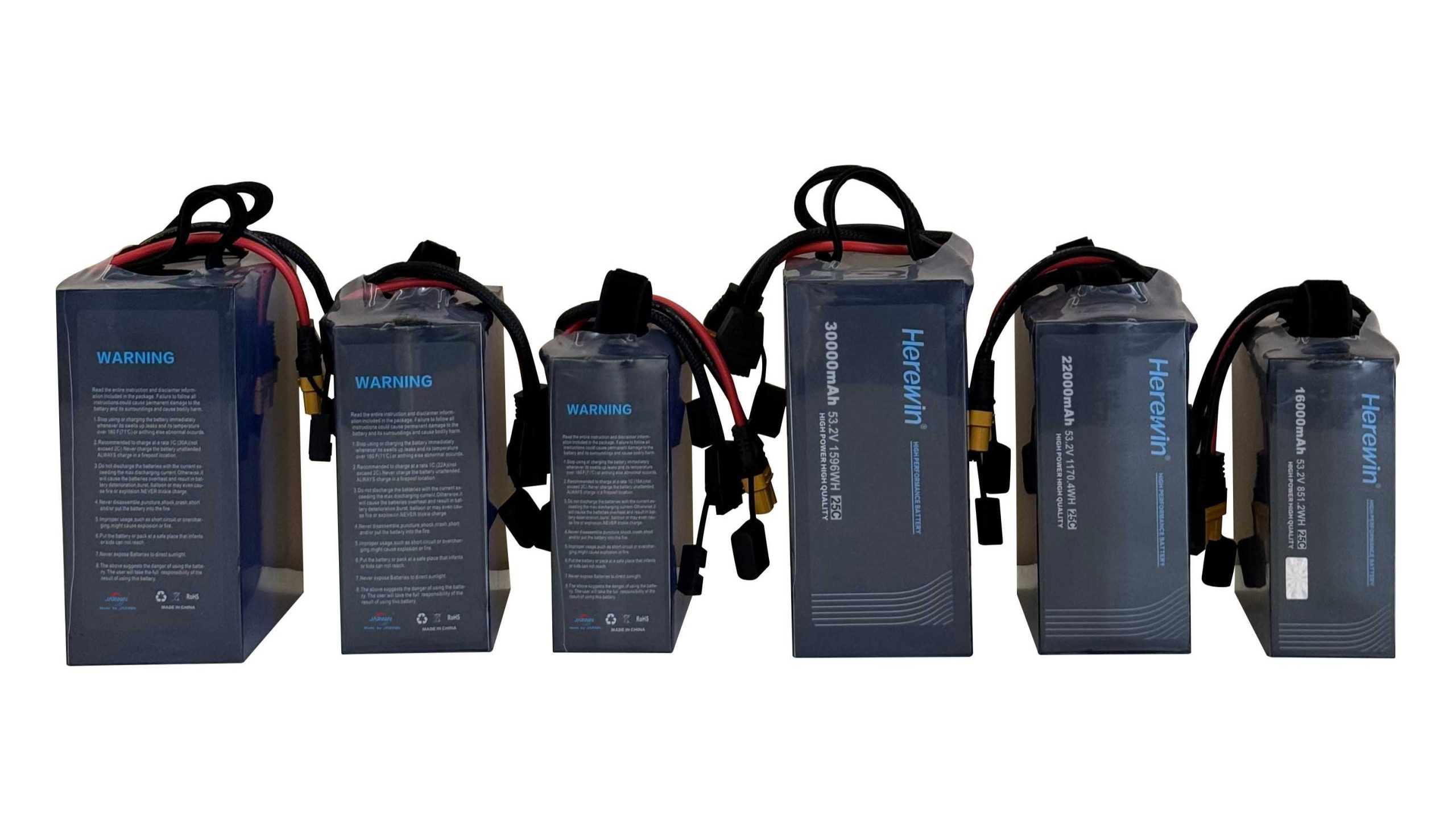
With that sheet in hand, a supplier can quote against your requirements instead of a generic catalog. Herewin builds smart drone batteries with integrated BMS communication and supports industrial UAV programs with customized BMS communication, pack design and system validation. Share your battery, BMS and communication requirements with Herewin’s integration team, and we can work through the configuration your aircraft needs.



 العربية
  English
  Español
  한국어
한국어  Deutsch
  Français
  日本語
日本語  Русский
  Bahasa Indonesia
  ไทย
ไทย  Português do Brasil
  Italiano
  Nederlands