
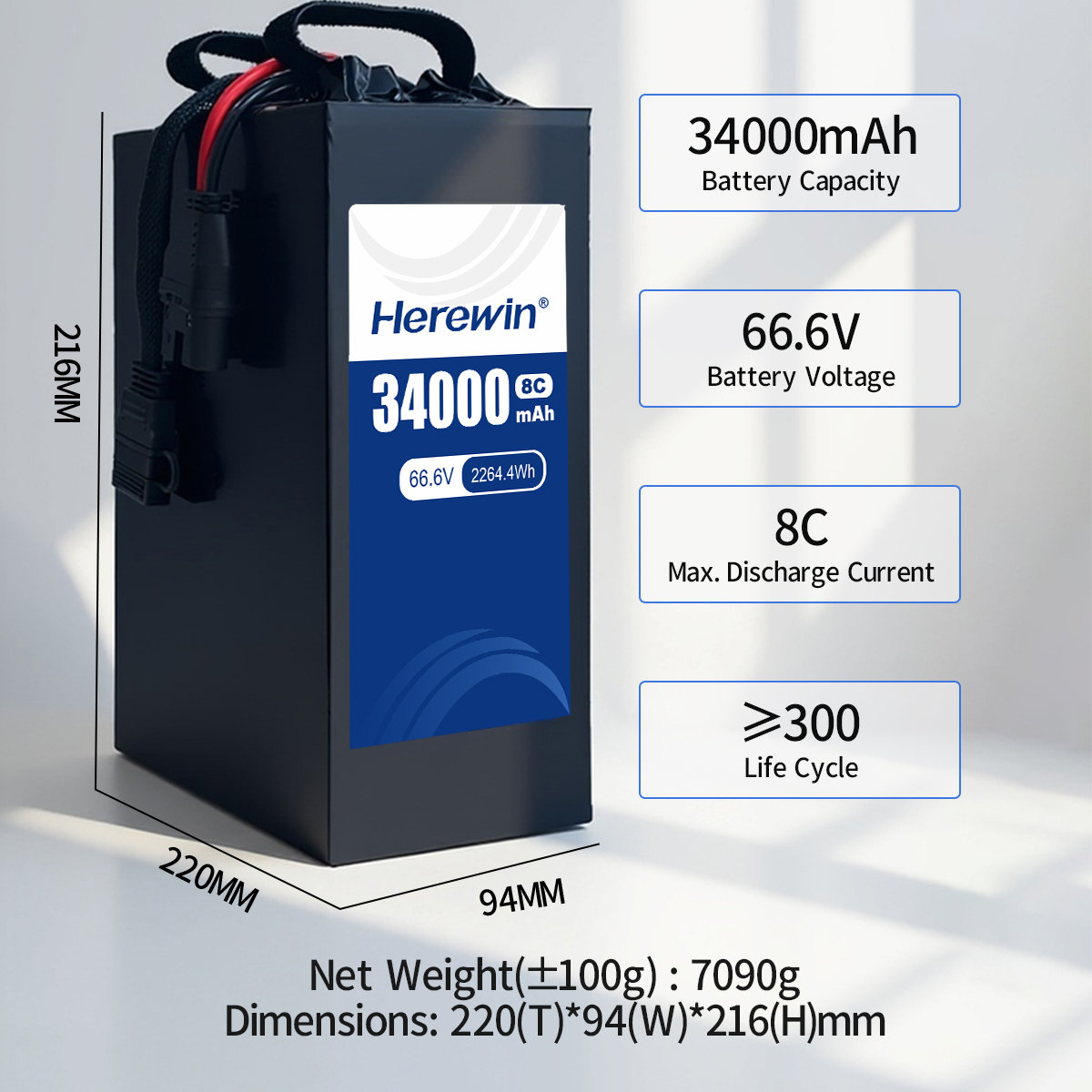
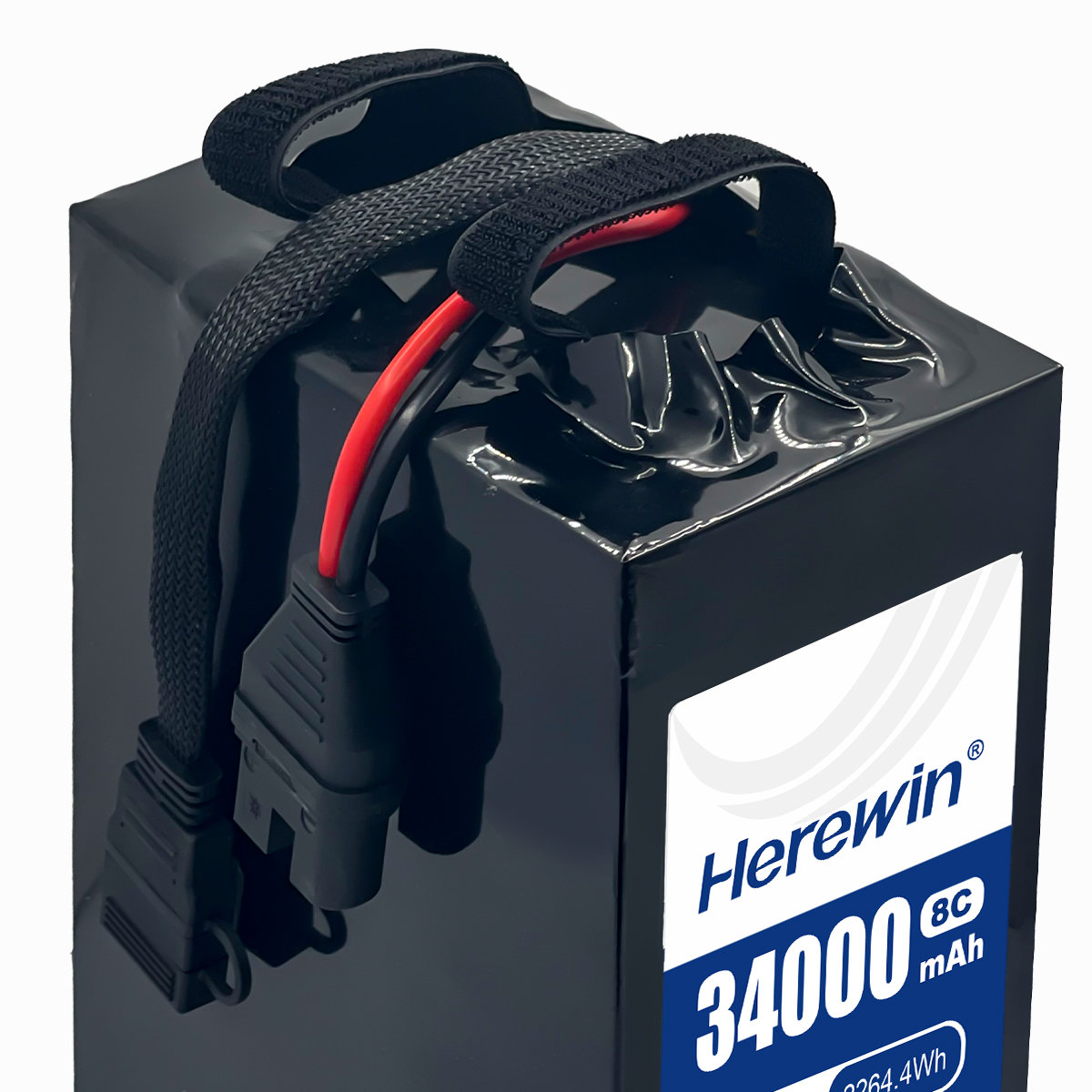
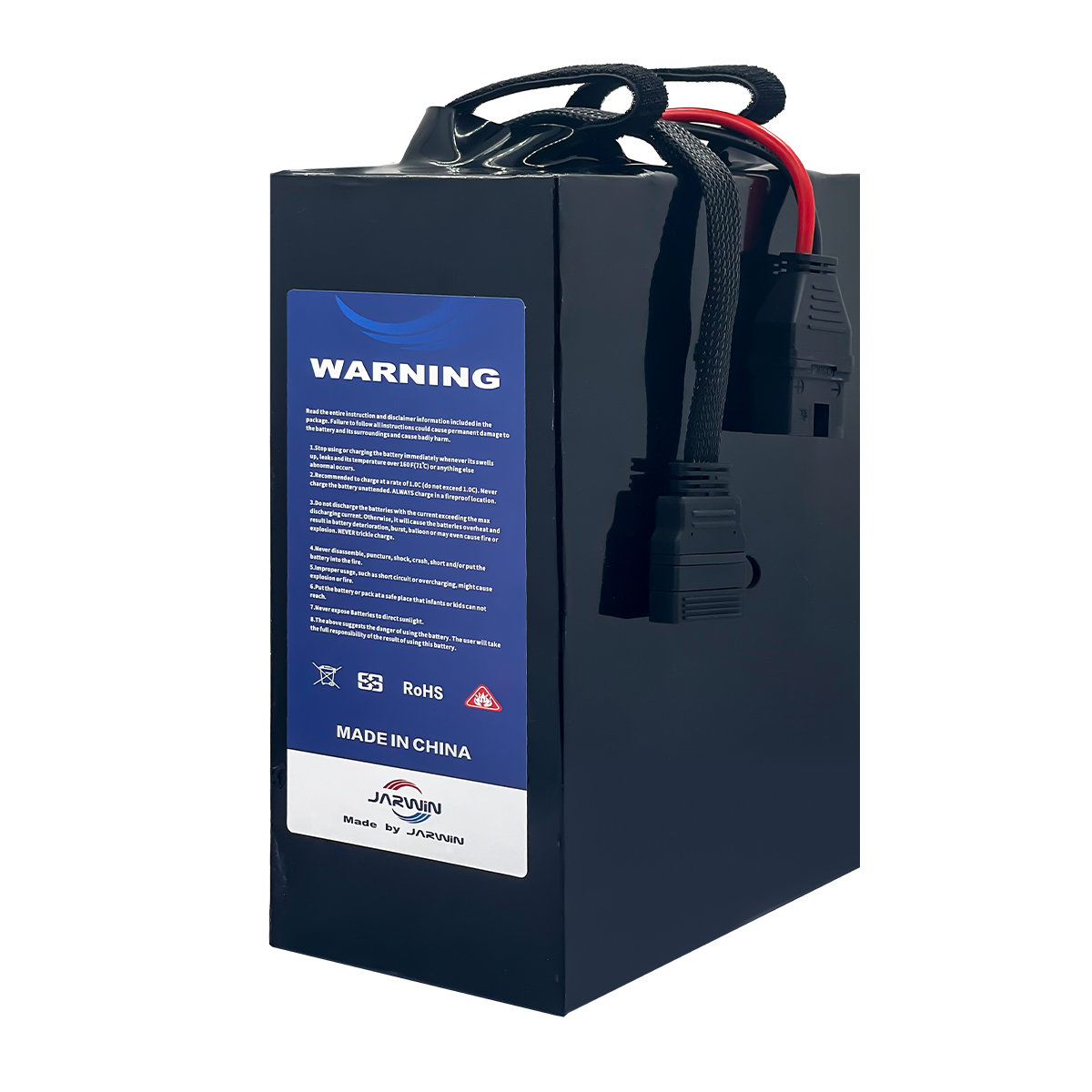
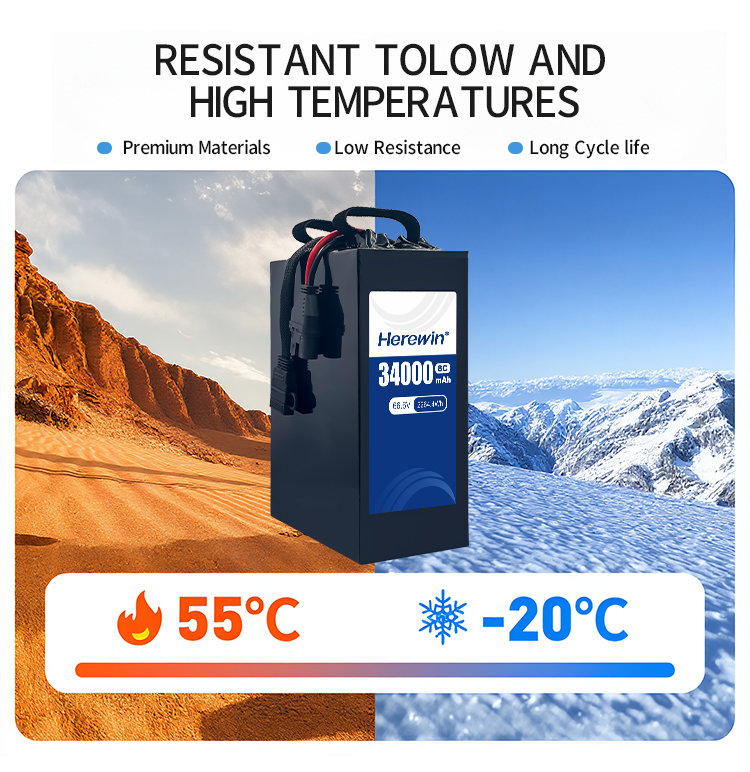

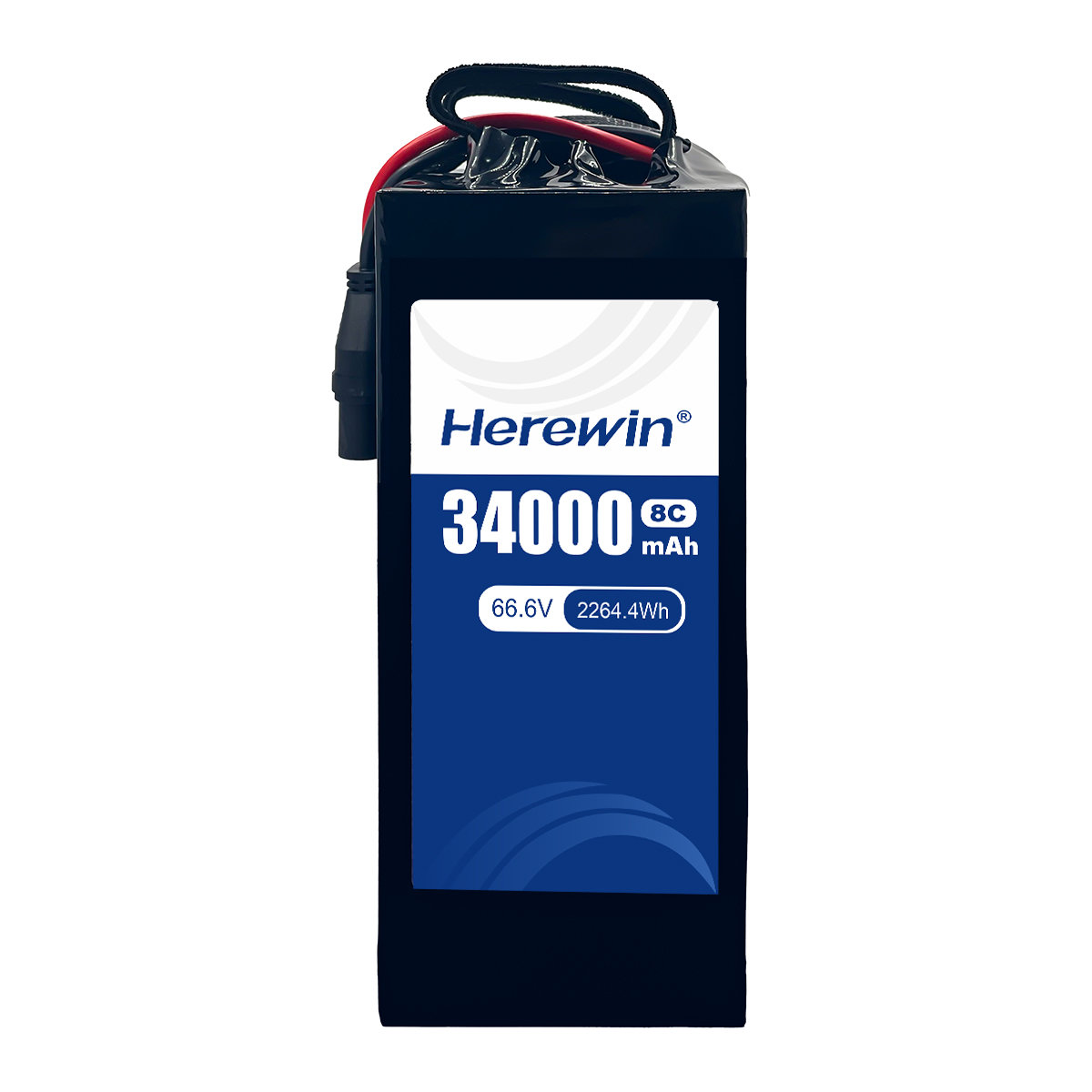
Herewin 18S 66.6V 34000mAh High Energy Density NMC Drone Battery
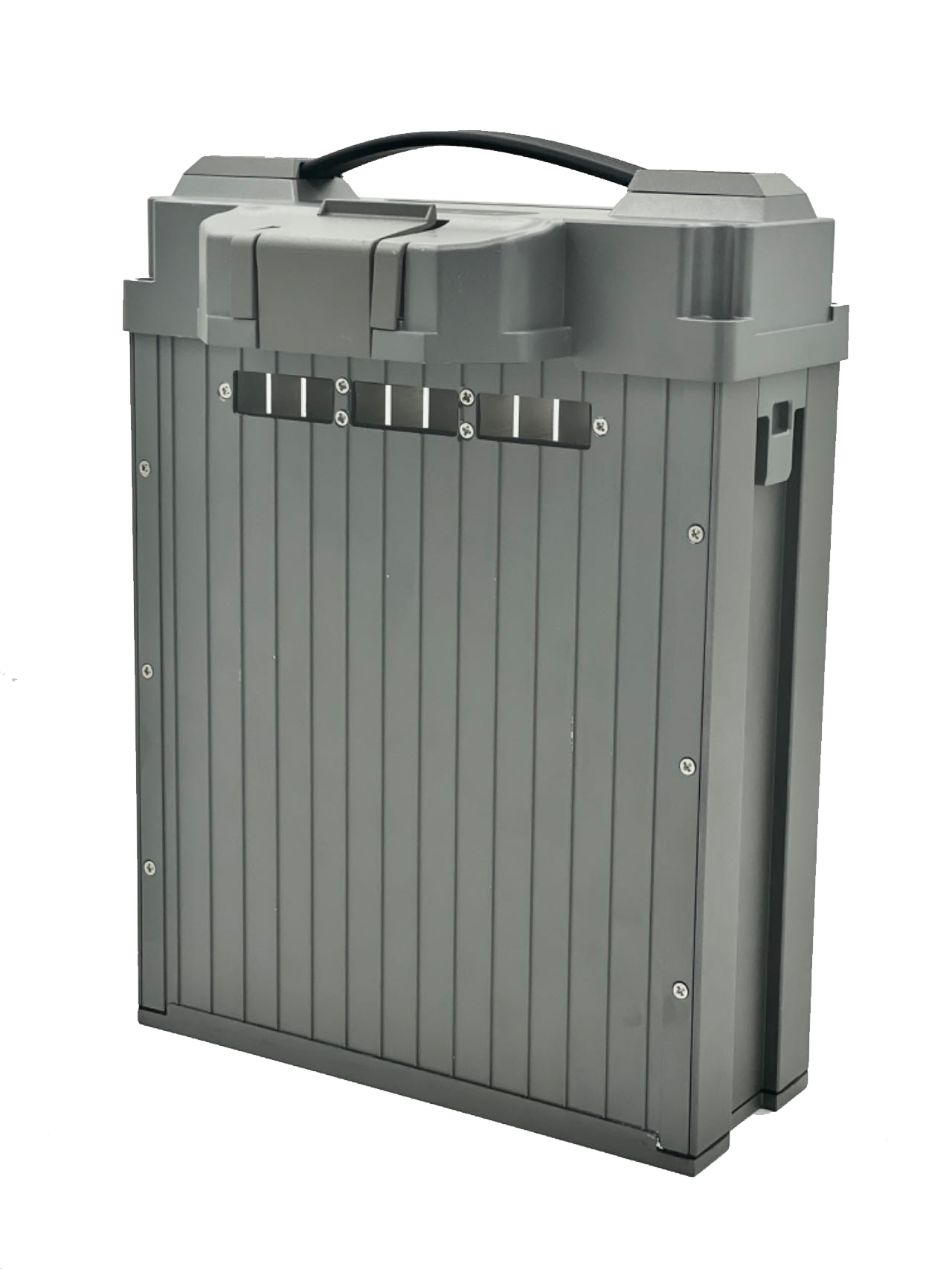
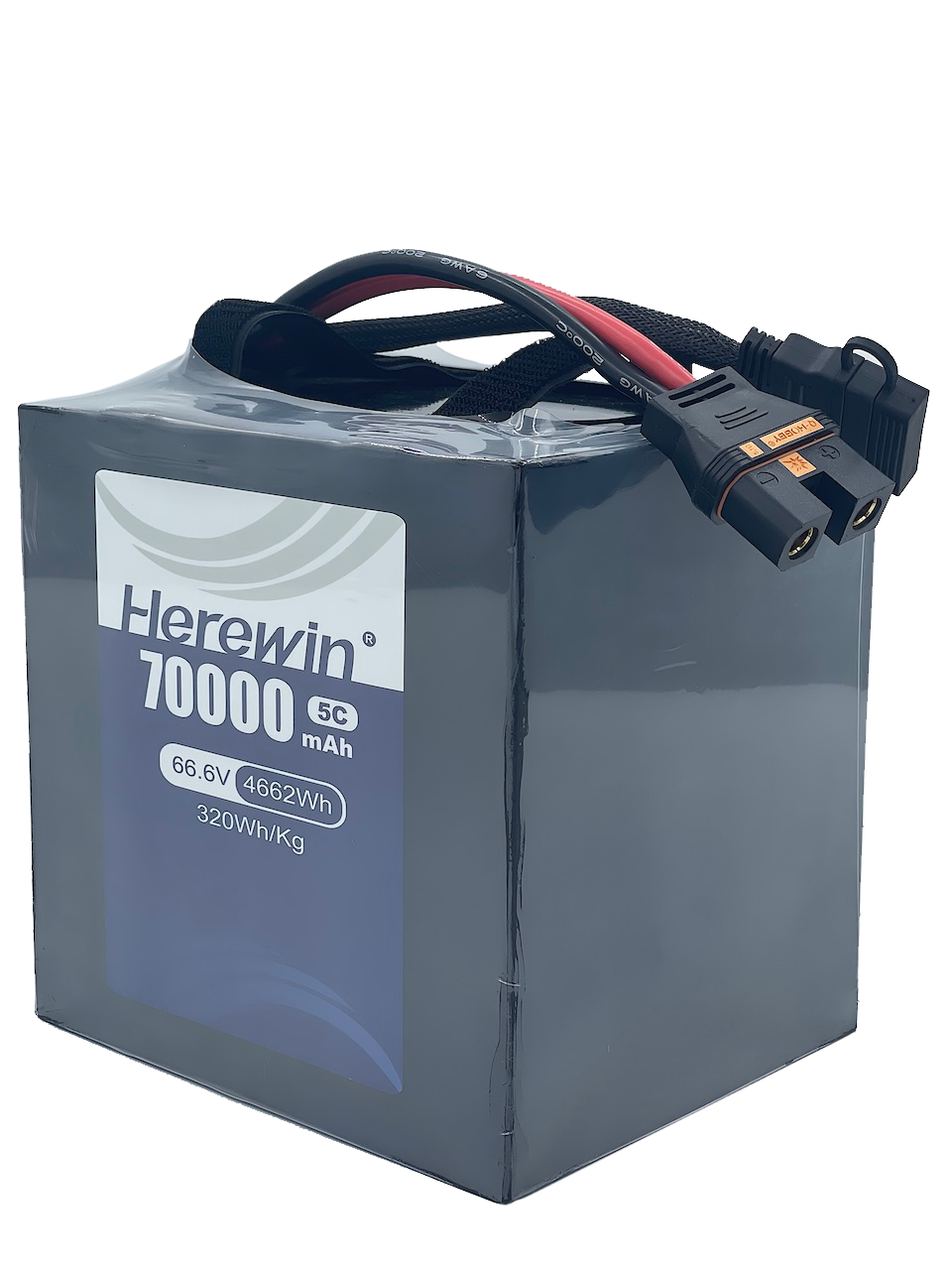
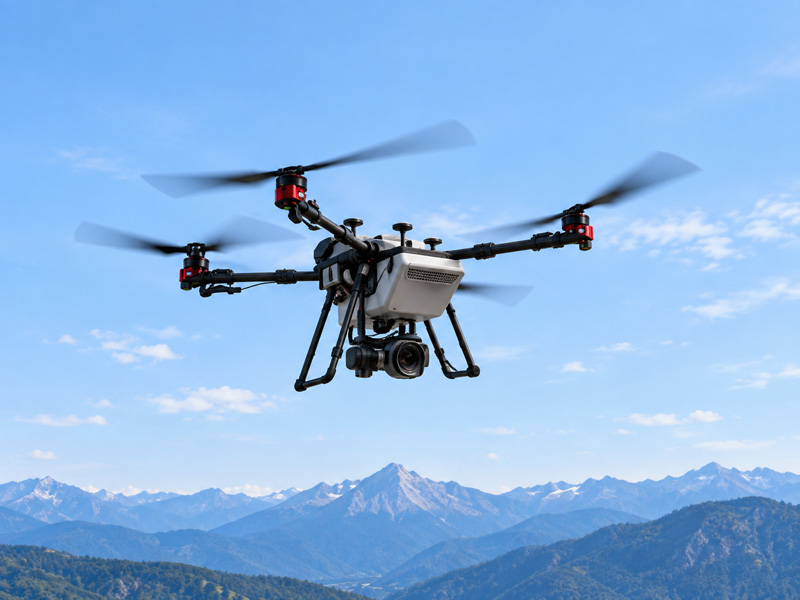
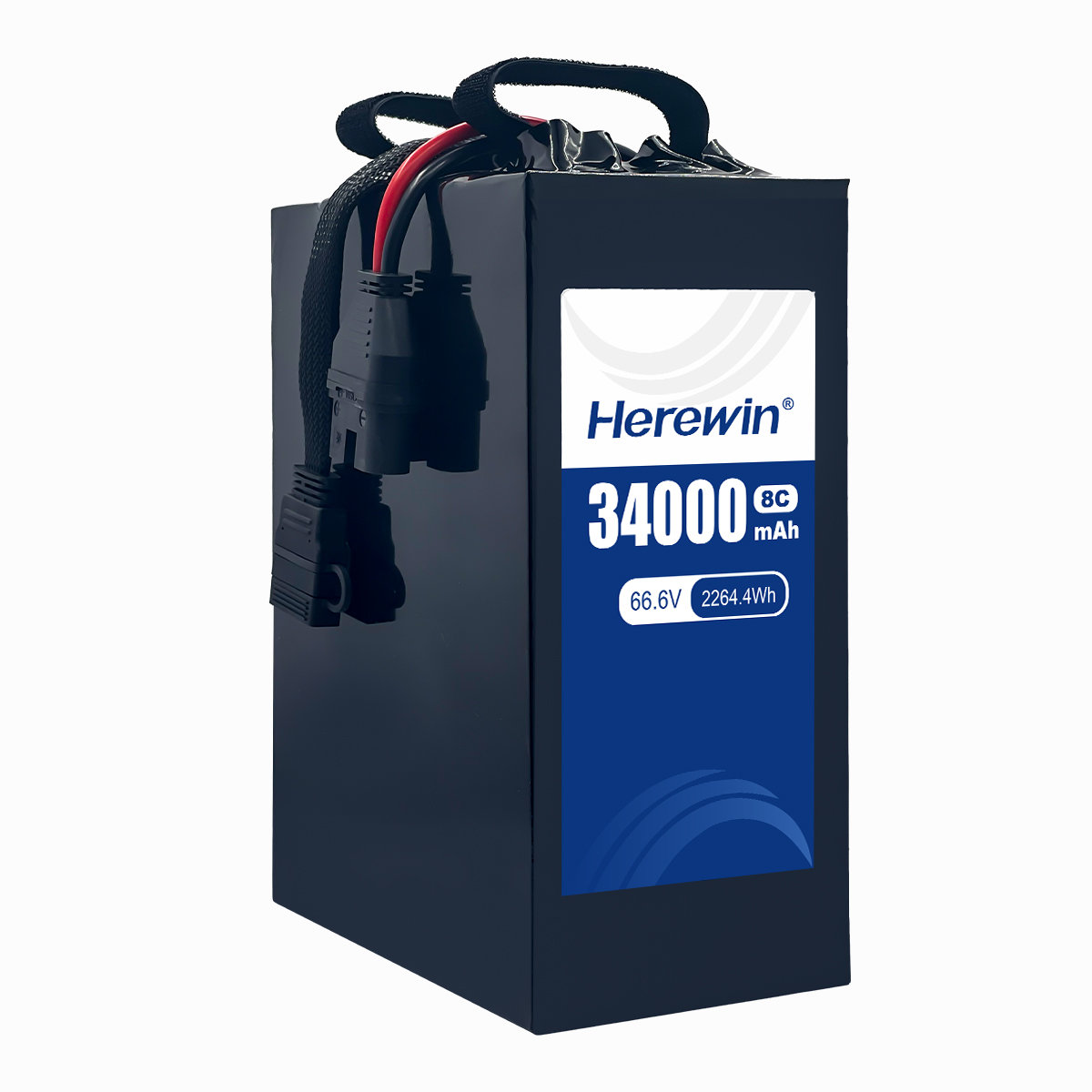
The 18S 66.6V 34000mAh high energy density drone battery combines NMC lithium technology with a 2264.4Wh energy capacity in a 7.09kg battery pack, designed for cargo, agricultural, cleaning, and long-endurance UAV applications.
· High Energy Density NMC Lithium Battery Technology
· 18S 66.6V 34000mAh Capacity with 2264.4Wh Nominal Energy
· Lightweight 7.09kg Battery Pack for UAV Weight Optimization
· 8C Rated Discharge Capability and 1C Maximum Charging Rate
· Designed for Cargo, Agricultural, Cleaning, and Long-Endurance Drones
18S 66.6V 34000mAh High Energy Density NMC Drone Battery Technical Specifications
| Model | T1090190EF |
| バッテリータイプ | NMC Lithium-Ion Drone Battery |
| Configuration | 18S1P |
| Nominal Voltage | 66.6V |
| Capacity | 34000mAh / 34Ah |
| Nominal Energy | 2264.4Wh |
| Energy Density (Pack) | Approx. 319Wh/kg (calculated) |
| Rated Discharge Rate | 8C (duration to be confirmed) |
| Max. Charging Rate | 1C |
| サイクル・ライフ | ≥300 cycles |
| Net Weight | 7090g ±100g |
| Dimensions | 220(T) × 94(W) × 216(H) mm |
| Cell Chemistry | NMC / Ternary Lithium |
| アプリケーション | Cargo Drone / Agricultural Drone / Cleaning Drone / Long-Endurance UAV |
18S 66.6V 34000mAh High Energy Density Drone Battery Overview
18S 66.6V 34000mAh High Energy Density Drone Battery Overview
The 18S 66.6V 34000mAh high energy density drone battery is developed for professional UAV platforms that require substantial onboard energy without unnecessary battery weight. Built with NMC lithium-ion technology, this 18S1P battery pack provides 2264.4Wh of nominal energy and weighs approximately 7.09kg, making it a suitable candidate for cargo transportation, agricultural operations, aerial cleaning, and long-endurance drone systems.
For industrial UAV manufacturers, battery selection involves more than capacity alone. Aircraft weight, electrical compatibility, power demand, mission duration, and installation space all influence the final battery configuration. The Herewin T1090190EF combines a 34Ah capacity, 66.6V nominal voltage, and a compact battery structure to address these requirements in professional UAV applications.
High Energy Density NMC Drone Battery Technology
Energy density is a key consideration when developing drones that must carry useful payloads or operate for extended periods. Higher battery energy density allows designers to increase onboard energy without a proportional increase in battery mass, helping them balance flight endurance against the aircraft’s total takeoff weight.
This battery uses nickel manganese cobalt (NMC) lithium-ion chemistry, commonly referred to as ternary lithium technology. NMC cells are used in applications where energy storage capacity and weight efficiency are important design considerations. With a nominal energy capacity of 2264.4Wh and a pack weight of approximately 7.09kg, this configuration provides a calculated pack-level specific energy of approximately 319Wh/kg.
For UAV engineering teams evaluating different battery configurations, these figures provide a practical starting point for comparing available energy and battery mass. Actual flight endurance will depend on the drone’s propulsion efficiency, payload, weather conditions, usable battery capacity, and operating profile.
18S 66.6V 34Ah UAV Battery for Professional Power Systems
The 18S1P configuration delivers a nominal voltage of 66.6V and a capacity of 34000mAh. This electrical configuration is intended for UAV systems designed to operate with a compatible 18S lithium-ion battery platform.
Voltage compatibility is particularly important for industrial multirotor aircraft, where the propulsion system, electronic speed controllers, wiring, and onboard electronics must operate within their specified electrical limits. Selecting an appropriate battery voltage can support more efficient system integration and reduce the need for unnecessary changes to the aircraft’s power architecture.
The 34Ah capacity provides a substantial energy reserve for applications involving extended operating periods or repeated professional missions. However, battery suitability should always be evaluated against the aircraft’s actual voltage range, continuous current requirements, and peak power demand.
Lightweight UAV Battery Design for Payload and Endurance Optimization
Every kilogram of battery weight affects the overall weight budget of an unmanned aircraft. For cargo drones, reducing unnecessary battery mass can help preserve the weight allowance available for transported goods. For cleaning drones, battery weight must be considered together with cleaning equipment, water hoses, and other operational loads.
The T1090190EF measures 220 × 94 × 216mm and weighs approximately 7090g, with a specified weight tolerance of ±100g. These dimensions allow UAV manufacturers to evaluate installation feasibility during the aircraft design and battery compartment planning stages.
A lightweight battery design does not automatically guarantee longer flight time. The practical benefit depends on the relationship between available battery energy, propulsion efficiency, payload requirements, and total aircraft weight. For this reason, Herewin recommends evaluating battery weight and usable energy together when selecting a high energy density UAV battery.
8C Rated Discharge Capability for Industrial Drone Applications
In addition to energy capacity, industrial UAV batteries must provide sufficient discharge capability for the aircraft’s operating demands. The T1090190EF has an 8C rated discharge specification, which should be evaluated against the customer’s continuous and peak current requirements.
Different flight conditions can create significantly different electrical loads. Takeoff, acceleration, hovering with payload, and changing operating conditions may all affect battery current demand. Matching the battery discharge characteristics to the aircraft’s actual power profile is therefore essential.
For engineering evaluation, customers are encouraged to provide their expected continuous discharge current, maximum current, and peak duration. These parameters help determine whether this 18S 34Ah configuration is appropriate for the intended propulsion system and operating conditions.
1C Charging and Battery Cycle Life
The battery supports a maximum charging rate of 1C and has a specified cycle life of at least 300 cycles. These characteristics should be considered when planning charging equipment, spare battery quantities, maintenance intervals, and the overall operating workflow.
For commercial drone fleets, battery management is an important part of controlling daily operating costs. Charging frequency, depth of discharge, temperature, storage conditions, and operating current can all influence long-term battery performance.
Aircraft operators should use charging equipment compatible with the battery’s specified charging voltage and current limits. The appropriate charger and operating procedures should be confirmed before deployment.
Cargo Drone Battery for Logistics and Transportation UAVs
Cargo drones require careful optimization of battery weight and energy capacity because every additional kilogram affects the aircraft’s payload and operating range. A high energy density cargo drone battery can be valuable for transportation platforms where battery mass, available energy, and mission planning must be considered together.
The 66.6V 34Ah NMC battery provides 2264.4Wh of nominal energy for compatible cargo UAV systems. It can be evaluated for transportation missions that require an appropriate balance between onboard energy and available payload capacity.
For logistics drone manufacturers, final battery selection should consider expected payload weight, route distance, propulsion efficiency, reserve energy requirements, and the aircraft’s allowable battery mass.
Agricultural Drone Battery for Field Operations
Agricultural drones operate in demanding environments where power requirements vary with aircraft size, payload, and field conditions. Battery weight and available energy are important factors for spraying, monitoring, and other agricultural UAV applications.
This 18S NMC lithium-ion battery can be considered for agricultural drone platforms designed around a compatible 66.6V nominal battery system. Its 34Ah capacity provides onboard energy for professional field missions, while the relatively lightweight pack design supports aircraft weight-budget planning.
For agricultural applications, manufacturers should verify the required discharge current, charging workflow, environmental protection, and compatibility with the intended aircraft before integration.
Cleaning Drone Battery for Aerial Cleaning Systems
Aerial cleaning drones often perform prolonged hovering operations while carrying specialized cleaning equipment. Depending on the system design, the aircraft may also experience additional forces associated with hoses, attachments, or operating near structures.
For these platforms, a cleaning drone battery must be selected according to actual hovering power, available energy, aircraft weight, and electrical compatibility. The T1090190EF offers an 18S 66.6V configuration and a 34Ah capacity that can be evaluated for suitable aerial cleaning systems.
Battery selection should be based on measured operating loads rather than nominal capacity alone. This is particularly important for cleaning applications involving extended hovering or changing environmental conditions.
Long Endurance UAV Battery for Extended Flight Missions
Long-endurance UAV applications place particular importance on maximizing usable onboard energy while controlling aircraft mass. Surveying, inspection, monitoring, and other extended missions can benefit from a battery configuration with a favorable energy-to-weight relationship.
With approximately 2264.4Wh of nominal energy and a 7.09kg pack weight, this NMC battery provides a potential solution for UAV designers seeking to optimize energy storage within a defined weight budget.
Flight duration depends on the complete aircraft system, including motor efficiency, propeller selection, payload, operating speed, environmental conditions, and usable battery energy. For accurate endurance estimates, customers should evaluate the battery alongside their aircraft’s measured power consumption.
Herewin NMC Battery Solutions for Industrial UAV Manufacturers
Herewin supports professional UAV battery development through cell technology, battery pack engineering, and application-oriented product selection. For manufacturers evaluating high energy density battery solutions, important considerations include electrical compatibility, discharge performance, structural dimensions, weight requirements, and long-term operating conditions.
When planning a new UAV platform or replacing an existing battery, customers can share their aircraft specifications, target endurance, operating current, allowable battery weight, and installation dimensions for technical evaluation.
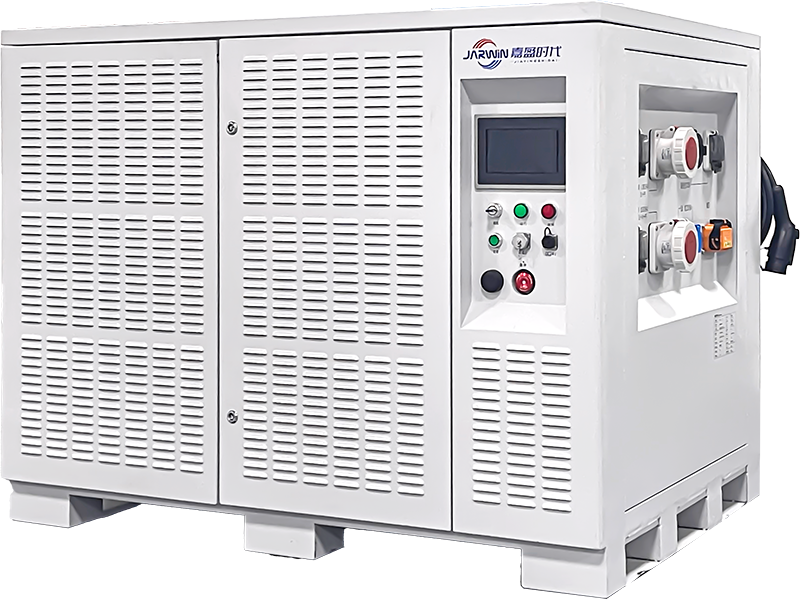
For related charging equipment, explore our drone battery charger solutions.
For additional drone battery configurations, browse our Herewin UAV battery products and solutions.
For more product case videos and application updates, please visit our social media channels.
18S 66.6V 34000mAh High Energy Density Drone Battery Applications
The 18S 66.6V 34000mAh high energy density NMC drone battery is designed for professional UAV platforms requiring high onboard energy capacity and weight-conscious battery integration. With 2264.4Wh of nominal energy and an approximate pack weight of 7.09kg, it can be evaluated for logistics, agricultural, cleaning, and long-endurance UAV operations.
- Cargo and Delivery Drones: High energy density power for compatible cargo UAV platforms where payload capacity and battery weight must be carefully balanced.
- Agricultural Drones: 18S 66.6V NMC battery solution for agricultural UAV platforms with suitable operating voltage and discharge requirements.
- Cleaning Drones: High-capacity lithium-ion battery for aerial cleaning systems requiring sustained hovering and careful weight management.
- Long-Endurance UAVs: Energy-dense battery configuration for professional aircraft designed to optimize flight duration within a defined weight budget.
High Energy Density NMC Drone Battery Detail Display
関連商品
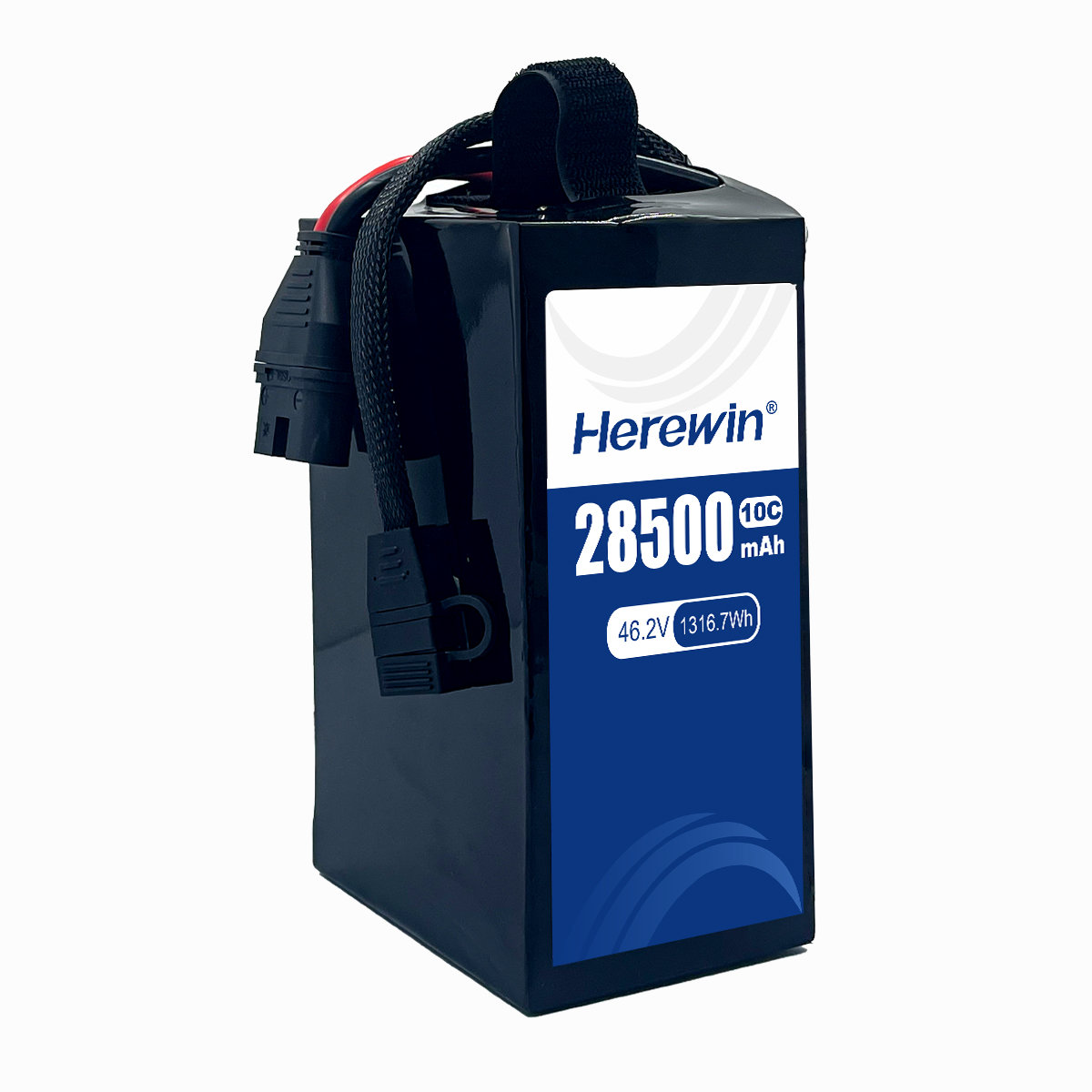
· 12S1P LiHV battery platform with 3.85V nominal cell voltage
· 28500mAh capacity for logistics, cleaning and agricultural drones
· 10C discharge capability for professional UAV power requirements
· Cobalt-based ternary lithium chemistry with semi-solid technology
· 4570g battery pack, 1C charging and ≥300 cycles
· 400Wh/kg ultra-high energy density for extended flight time
· Semi-solid NMC-based energy platform for lightweight UAV integration
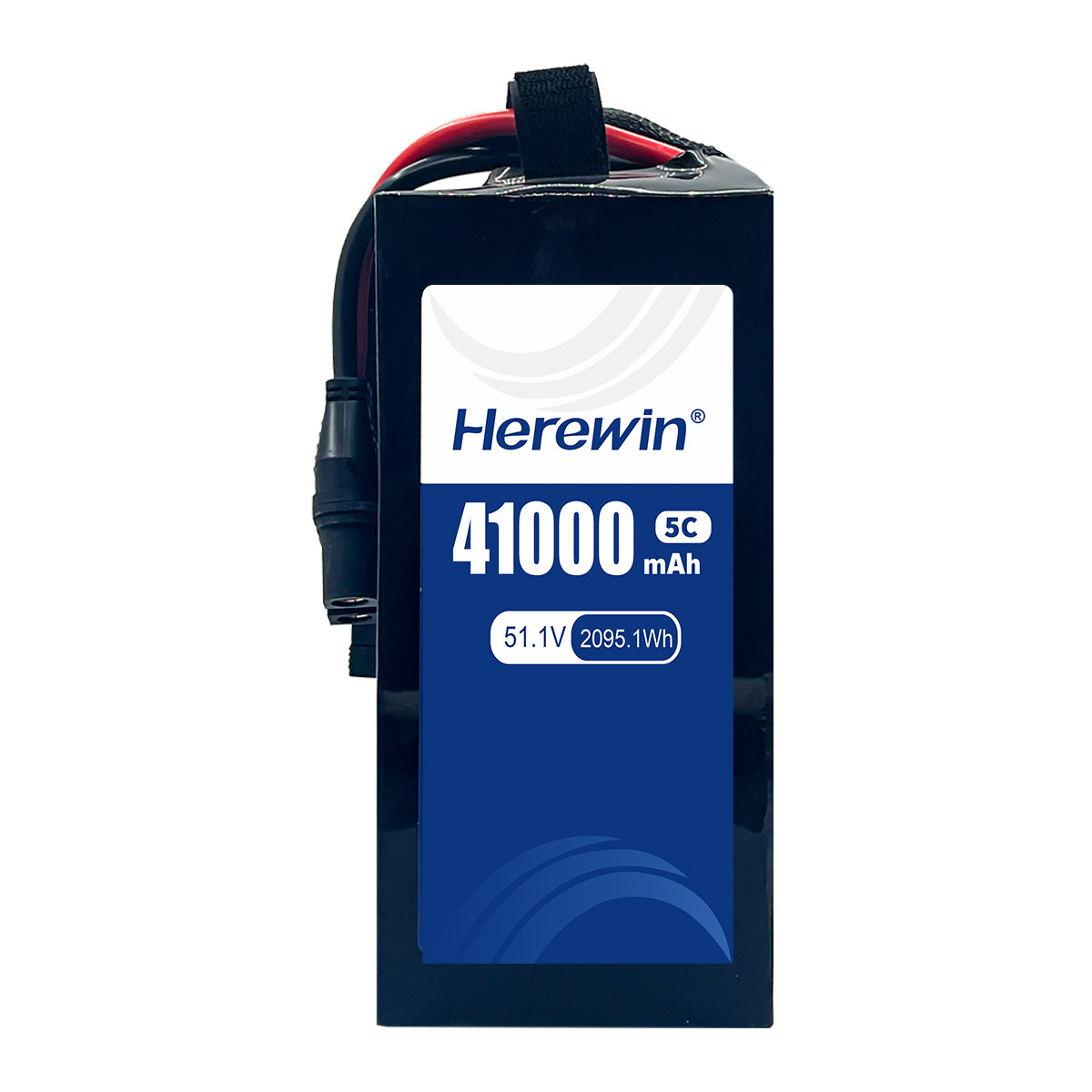
· 14S1P 51.1V 41000mAh platform with only 5700g pack weight
· 8C discharge for stable endurance-focused drone output
· Cycle life ≥400 with operating temperature range of -20~60℃
· 350Wh/kg high energy density for extended flight time
· Semi-solid NMC-based energy platform for high-end UAV integration
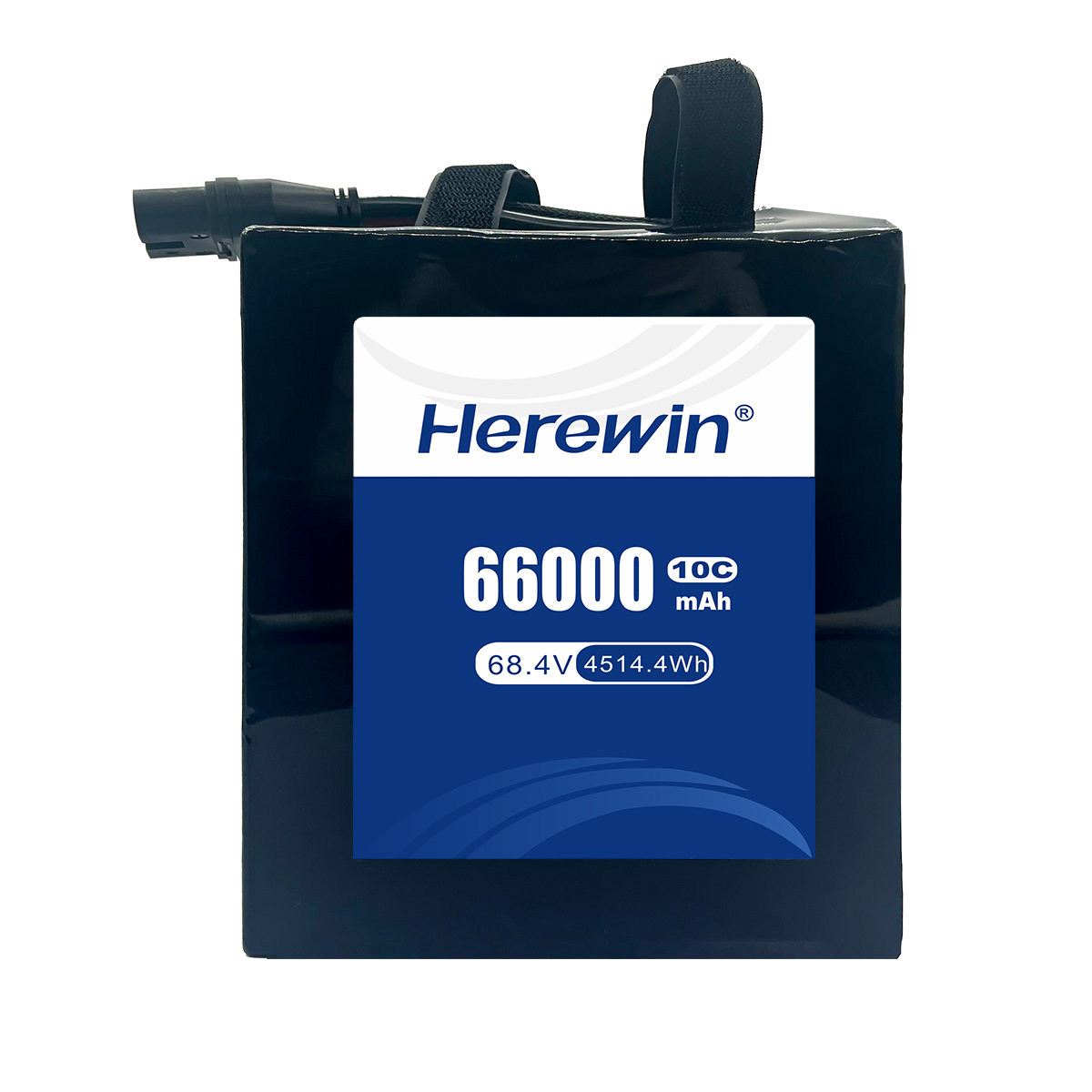
· 10C discharge for stable heavy-duty drone output
· 18S2P 68.4V 66000mAh platform with 13950g pack weight
· Cycle life ≥100 with operating temperature range of -20~60℃

· 320Wh/kg high energy density for longer usable endurance
· 15C discharge for stable heavy-duty UAV output
· 24S2P 88.8V high-voltage platform for large industrial drone systems
· 90000mAh large-capacity reserve with 26300g pack weight
· Recommended connector options: QS10 / QS12 / AS150U, final connector can be customized

·Semi-solid battery with 280Wh/kg high energy density
·10C high-rate discharge for demanding UAV power output
·Lightweight 6.1kg design for longer flight endurance
·1C charging and ≥800 cycle life for reliable operation
·Ideal for agricultural, cleaning, and logistics drones
関連ニュース
Need a High Energy Density NMC Battery for Your UAV?
Tell us your drone application, required voltage, target flight endurance, payload weight, continuous and peak discharge current, and battery installation limits. Herewin can help evaluate a suitable NMC drone battery solution for your UAV platform.
 日本語
 English
 Español
 한국어
 Deutsch
 Français
 Русский
 Bahasa Indonesia
 ไทย
 العربية
 Português do Brasil
 Italiano
 Nederlands