







The rapid global expansion of 5G infrastructure has fundamentally transformed base station power demands. Higher equipment densities and dynamic edge workloads create strict physical and operational energy constraints across urban and remote sites alike. Legacy Valve-Regulated Lead-Acid (VRLA) batteries—engineered for lower load densities and manual maintenance—now face severe operational limitations in usable depth of discharge, thermal tolerance, and remote health visibility.
To protect network availability and control lifecycle operational expenditure (OPEX), telecom decision-makers, EPC contractors, and infrastructure integrators are accelerating 48V lithium battery replacement for telecom infrastructure. The primary engineering challenge is no longer proving lithium’s superiority, but executing a telecom battery retrofit that reduces maintenance costs and backup risks without requiring a complete overhaul of installed -48V DC power infrastructure.
This decision guide explains why telecom operators and integrators are accelerating 48V LiFePO4 retrofits, what engineering factors determine successful deployment, how to evaluate supplier capability, and why lifecycle economics favor modern lithium systems.
Why 5G Densification Makes Battery Reliability a Network-Level SLA Issue
In the 4G era, macro-sites were relatively few, power loads were predictable, and occasional battery maintenance during routine truck rolls was manageable. Modern 5G deployments fundamentally change telecom site economics. Managing tens of thousands of distributed micro-cabinets, small cells, and urban rooftop sites means that physical battery maintenance becomes cost-prohibitive.
When a network relies on thousands of unmonitored legacy batteries, an undetected battery failure at a single site no longer causes an isolated fault—it risks cascading Service Level Agreement (SLA) breaches across dense urban coverage zones. As base stations shift from static infrastructure to dynamic edge nodes, energy reliability transitions from a simple maintenance task to a core operational risk.
Why Changing Site Workloads Limit Legacy Lead-Acid Systems
Lead-acid batteries remain a mature and low-initial-cost technology. VRLA technology was optimized for stable standby environments with predictable maintenance access and lower power draws. Rather than a failure of lead-acid chemistry itself, the acceleration of telecom battery retrofit initiatives reflects an evolution in site requirements that legacy systems were never engineered to support.
5G site expansion creates a clear power density and O&M mismatch. Legacy VRLA banks require frequent replacement, consume nearly double the cabinet space per usable kWh, and lack automated remote State of Health (SOH) telemetry.
Shorter Service Life Creates Frequent Replacement Cycles
In float-charge standby service at 25°C, standard VRLA telecom batteries typically achieve 3 to 5 years of standby service life, depending on temperature, float conditions, and discharge frequency. In warm climate zones or unconditioned outdoor cabinets where ambient temperatures regularly exceed 35°C, lead-acid aging accelerates dramatically—VRLA service life can decrease significantly as operating temperatures rise, with many manufacturers referencing approximately 50% life reduction for every 10°C increase above the recommended operating temperature.
Across distributed base station networks, a short 3-to-5-year replacement cycle creates an ongoing, recurring burden on procurement, field logistics, manual installation, and battery disposal.
Large Footprint and Weight Limit Site Optimization
Compared with compact lithium modules, VRLA technology requires significantly more physical space and weight to deliver the same usable backup power. Providing 4 to 8 hours of emergency backup power for a high-power 5G macro site using legacy lead-acid cells requires massive, heavy battery strings:
Floor-Loading Constraints: Heavy multi-string VRLA configurations often exceed structural floor-load limits on urban rooftops or leased utility poles, requiring expensive structural reinforcement before active 5G equipment can be added.
Cabinet Real Estate: In compact outdoor enclosures, multi-string lead-acid configurations consume 6U to 12U of vertical rack space. This restricts available space for additional 5G rectifiers, baseband units (BBUs), or revenue-generating edge servers.
Limited Visibility into Battery Health
Legacy lead-acid systems offer minimal telemetry beyond total string voltage. Simple voltage readings fail to reveal internal resistance growth, individual cell degradation, or capacity loss (SOH decay).
Without automated cell-level monitoring, field technicians must conduct physical site visits (“truck rolls”) to perform manual discharge testing and specific gravity checks. When a grid outage occurs, degraded lead-acid cells can experience rapid voltage collapse within minutes, causing sudden site outages, dropped calls, and strict SLA breach penalties before technicians can respond.
What Changes When Telecom Sites Upgrade to 48V Lithium Battery Systems?
Upgrading a base station from legacy lead-acid to a 48V LiFePO4 system goes beyond swapping hardware—it updates site power from passive standby storage to an active, remotely managed energy asset.
Operational Parameter | Legacy VRLA Backup | Modern 48V LiFePO4 Retrofit |
|---|---|---|
Outage Response | Passive discharge, unmonitored cell decay | Active BMS protection with remote telemetry |
Usable Capacity | Limited to ~50% DoD before rapid voltage collapse | 80%–90%+ DoD with flat voltage plateau |
Maintenance Impact | Frequent emergency truck rolls upon battery failure | Automated NOC alerts for predictive maintenance |
Longer Backup Life with Higher Usable Energy Capacity
Telecom-grade LiFePO4 systems deliver superior energy density—typically achieving 100–150 Wh/kg at the pack level depending on enclosure design and BMS integration—paired with exceptional cycle longevity:
Usable Capacity (DoD): Lead-acid banks are typically limited to around 50% DoD in telecom applications to avoid accelerated capacity degradation and shortened service life. In contrast, telecom-grade 48V LiFePO4 batteries operate comfortably at 80% to 90%+ DoD. A 51.2V 100Ah (nominal 5.12 kWh) lithium battery delivers approximately 4.6 kWh of usable energy under a 90% DoD assumption, whereas a nominal 48V 100Ah lead-acid bank yields only 2.4 kWh of usable power.
Mitigation of Peukert’s Effect: Under high-current discharge conditions typical of 5G peak traffic, lead-acid effective capacity drops significantly due to Peukert’s law. LiFePO4 batteries maintain stable voltage plateaus and deliver virtually full rated capacity even under rapid C-rate discharge.
Extended Cycle Longevity: Quality 48V telecom-grade LiFePO4 systems deliver 4,000 to 6,000+ cycles under controlled laboratory conditions, while actual telecom field service life is governed by calendar aging, operating temperatures, and BMS float management—typically supporting a 10+ year design service life when properly managed under suitable temperature and charging conditions.
Reduced Maintenance Frequency and Operational Truck Rolls
LiFePO4 cells are sealed, maintenance-free units that require no water replenishment, terminal cleaning, or periodic equalization charging. By replacing 3-year lead-acid replacement cycles with a 10-year design service life under typical operating conditions, operators eliminate routine battery maintenance visits.
In many retrofit scenarios, lithium adoption can significantly reduce battery-related maintenance visits by eliminating routine replacement and manual inspection requirements, allowing engineering teams to shift resources from reactive firefighting to planned network expansion.
Intelligent Battery Monitoring and Remote O&M
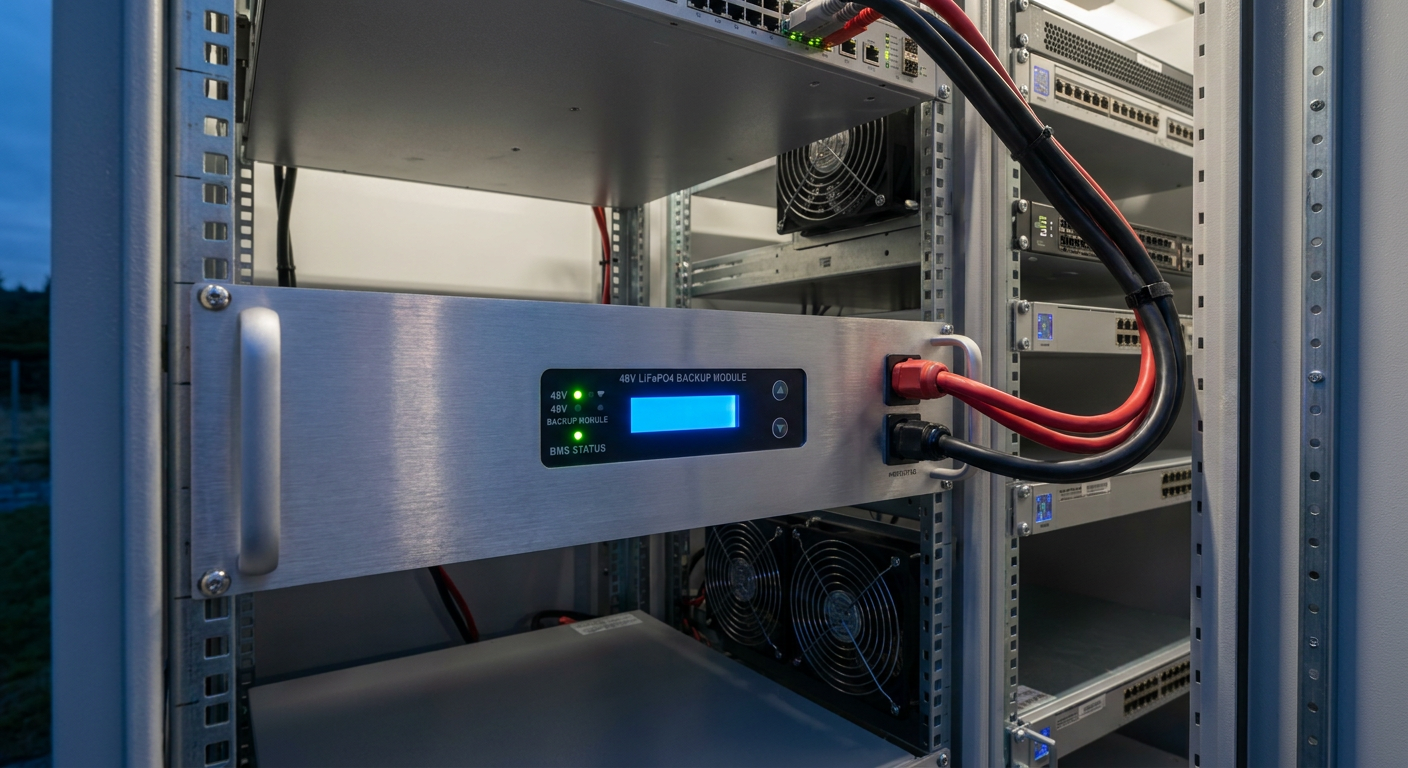
Every modern 48V telecom lithium battery includes an integrated Battery Management System (BMS). The BMS acts as an intelligent edge controller that continuously measures cell-level parameter data:
Real-Time Metrics: Voltage, charge/discharge current, internal cell temperature, State of Charge (SOC), and State of Health (SOH).
Automated Safety Protection: Over-voltage, under-voltage, short-circuit, over-current, and multi-stage thermal monitoring and protection mechanisms.
Remote Telemetry: Integrated RS485, CANbus, or SNMP interfaces feed real-time diagnostics directly into the operator’s Network Operations Center (NOC) or Energy Management System (EMS).
Instead of waiting for an outage to discover a failed battery, site managers receive automated predictive alerts when individual cell voltage drift exceeds safety thresholds, enabling targeted preventative maintenance during scheduled maintenance windows.
From Backup Battery to Intelligent Energy Asset: Convergence with ESS
In modern network architectures, a base station backup battery is no longer just a passive emergency reserve. As operators face rising grid electricity tariffs and decarbonization targets, 48V lithium systems enable a transition toward distributed energy management platforms:
Peak Shaving and Load Shifting: In regions with time-of-use (TOU) electricity pricing, smart BMS units coordinate with hybrid rectifiers to charge batteries during off-peak hours and discharge during peak tariff rate hours, directly lowering site energy bills.
Solar Hybrid Integration: In weak-grid or off-grid locations across emerging markets, 48V LiFePO4 modules seamlessly integrate with solar PV controllers and microgrids, dramatically reducing diesel generator run-time and fuel logistics costs.
Why 48V Architecture Fits Modern Telecom Backup Applications
The -48V DC nominal standard has been the global telecommunications power architecture benchmark for over half a century. Deploying a dedicated 48V LiFePO4 battery for telecom base station backup ensures seamless integration with this long-standing standard.
Understanding why 48V architecture remains optimal—and how lithium retrofits interface with legacy plants—is essential for smooth field engineering.
Standard -48V DC Bus Infrastructure:
AC Grid Input → DC Rectifier (53.5V Float) → 5G BBU / AAU Base Station Loads → 48V Rack-Mount LiFePO4 Battery
Direct Compatibility with Existing Telecom -48V DC Systems
Standard telecom DC rectifiers operate on a floating bus system with a nominal output of -48V DC, maintaining float voltage settings between 52.5V and 54.0V DC and equalization settings up to 56.4V DC.
16-cell series (16S) LiFePO4 battery packs feature a nominal voltage of 51.2V (operating window: 43.2V to 57.6V DC). This voltage profile matches standard telecom rectifier outputs, allowing compatible 48V telecom backup power solutions to integrate with existing DC busbars with minimal infrastructure modification, avoiding expensive rectifier replacements or step-up/step-down converters.
What Telecom Engineers Should Check Before a 48V Lithium Retrofit
Upgrading a base station power bank from VRLA to LiFePO4 does not require replacing the entire DC power plant. However, field engineers and site integrators must verify four key system parameters to ensure seamless plug-and-play commissioning:
Rectifier Voltage Settings: Verify that the existing DC rectifier plant (e.g., Vertiv, Huawei, Delta, Eltek) supports programmable float (53.5V–54.0V) and charge cut-off voltages aligned with 16S LiFePO4 chemistry. Engineers should also verify lithium charging parameters, as LiFePO4 systems typically do not require the continuous float charging strategy used for legacy VRLA batteries.
Communication Protocol Matching: Ensure the lithium BMS supports pre-tested protocol drivers (RS485/CANbus) compatible with the installed site controller or EMS.
Busbar and Protection Sizing: Confirm that DC circuit breakers and busbars are rated for the higher peak charge/discharge currents enabled by lithium’s lower internal resistance.
Physical Cabinet Constraints: Check 19-inch rack depth and vertical U-space to maximize density when consolidating multiple VRLA strings into compact 2U/3U lithium modules.
Modular Parallel Expansion
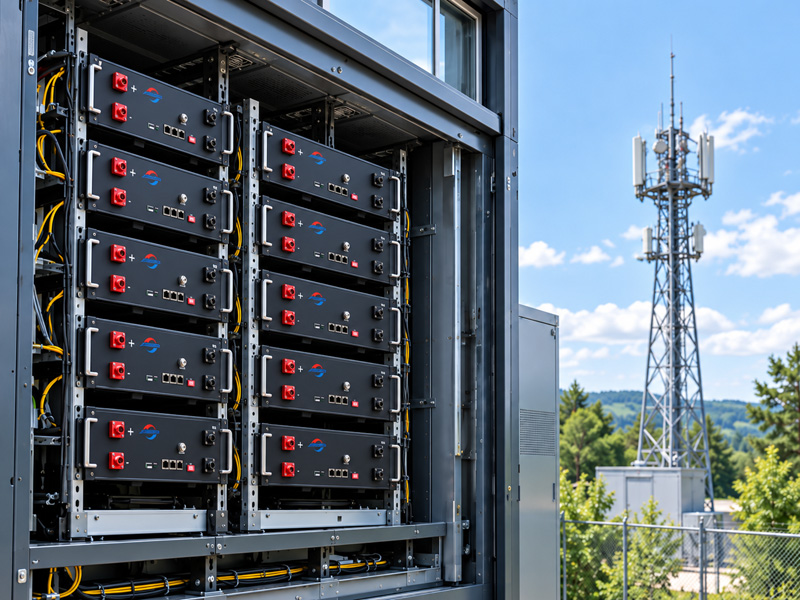
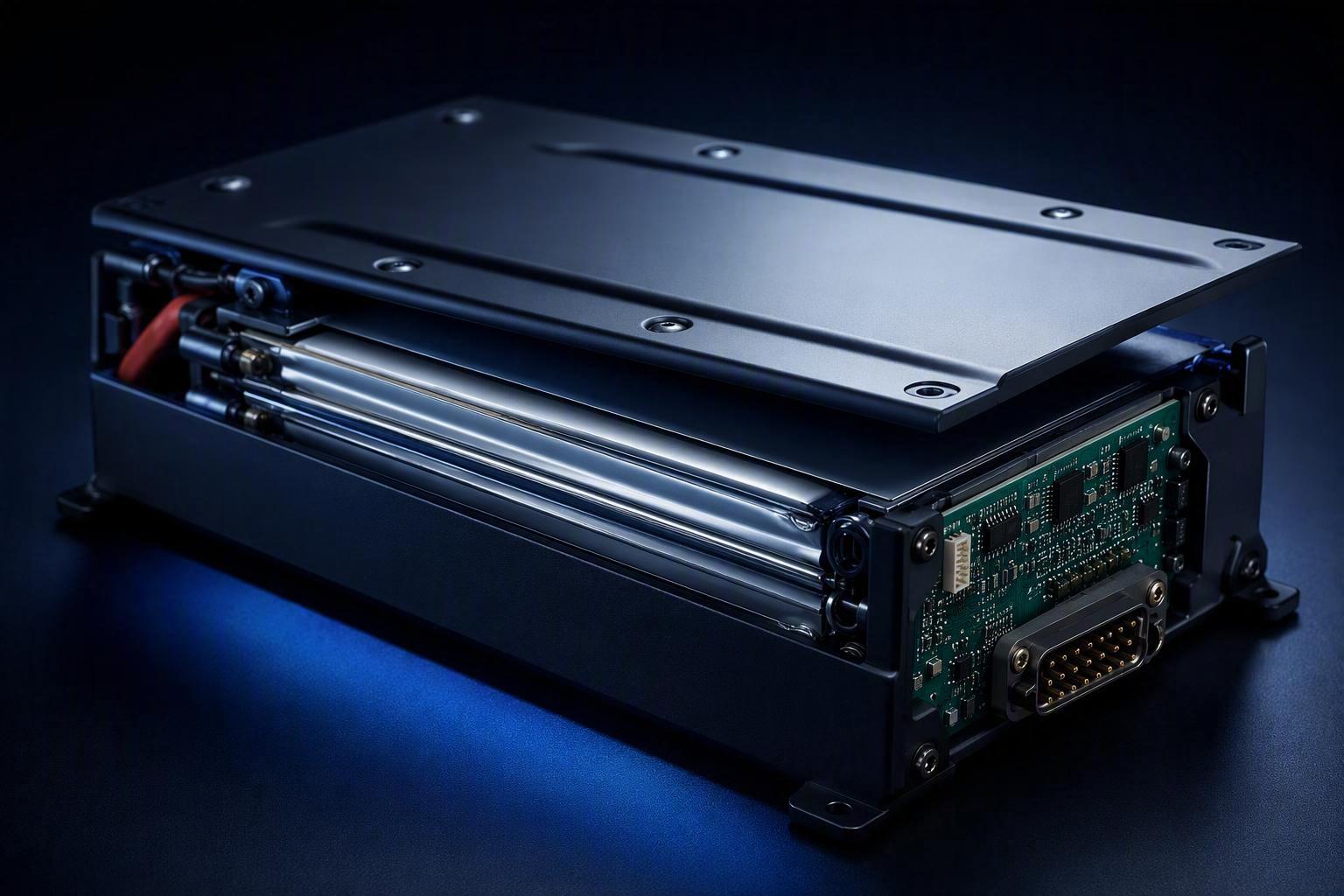
Modern telecom lithium batteries utilize standardized 19-inch rack-mount enclosures (typically 2U, 3U, or 4U high). Standard capacities include 50Ah (2.4 kWh), 100Ah (4.8 kWh), and 200Ah (9.6 kWh) modules.
Parallel Scaling: Integrated smart BMS controllers support automatic parallel address assignment, enabling 8 to 16+ battery modules to connect in parallel on a single DC bus without current-hogging or circulating current issues.
Flexible Sizing: A site can start with a single 100Ah module for 4G baseline power and seamlessly add additional 100Ah modules as 5G traffic grows, without discarding existing battery assets.
Wide Temperature Resilience and Thermal Management
Outdoor cabinet environments expose power electronics to severe temperature swings. While lead-acid batteries suffer severe capacity loss below 0°C and rapid grid corrosion above 30°C, LiFePO4 chemistry maintains broad operational stability:
Operating Range: Discharges reliably from -20°C to 55°C, and charges safely from 0°C to 50°C.
Thermal HVAC Savings: Because lithium batteries tolerate higher operating temperatures without accelerated degradation, operators can raise cabinet cooling setpoints from 22°C up to 30°C or 35°C. This directly lowers cabinet air-conditioning power draw and associated cooling OPEX.
Common Pitfalls in Telecom Lithium Battery Retrofits
While replacing legacy VRLA banks with 48V LiFePO4 batteries offers clear long-term operational advantages, field deployments can encounter unexpected commissioning delays if engineering details are overlooked. Telecom operators and integrators frequently encounter four common pitfalls:
Only Replacing Modules Without Verifying Rectifier Charging Profiles: Failing to adjust rectifier float and absorption voltage limits for 16S LiFePO4 packs can cause continuous overcharging or incomplete charging.
Ignoring BMS Protocol Compatibility: Installing batteries without pre-tested RS485 or CANbus protocol drivers for installed rectifiers (e.g., Vertiv, Huawei, Delta) leads to NOC monitoring blind spots and site communication alarms.
Sizing Batteries Based on Nominal Ah Instead of Usable Energy: Selecting a 100Ah lithium unit solely to match a nominal 100Ah lead-acid rating overlooks lithium’s superior Depth of Discharge (DoD), which often allows smaller, lower-weight pack configurations.
Deploying Residential or Non-Telecom Grade Lithium Packs: Using standard commercial batteries lacking telecom-grade thermal protection, dry-contact alarm outputs, or 19-inch rack-mount chassis compromises site reliability under harsh outdoor conditions.
Once these engineering prerequisites and risk factors are addressed, evaluating a lithium retrofit project centers on quantifying its long-term financial impact.
48V Lithium Retrofit vs. Lead-Acid: Evaluating Total Cost of Ownership (TCO)
While 48V lithium batteries carry a higher initial purchase price (CAPEX) than VRLA batteries, evaluating backup power solely on initial purchase price is misleading. In many telecom retrofit scenarios, lithium systems can significantly reduce 10-year battery-related operating costs, especially in high-temperature regions, remote sites, and networks with high maintenance logistics.
Example TCO Comparison for a Typical Telecom Retrofit Scenario
Estimated Scenario Assumptions:
Single 5G macro site requiring 4.8 kWh usable backup power (48V 100Ah usable requirement).
Electricity cost: $0.15/kWh. Technician truck roll cost: $150 per visit.
Parameter / Cost Driver | Legacy VRLA Lead-Acid Bank | Upgraded 48V LiFePO4 System | Financial & Operational Impact |
|---|---|---|---|
Nominal Capacity Needed for 4.8 kWh Usable | 48V 200Ah (9.6 kWh nominal @ 50% DoD) | 48V 100Ah (5.12 kWh nominal @ 90% DoD) | Lithium requires 47% less nominal capacity |
Initial Battery CAPEX | ~$1,200 | ~$2,200 | Lithium initial CAPEX is ~83% higher |
Expected Lifespan (at 30°C average site temp) | 3.3 Years (~400 cycles) | 10+ Years (4,000+ cycles) | Lead-acid requires ~2-3 replacements over 10 years |
10-Year Battery Replacement CAPEX | ~$2,400 – $3,600 (2 to 3 replacement cycles) | $0 (0 replacement cycles) | Lithium saves $2,400 – $3,600 in replacement units |
10-Year Maintenance & Truck Roll Labor | ~$1,800 (12 scheduled/unscheduled visits) | ~$300 (2 inspection visits) | Lithium saves $1,500 in maintenance OPEX |
Cabinet HVAC Energy Consumption (10 Years) | High (cooling required to maintain 25°C) | Low (tolerates 35°C setpoints) | Saves ~$800 in HVAC energy costs |
Round-Trip Energy Efficiency | ~75% – 80% | ~95% – 98% | Lithium wastes 15% less charging energy |
Total 10-Year Estimated TCO | ~$5,400 – $6,600 | ~$3,300 | Net TCO Savings: ~38% – 50% per site |
Across a large-scale multi-site deployment, switching to 48V lithium delivers substantial accumulated lifecycle savings, with payback periods commonly achieved within several years, depending on climate conditions, labor costs, replacement frequency, and electricity pricing.
Where Telecom Lithium Retrofits Deliver the Fastest ROI
While almost all telecom sites benefit from lithium upgrades, four specific procurement and deployment scenarios offer the fastest payback:
1. TowerCos Managing Thousands of Leased Sites
Tower companies managing dense networks of leased rooftops and utility poles face strict floor-loading weight limits and high site access costs. Consolidating heavy VRLA strings into compact 2U/3U 48V lithium modules avoids costly structural roof reinforcement while freeing up rack space for additional tenant equipment.
2. Outdoor Base Stations in High-Temperature Climates
In warm regions or unconditioned outdoor cabinets where temperatures regularly exceed 35°C, legacy lead-acid batteries degrade rapidly. LiFePO4 batteries tolerate higher ambient setpoints (30°C–35°C) without accelerated degradation, significantly cutting air-conditioning power consumption and routine battery replacement costs.
3. Remote Towers and Mountain Relay Sites
For remote relay towers, island base stations, or mountain sites accessible only by off-road vehicles or helicopters, dispatching technicians for battery maintenance is cost-prohibitive. The zero-maintenance design and long calendar service life of 48V lithium systems eliminate frequent maintenance truck rolls.
4. Off-Grid and Hybrid Solar Base Stations
In weak-grid or off-grid locations, 48V LiFePO4 modules seamlessly integrate with solar PV controllers and microgrids. Operating alongside solar or diesel generators, lithium batteries handle daily high-cycle discharge to dramatically reduce generator runtime, fuel consumption, and fuel logistics OPEX.
How to Evaluate a 48V Telecom Lithium Battery Supplier
Selecting the right telecom lithium battery supplier is critical for ensuring long-term network reliability, safety compliance, and seamless EMS integration. When qualifying 48V telecom backup battery suppliers, procurement and engineering teams should structure evaluation around a 5-stage technical checklist:
Stage 1: Electrical System & Rectifier Compatibility
DC Bus Voltage Matching: Confirm that pack operating voltage (43.2V–57.6V) and charge profiles match existing -48V DC rectifier float/equalization settings.
Dry Contact Alarms: Ensure hardware relay outputs exist for critical legacy site alarm controllers.
Stage 2: Cell Quality & Battery Reliability
A-Grade Prismatic LiFePO4 Cells: Verify cell grading, cell traceability, and intrinsic thermal safety profiles.
Cycle Longevity Data: Review third-party factory test reports certifying ≥4,000 cycles at 80% DoD (0.5C rate at 25°C) with capacity retention above 80%.
Stage 3: Network Integration & BMS Intelligence
Multi-Protocol Communication: Verify native support for dual RS485 and CANbus interfaces, with optional SNMP cards for IP management.
Pre-Tested Protocol Drivers: Ensure the BMS features tested communication profiles for major DC rectifier brands (e.g., Vertiv, Delta, Huawei, Eltek).
Stage 4: Deployment Capability & Safety Compliance
International Certifications: Ensure verified compliance with UN38.3 (transport), IEC 62619 (industrial lithium safety), CE, and applicable UL standards (such as UL1973 or UL9540A).
Mechanical & Turnkey ODM/OEM: Evaluate vendor capabilities for custom 19-inch rack dimensions (2U–4U), IP20 to IP65 outdoor enclosure customization, and global turnkey logistics.
Stage 5: Warranty, Manufacturing & Field Deployment Track Record
Warranty & Lifecycle Guarantee: Request clear 5-to-10-year warranty terms with explicit SOH retention clauses.
Manufacturing Capacity & Consistency: Verify factory production scale and automated quality control to ensure batch-to-batch cell consistency.
Proven Field Deployment Experience: Prioritize suppliers with documented overseas field deployments and proven performance history with major telecom operators or integrators.
Always request factory cell test reports and third-party IEC 62619 safety certificates before issuing volume procurement orders. Ensure the supplier’s BMS supports pre-tested protocol drivers for your specific DC rectifier brand (e.g., Vertiv, Delta, Huawei, Eltek). Review detailed DC power system compatibility considerations to avoid field commissioning issues.
Why Telecom Integrators Prefer Engineering-Based Battery Suppliers
Successfully executing a large-scale telecom battery retrofit requires more than off-the-shelf hardware. Regional EPC contractors and TowerCos increasingly prioritize battery partners with deep engineering customization capabilities:
Protocol & BMS Customization: Pre-integrated communication drivers for major DC rectifiers and NOC controllers eliminate field commissioning troubleshooting.
Enclosure & Mechanical Flexibility: Turnkey customization for 19-inch rack enclosures (2U–4U) and IP65 outdoor cabinets simplifies physical retrofits across diverse site footprints.
Compliance & Turnkey OEM/ODM: Global transport (UN38.3), safety (IEC 62619), and regional market approvals ensure smooth regulatory acceptance across international markets.
よくあるご質問
Can 48V lithium batteries replace VRLA batteries directly?
In most retrofit scenarios, yes. Standard 16S (51.2V nominal) LiFePO4 telecom batteries match the -48V DC float bus voltage profile (52.5V–54.0V) used by legacy telecom rectifiers. However, successful replacement requires verification of rectifier voltage settings, BMS communication compatibility, protection devices, and physical cabinet constraints.
Do 48V telecom lithium batteries work with Huawei, Vertiv, or Delta rectifiers?
Modern telecom lithium batteries feature intelligent BMS controllers with pre-loaded RS485 and CANbus protocol drivers compatible with major rectifier brands, including Huawei, Vertiv, Delta, and Eltek.
How do I size a 48V lithium battery replacement for an existing telecom site?
Because lithium batteries support 80%–90%+ Depth of Discharge (DoD) without damaging cells, sizing depends primarily on usable kWh requirements rather than nominal capacity. For instance, a 48V 100Ah LiFePO4 module (5.12 kWh nominal) can typically replace a much larger 48V 200Ah VRLA bank (which yields only ~4.8 kWh usable power at 50% DoD) while saving up to 50% in physical rack footprint.
What certifications are required for 48V telecom lithium batteries?
Commonly required certifications and compliance documents include UN38.3 for safe transport of dangerous goods, IEC 62619 for industrial safety compliance, CE, and applicable UL standards (such as UL1973 or UL9540A) depending on the target regional market.
What is the expected lifespan of a 48V LiFePO4 telecom battery?
Quality 48V LiFePO4 telecom batteries deliver 4,000 to 6,000+ charge cycles under lab conditions and support a calendar service life of 10 to 12+ years—compared to 3 to 5 years for standard VRLA cells in high-temperature outdoor enclosures.
Upgrading telecom backup power from traditional lead-acid to 48V lithium systems represents a strategic modernization of site power infrastructure. By overcoming the power density, physical rack space, and thermal management constraints of legacy VRLA banks, 48V LiFePO4 solutions deliver superior energy utilization, real-time telemetry visibility, and lower long-term operating costs across densified 5G networks.
For network operators, TowerCos, and EPC integrators, executing a successful retrofit depends on careful engineering verification—ensuring DC rectifier voltage compatibility, BMS protocol matching, and proper protection sizing. When implemented with telecom-grade equipment and proper technical planning, retrofitting to 48V lithium transforms passive backup storage into an active, remotely managed energy asset that safeguards network uptime for years to come.






 日本語
日本語  English
  Español
  한국어
한국어  Deutsch
  Français
  Русский
  Bahasa Indonesia
  ไทย
ไทย  العربية
  Português do Brasil
  Italiano
  Nederlands