



Commercial unmanned aerial vehicle (UAV) platforms are executing increasingly demanding operational missions, ranging from precision agricultural spraying and high-altitude LiDAR mapping to long-range linear infrastructure inspection and autonomous logistics delivery. As airframes, avionics, and sensor payloads evolve, engineering teams are confronting a fundamental physical constraint: the aircraft power system.
For over a decade, Lithium Polymer (LiPo) chemistry has served as the default power source for industrial multicopters and fixed-wing drones. However, as mission profiles demand longer flight endurances and larger payload capacities, traditional LiPo packs are approaching their gravimetric and volumetric limits. Concurrently, high-energy-density semi-solid state battery technology has progressed from laboratory development toward commercial deployment, offering higher gravimetric energy densities and enhanced safety profiles.
For engineering teams, this shift transforms battery selection from a simple component swap into a system-level trade-off. The decision is rarely a binary choice between old and new technologies. Instead, UAV manufacturers face a complex system trade-off: given a fixed airframe design and Maximum Takeoff Weight (MTOW), how does swapping battery architecture alter payload margin, thermal dissipation, motor C-rate delivery, and total fleet operating costs?
The right battery choice depends less on which chemistry is newer and more on how the aircraft is expected to perform across its specific mission profile.
Why UAV Integrators Are Reconsidering Traditional LiPo Batteries
Evaluating semi-solid technology requires a clear look at LiPo’s realistic boundaries—starting with why traditional chemistry dominated for so long.
The Established Advantages of LiPo Chemistry
Lithium Polymer technology remains the dominant energy source in the commercial UAV market for several compelling reasons:
High Discharge Capability (C-Rate): Premium LiPo cells deliver exceptional continuous discharge rates (typically 25C to 75C) and strong burst discharge spikes. This rapid energy release is vital for high-thrust maneuvers, heavy-lift takeoffs, and turbulent wind compensation.
Mature Supply Chain & Cost Structure: Decades of manufacturing scale have optimized LiPo production, resulting in low initial unit acquisition costs (CAPEX) and predictable component availability.
Wide Form Factor Flexibility: Pouch-cell manufacturing allows custom cell dimensions, enabling integrators to fit packs into specialized airframe cavities.
LiPo Engineering Trade-off: High C-rate capability and mature chemistry balanced against a lower gravimetric energy density ceiling (200–250 Wh/kg).
Platform Limitations in Next-Generation UAV Design
Despite these strengths, conventional LiPo chemistry imposes distinct physical constraints on modern commercial drone platforms:
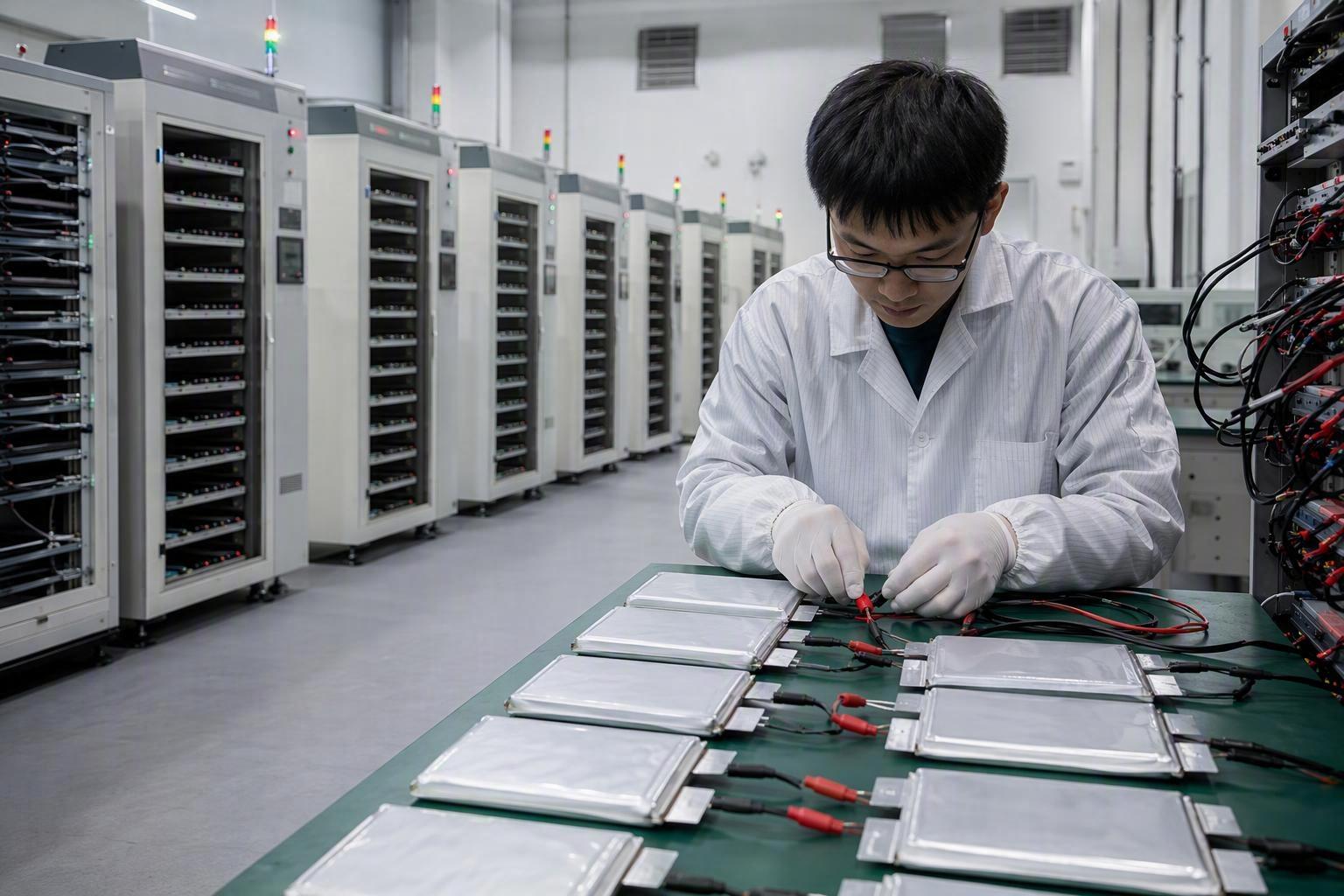
The Gravimetric Energy Density Ceiling: Many conventional commercial LiPo cells operate within the 200 Wh/kg to 250 Wh/kg range at the cell level. Once structural casing, wiring, connectors, and Battery Management System (BMS) hardware are integrated, pack-level density drops to roughly 140 Wh/kg to 200 Wh/kg. This ceiling directly constrains flight endurance when carrying heavy operational payloads.
Thermal Stress and Swelling: Under sustained high-current draw, resistive heating in organic electrolytes can cause gas generation and cell swelling. Over time, physical deformation degrades internal stack pressure and accelerates capacity loss.
Limited Cycle Life Under Heavy Duty Cycles: When cycled aggressively at high depth-of-discharge (80% DOD or higher), standard LiPo packs typically experience capacity degradation to 80% State of Health (SOH) often within 200 to 500 cycles depending on chemistry, operating temperature, and depth of discharge. For commercial fleet operators, frequent battery replacement increases Total Cost of Ownership (TCO).
Semi-Solid vs LiPo: Platform-Level Impact
Cell-level spec sheets rarely tell the complete story on an airframe. Integrators must evaluate how chemistry shifts alter aircraft physics, flight mechanics, and field operations.
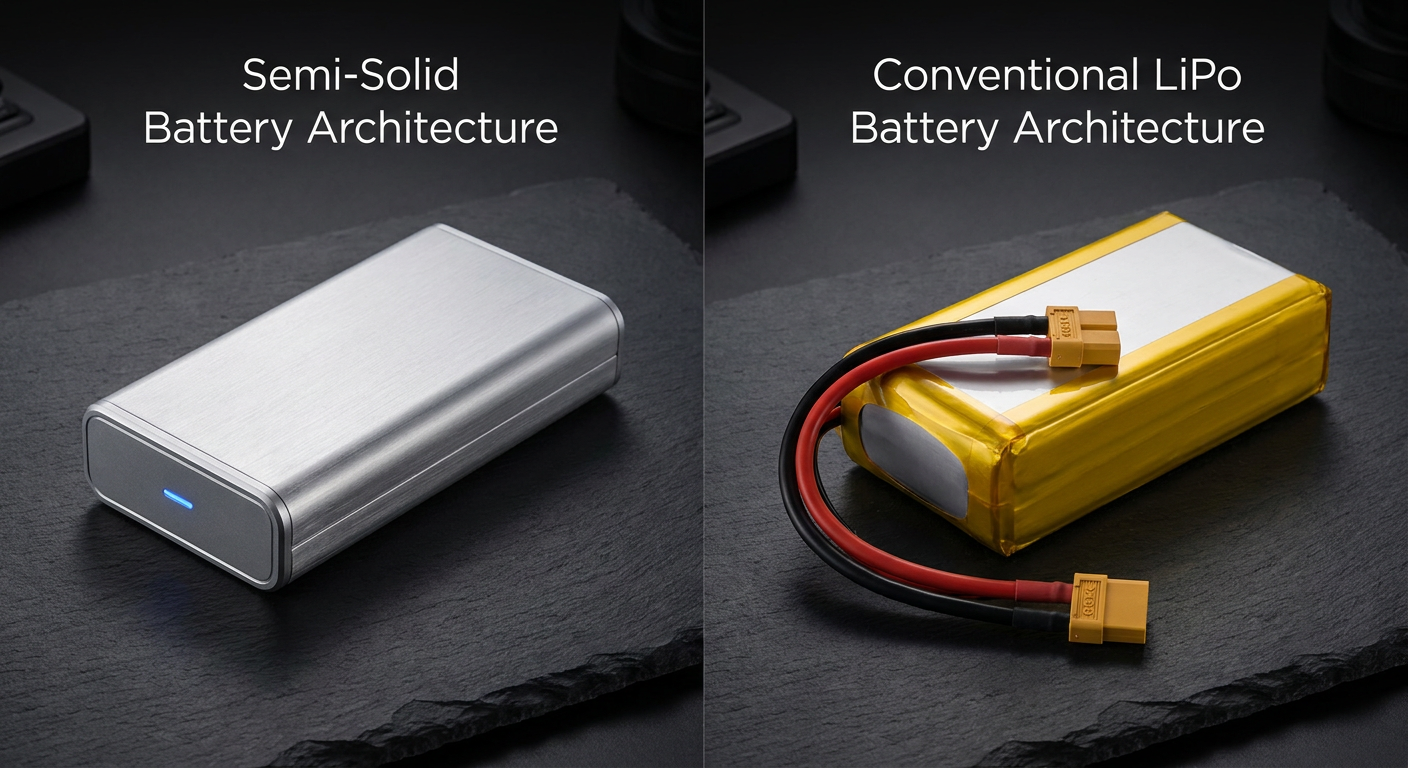
Architectural Parameter | Conventional Industrial LiPo | Semi-Solid State UAV Battery | Platform Integration Impact |
|---|---|---|---|
Cell Energy Density | 200 – 250 Wh/kg | 280 – 350 Wh/kg | +20% to +50% cell-level energy density increase |
Pack-Level Energy Density | 140 – 200 Wh/kg | 220 – 260 Wh/kg | Substantially higher Wh capacity within the same battery weight allocation |
Continuous Discharge (C-Rate) | 25C – 75C | Optimized for sustained discharge efficiency rather than extreme burst power | LiPo leads in extreme current burst; semi-solid excels in steady cruise power |
Thermal Safety Threshold | Flammable electrolyte; swelling risk | Gel-like electrolyte structure; robust safety profile | Improved resistance to thermal propagation under abuse conditions |
Cycle Life (80% SOH) | 200 – 400 cycles | 500 – 1,000+ cycles (depending on conditions) | Fleet battery replacement frequency reduced by 2× to 3× |
Cold Temperature Retention (-20°C) | Severe capacity drop & voltage sag | ~65% – 75% capacity retention | Higher operational reliability in arctic or high-altitude environments |
1. Weight and Payload Allocation
In aircraft design, Maximum Takeoff Weight (MTOW) is a non-negotiable budget:
MTOW = Airframe Weight + Battery Mass + Usable Payload
When using conventional LiPo packs, engineering teams aiming for longer flight times are forced to increase battery mass. However, because added battery weight demands additional motor thrust—which in turn increases current draw—returns diminish rapidly.
Semi-solid cells incorporate a gel-like electrolyte structure combined with high-capacity anode materials (such as silicon-carbon composites). Reaching cell-level energy densities of 280 Wh/kg to 350 Wh/kg gives system designers two practical options:
Option A (Fixed Mass, Increased Energy): Maintain the existing battery weight allocation while increasing overall pack capacity (Wh) by 30% to 40%, directly extending mission endurance.
Option B (Fixed Energy, Reduced Mass): Maintain original Wh capacity while trimming battery weight, freeing up mass budget for heavier revenue payloads like LiDAR scanners, multispectral sensors, or cargo delivery systems.
2. Flight Time and Mission Range
For commercial service providers, flight time translates directly into operational coverage. A mapping UAV restricted to 25 minutes of flight time requires frequent return-to-base landings, battery swaps, and recalibrations.
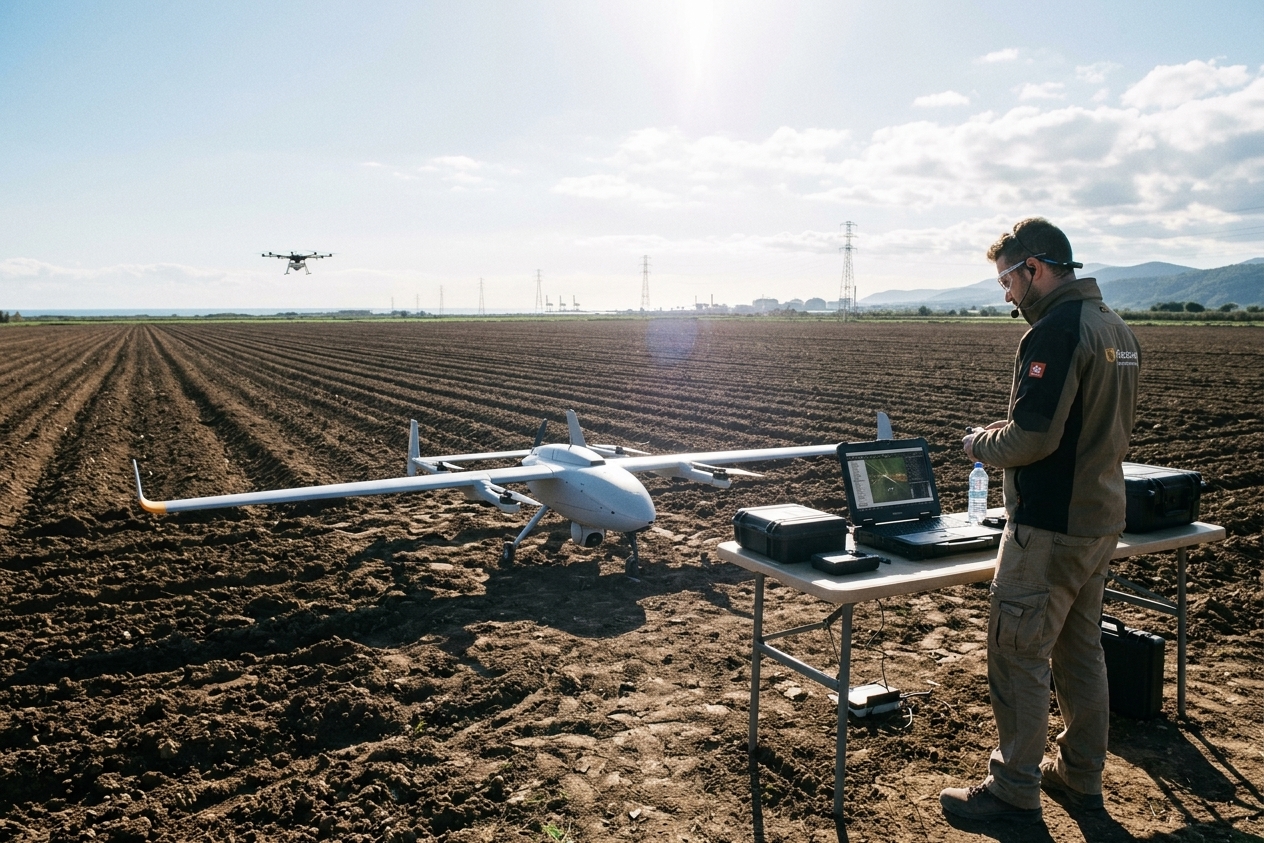
By transitioning to high-density architectures, such as high-voltage semi-solid UAV battery platforms, fixed-wing and hybrid VTOL platforms can extend flight endurances beyond 60 to 90 minutes, depending on aircraft configuration and payload mass. This extension expands the mission radius, enabling single-pass corridor inspections of powerlines or pipelines without mid-mission battery swaps.
Field Reality: A 30% increase in usable battery energy density can significantly improve survey coverage efficiency by eliminating transit flight overheads between multiple battery swaps.
3. Thermal Stability and Extreme Operating Environments
Thermal management is one of the most critical factors influencing UAV power system reliability. Liquid LiPo packs exhibit increased internal resistance at low temperatures, causing voltage sag during takeoff that can trigger low-voltage automated land commands. In high-ambient desert environments (+40°C to +50°C), sustained high-current discharge pushes cell internal temperatures toward thermal stress limits.
Semi-solid state chemistry incorporates gel-like electrolyte structures that are designed to provide improved thermal stability across wider operating conditions (-20°C to +60°C). During abuse testing or mechanical stress, semi-solid cells demonstrate improved resistance to thermal propagation compared to conventional liquid LiPo cells.
4. Battery Lifecycle and Fleet Total Cost of Ownership (TCO)
While semi-solid cells carry a higher initial purchase price per watt-hour than standard LiPo packs, evaluating procurement solely on initial CAPEX is misleading for enterprise operations. Total cost of ownership is determined by per-cycle depreciation and operational field swap frequency.
Because the polymer-gel interface reduces electrode degradation and micro-cracking during repeated intercalation cycles, semi-solid packs achieve 500 to over 1,000 discharge cycles depending on operating conditions and depth of discharge. By doubling or tripling the operational service life of each pack, fleet managers reduce per-flight energy depreciation costs and lower the total number of physical battery packs required in inventory.
Where Conventional LiPo Still Makes Sense
A balanced B2B engineering evaluation must acknowledge where traditional chemistry remains superior. Claiming that semi-solid technology renders LiPo obsolete ignores fundamental electrochemistry realities.
Item | Detail |
|---|---|
Power-Dense Profile (LiPo) | High C-Rate + Rapid Burst Thrust + Low CAPEX |
Endurance-Dense Profile (Semi-Solid) | High Wh/kg + Wide Thermal Envelope + Extended Cycle Life |
1. High-G Maneuver and Extreme Burst Thrust Drones
First-Person View (FPV) drones and specialized high-acceleration UAVs require extreme burst discharge rates (50C to 100C) to support rapid maneuvers. Current commercial semi-solid cells—engineered for maximum gravimetric energy density—are optimized for sustained cruise power. Attempting to power an extreme-burst platform with energy-dense semi-solid cells will result in voltage sag, making high-discharge LiPo packs the appropriate power source for high-C profiles.
2. Cost-Sensitive, Low-Utilization Airframes
For consumer drones, entry-level training platforms, or specialized UAVs that log fewer than 50 flight hours annually, initial procurement cost dominates the business model. In these applications, the extended cycle life of semi-solid cells offers minimal economic return, making mature industrial LiPo and high-voltage battery lines the more cost-effective choice.
3. Short-Duration High-Thrust Missions
When a UAV mission involves short-duration (<12 minutes) hover tasks that demand continuous high-thrust output—such as heavy winch operations or specialized short-range maneuvers—power density (W/kg) matters more than energy density (Wh/kg). In these high-power scenarios, high-discharge LiPo or specialized high-C hybrid cells remain the correct engineering choice.
When Semi-Solid Batteries Become the Better Choice
For specific commercial mission profiles, the advantages of semi-solid state technology align directly with operational goals.
1. Long-Endurance Survey, Mapping, and Surveillance UAVs
Fixed-wing, multirotor, and hybrid VTOL platforms dedicated to mapping, photogrammetry, and linear infrastructure inspection benefit immediately from semi-solid architectures. Replacing a standard 200 Wh/kg LiPo pack with a 300 Wh/kg semi-solid pack allows survey teams to complete large-scale mapping missions in a single flight, dramatically lowering labor costs and operational downtime.
2. Heavy-Payload LiDAR and Multi-Sensor Inspection
High-precision LiDAR sensors, thermal imaging pods, and onboard edge-compute modules draw significant electrical power while adding dead weight to the airframe. Semi-solid cells provide the gravimetric margin necessary to carry these advanced sensor suites without degrading flight endurance below safe operational thresholds.
3. High-Duty Cycle Precision Agriculture UAVs
Agricultural spraying and spreading drones carry substantial liquid or granular payloads while operating under high daily sortie counts. By adopting semi-solid battery systems, operators gain increased payload allowance per flight and extended cycle life under heavy daily fast-charging routines. This maximizes spraying efficiency during tight operational windows and reduces battery rotation requirements during peak agricultural seasons.
4. Enterprise Drone Fleets Operating High Daily Cycles
Enterprise operators running automated drone-in-a-box stations or multi-shift inspection programs prioritize long-term cycle stability. The higher cycle life of semi-solid chemistry reduces maintenance interventions, prevents pack swelling inside automated docking stations, and simplifies overall fleet inventory management.
Key Verification Domains Before Switching Battery Technology
Transitioning an established UAV platform from conventional LiPo to semi-solid architecture requires systematic verification across five engineering domains:
1. Energy Density at the Pack Level
Always distinguish cell-level spec sheets from integrated pack-level performance. Ask suppliers for exact pack-level gravimetric (Wh/kg) and volumetric (Wh/L) energy density metrics, factoring in:
Structural enclosure mass and impact protection
Inter-cell busbar resistance and wiring harness weight
Integrated BMS board weight and thermal potting materials
2. Discharge Performance and Voltage Sag Under Load
Review the cell discharge curves across the aircraft’s full operational spectrum. Ensure the pack can maintain nominal voltage during high-power mission phases—such as vertical takeoff, landing, and heavy wind compensation—without breaching motor minimum voltage thresholds.
3. BMS Protocol Compatibility and Telemetry Integration
Smart enterprise drones require real-time state-of-charge (SOC), state-of-health (SOH), individual cell voltage, and thermal telemetry. Ensure the integrated BMS supports standard CAN bus communication protocols and interfaces seamlessly with major industrial flight controllers.
4. Mechanical Packaging and Structural Integration
Because semi-solid cells feature different volumetric expansion characteristics than liquid LiPo cells, airframe battery bays may require mechanical adjustments. Verify physical dimensions, vibration isolation mountings, and heat dissipation pathways within the fuselage.
5. Supplier Engineering, Custom Pack Design, and OEM Capabilities
Off-the-shelf battery packs rarely optimize airframe spatial constraints. UAV integrators should partner with an established semi-solid drone battery supplier offering end-to-end custom UAV battery pack engineering and OEM drone battery solutions—from custom cell matching and pack geometry design to UN38.3, UL, and CE transport safety certifications. Reviewing high-energy-density UAV battery evaluation criteria helps engineering teams systematically audit potential power suppliers.
Application-Driven Battery Selection
The debate between semi-solid state batteries and conventional LiPo is not about identifying a single universal winner. Instead, it reflects the maturation of the commercial drone industry toward application-specific power architecture design.
Conventional LiPo remains the preferred architecture for high-burst thrust applications, FPV racing, short-duration high-power missions, and cost-sensitive platforms where initial CAPEX dominates.
Semi-Solid State Technology represents a major leap forward for long-endurance platforms, heavy-payload sensor missions, extreme thermal environments, and high-frequency commercial fleets where flight range and cycle TCO drive profitability.
By matching battery chemistry to specific mission requirements rather than chasing peak gravimetric density alone, UAV integrators can build safer, more reliable, and commercially competitive aerial platforms.


 Français
  English
  Español
  한국어
한국어  Deutsch
  日本語
日本語  Русский
  Bahasa Indonesia
  ไทย
ไทย  العربية
  Português do Brasil
  Italiano
  Nederlands