
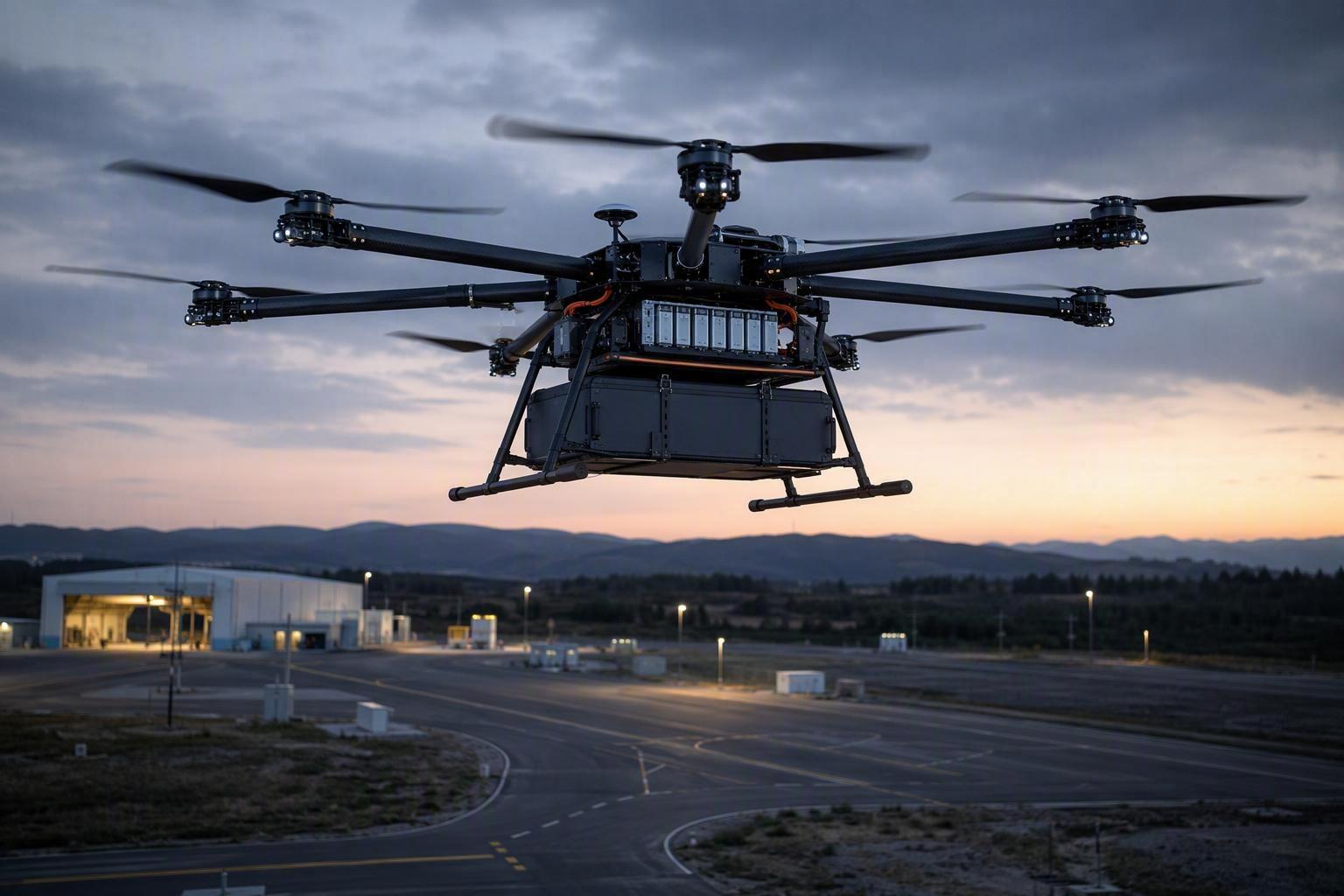
A few years ago, “500Wh/kg” belonged in research papers — the number engineers cited to explain why electric aviation was still waiting on the battery. In 2026 that ceiling is slipping. Lithium-metal and solid-state cells in this class are moving out of prototypes into flight tests, small-batch production, and early commercial shipments. The question has stopped being whether it is possible and become how fast, and who gets there first.
That is why airframe and battery teams across eVTOL, UAV, and defense programs are lining up behind the shift. Longer mission endurance, heavier sensor and cargo payloads, safer thermal behavior, and the range expansion electric vertical takeoff and landing needs to leave short urban hops all come down to more watt-hours per kilogram.
This piece looks at the trend from the industry’s point of view: why this technology is becoming real now, what the frontier actually looks like today, and how far the road from lab bench to production really is.
Why aircraft are more sensitive to energy density than any other industry
An aircraft carries its own energy supply. Every kilogram of battery also pulls along the structure, rotors, and power systems that must lift it. That’s what sets it apart from a ground vehicle, where adding battery mostly just trims efficiency. Weight on a vehicle costs you range; weight on an aircraft costs you lift, thrust margin, and climb performance all at once.
The trade-off is unforgiving. Most UAV packs flying today sit in the 200–300Wh/kg range, and graphite-anode cells top out near 300–350Wh/kg. Push beyond that and you’re not just redesigning the cell — you’re changing the chemistry. That ceiling is why the whole industry is turning away from graphite and toward lithium metal.
The limit comes down to the anode. In a conventional cell, lithium shuttles between two graphite hosts, and those hosts are heavy: graphite stores roughly one lithium ion for every six carbon atoms. That dead weight is the practical reason energy density stalls in the 300Wh/kg range, no matter how well you engineer the cathode.
The payoff justifies the effort. Doubling cell energy density isn’t a simple 2× endurance lift; it can translate into 2–3× more flight time, or a large payload dropped on a fully loaded platform. That real magnitude is why the shift is happening. The question isn’t whether energy density matters. It’s how far the push has actually traveled — and what you can buy from it today.
Where 500Wh/kg stands today: a route map, not a vendor list
It helps to separate the chemistry routes from the companies promoting them. Each route has a different density ceiling and a different maturity level.
Technology route | Typical cell-level energy density | Maturity | Main UAV/aerospace use cases |
|---|---|---|---|
High-silicon / composite-anode Li-ion | ~350–450Wh/kg | Commercial / near-commercial | Long-endurance UAV, high-altitude platforms |
Semi-solid (hybrid electrolyte) | ~280–400Wh/kg (pack-level) | Small-batch to commercial | Heavy-lift, VTOL, cargo drones |
Lithium metal (with anode layer) | ~450–500Wh/kg+ (claimed) | Pilot / early production | Defense UAV, select eVTOL |
Anode-free lithium metal / solid-state | 500–600Wh/kg+ (claimed) | Lab to early pilot | Next-gen platforms; cycle life and dendrites unresolved |
One U.S. lithium-metal maker, Sion Power, has pushed its >500Wh/kg-class cells toward defense and aerospace shipments, with initial deliveries expected late 2026. Another, Amprius, already ships silicon-anode cells commercially to ~450Wh/kg, with 500Wh/kg shown in third-party validation rather than as a broad product line. A materials group, Ganfeng Lithium, has moved a 500Wh/kg solid-state cell into small-batch production. These are genuine signals, not marketing.
Read the individual announcements together and the pattern is unmistakable. CATL has confirmed a 500Wh/kg-class all-solid-state cell and targets pilot production by 2027. Sion Power frames its >500Wh/kg lithium-metal cells around combat drones that fly two to three times longer and carry over 50% more payload. EHang flew its pilotless, passenger-carrying EH216-S for 48 continuous minutes on solid-state cells — a reported first for a carrying eVTOL. Ganfeng Lithium, the world’s largest lithium-metal producer, has moved a 500Wh/kg 10Ah solid-state cell into small-batch output. None of these are speculative slideware; they are shipped samples, flight logs, and production lines.
The industry consensus timeline is a steady climb rather than a sudden step. Lab and prototype cells are shipping today; pilot lines and first aerospace integrations run through 2026–2028; early commercial use in drones, UAS, and non-critical systems is expected around 2027–2030; and broader scale-up follows as yield, cost, and certification improve toward 2030 and beyond. That pacing matters more than any single press release, because it tells you when the density you can actually buy will step forward — and when to plan for it.
There’s also a distinction worth pinning down when you compare these numbers: cell-level versus pack-level density.
A 400Wh/kg cell does not produce a 400Wh/kg aircraft battery. The pack adds a BMS, enclosure, balancing wiring, and thermal controls — normally 15–25% overhead. So the number that matters on your airframe is the density of a pack you can actually mount, measured at your voltage and discharge profile, not the chemistry’s headline figure. When a vendor quotes “up to 500Wh/kg,” ask which value they mean before you commit tooling and engineering hours to it.
So how do you read these route claims? Start with the anode. Nearly every 500Wh/kg-class claim depends on removing or thinning the graphite anode. That is the single most useful test for whether a claim is real progress. Forget which firm claims what. Ask whether the anode is gone or made dramatically thinner. If the answer is no, treat the number with suspicion.
The other half of the math is what the frontier routes give back to reach those numbers. Lithium-metal and anode-free cells trade away cycle life and must be managed against dendrite growth, so they are tuned for missions where a single long flight matters more than hundreds of recharge cycles. That suits a defense sortie or a one-way cargo drop; it suits a platform that flies daily far less. No cell maximizes energy density, cycle life, and safety at once, so before you adopt any 500Wh/kg-class pack as your baseline, ask which spec the vendor optimized — and whether that matches the mission you actually fly.
Today, only defense programs and a few well-funded eVTOL platforms can pay for these frontier routes and get priority access. Their order volumes are large and their certification cycles are long enough to absorb early risk. Your medium-size UAV program likely does not sit in that queue — and that is normal, not a failure on your part.
What this actually means for your program
For most UAV and eVTOL programs, the takeaway isn’t “rush out and buy 500Wh/kg today” — it’s that the practical floor has moved. The density you can reasonably spec now sits around 350–450Wh/kg, a meaningful step beyond the 250–300Wh/kg packs most airframes are still flying. How far you can use it depends on the same variables every airframe decision does: whether the pack’s cycle life holds under your real duty cycle, whether its failure and abuse behavior satisfies your safety and certification path, and whether the supplier can build around your actual airframe constraints rather than an off-the-shelf size.
Before committing, confirm the pack clears the gates your program must pass — UN38.3 for air transport, CE and UL for market access, plus any airworthiness requirements — and probe low-temperature performance if your missions run cold at altitude. Then plan a staged path: adopt what is shippable and validated now, and track the next-generation chemistry in parallel instead of waiting for a “perfect” pack that keeps slipping.
What the path forward looks like
Nobody should treat 500Wh/kg as a purchase they must make this quarter — but it is worth treating as a baseline that is visibly moving. For airframe teams and procurement groups alike, the winning posture is incremental: lock in the highest-density chemistry that is validated and shippable today, and keep a close watch on the 500Wh/kg roadmap, and move when the economics and duty-cycle data line up for a given platform.
That staged posture is exactly the line Herewin holds. As a vertically integrated battery maker, we offer a verified 400Wh/kg semi-solid pack today, while keeping our 500Wh/kg anode-free lithium-metal cell clearly on the roadmap rather than selling it as a finished product. For the industry, that frontier is no longer a distant milestone; it is arriving stage by stage — which is precisely what makes it a trend worth watching.
 Français
  English
  Español
  한국어
한국어  Deutsch
  日本語
日本語  Русский
  Bahasa Indonesia
  ไทย
ไทย  العربية
  Português do Brasil
  Italiano
  Nederlands