
When your crews clean glass, stone, and solar arrays in the rain or right after a rinse, the battery is the make-or-break component. Corrosive splashback, wind gusts, and tight work windows punish packs far more than brochure specs suggest. This guide shows how to pick and operate an Urban Cleaning Drone Battery that stays dry inside, resists alkaline cleaners outside, and delivers stable power without sag—all while keeping costs predictable for municipal contracts.
Why the battery matters in urban cleaning
Waterproofing isn’t one thing; it’s three different challenges:
- Ingress protection against water and dust.
- Chemical resistance to alkaline detergents and salt mist.
- Electrical stability under heavy bursts from pumps and motors.
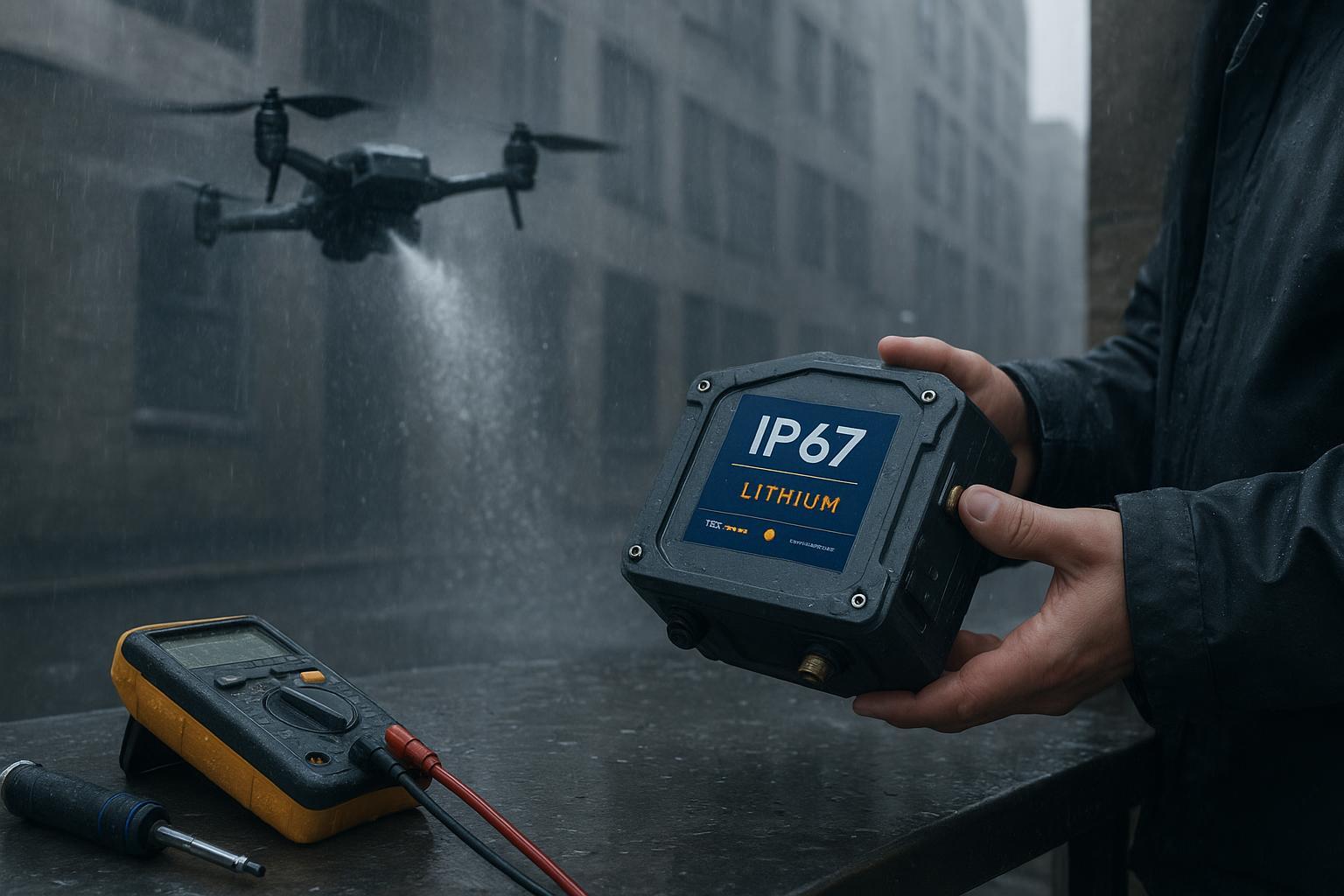
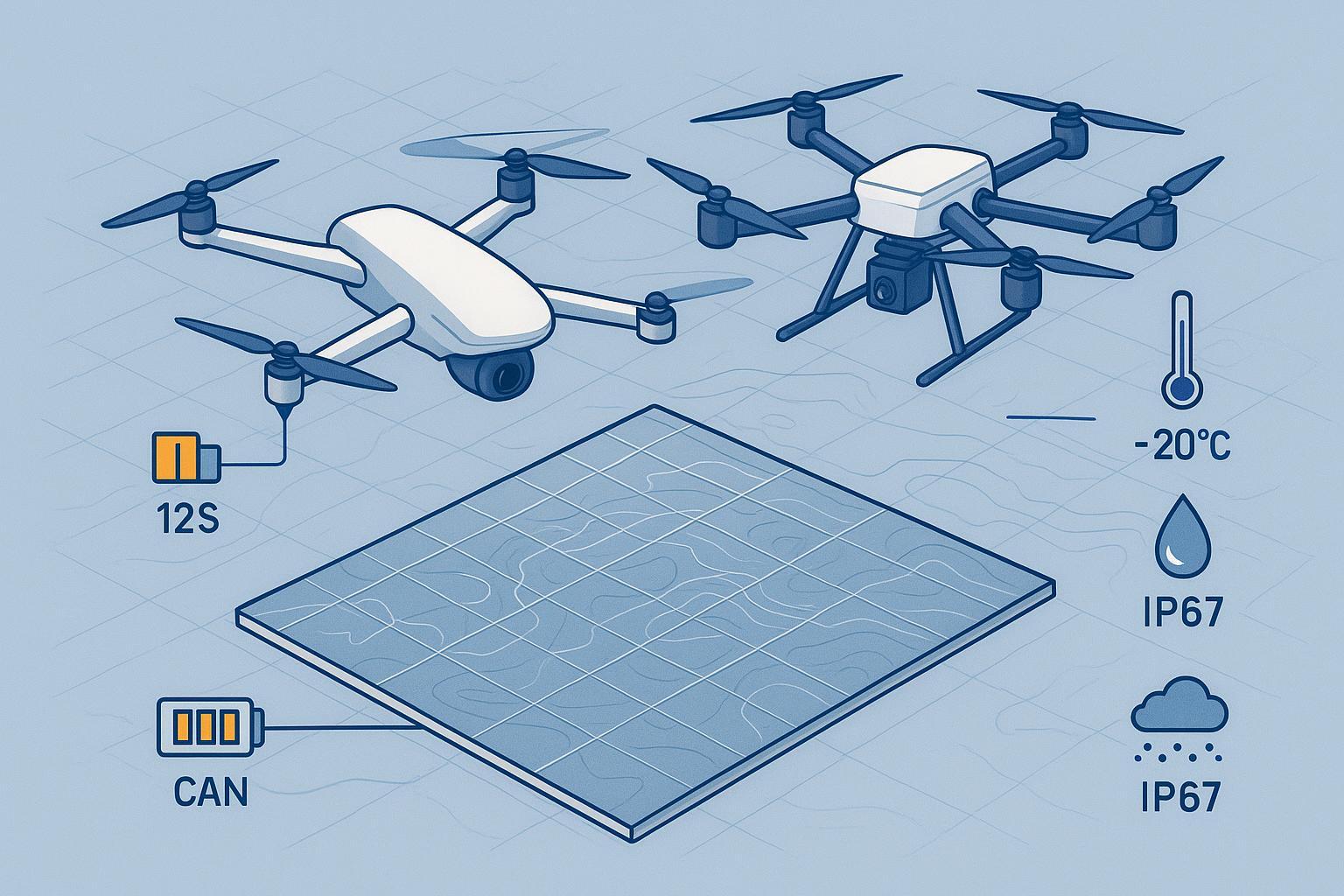
Start with ingress protection, IP67 means a dust-tight enclosure and resistance to temporary immersion (roughly 1 m for 30 minutes) under IEC 60529 test conditions. That protection is not the same as resistance to water jets—those are separate tests commonly described as IPX5/IPX6 (sustained spray at defined nozzle sizes, flow rates, and pressures). When you ask vendors for evidence, request the actual IEC 60529 test report and the specific IPX test method if washdown or jets are expected. Chemical and corrosion resistance are a different axis. IP67 only addresses water and dust ingress; it does not certify resistance to alkaline cleaners, detergents, or salt spray. For splash and long-term corrosion risk, specify corrosion testing on assembled packs and connector sets—for example, ASTM B117 neutral salt spray and, for closer real-world simulation, IEC 60068‑2‑52 cyclic salt mist with the stated severity and hours. Ask vendors to disclose the test method, duration, and pass/fail criteria rather than a generic “salt‑resistant” claim. Electrical stability under load completes the picture. Urban cleaning missions combine repeated high-current bursts (thrust, pumps) and environmental stressors (cold, gusts, aging) that raise internal resistance (IR) and cause voltage sag (Vdrop = I × R). Choose packs with low DCIR cells, robust thermal paths, properly sized conductors/connectors, and BMS settings tuned for transient margins (conservative undervoltage cutoffs, active balancing, and temperature‑based derating). In practice, require vendors to provide representative discharge/IR data and sample flight logs so you can verify that packs maintain voltage and temperature during pump transients and gusty conditions.
Urban Cleaning Drone Battery Compliance: A Standards Primer for Procurement
For a cost-effective municipal drone batteries tender, specify what each document actually covers and ask for proof:
- IP67 (IEC 60529) for enclosure sealing; consider IPX6 if high-pressure rinsing is expected. Request the test report ID and lab name; refer to IEC 60529 (IP Code) – IEC webstore for test definitions and limits.
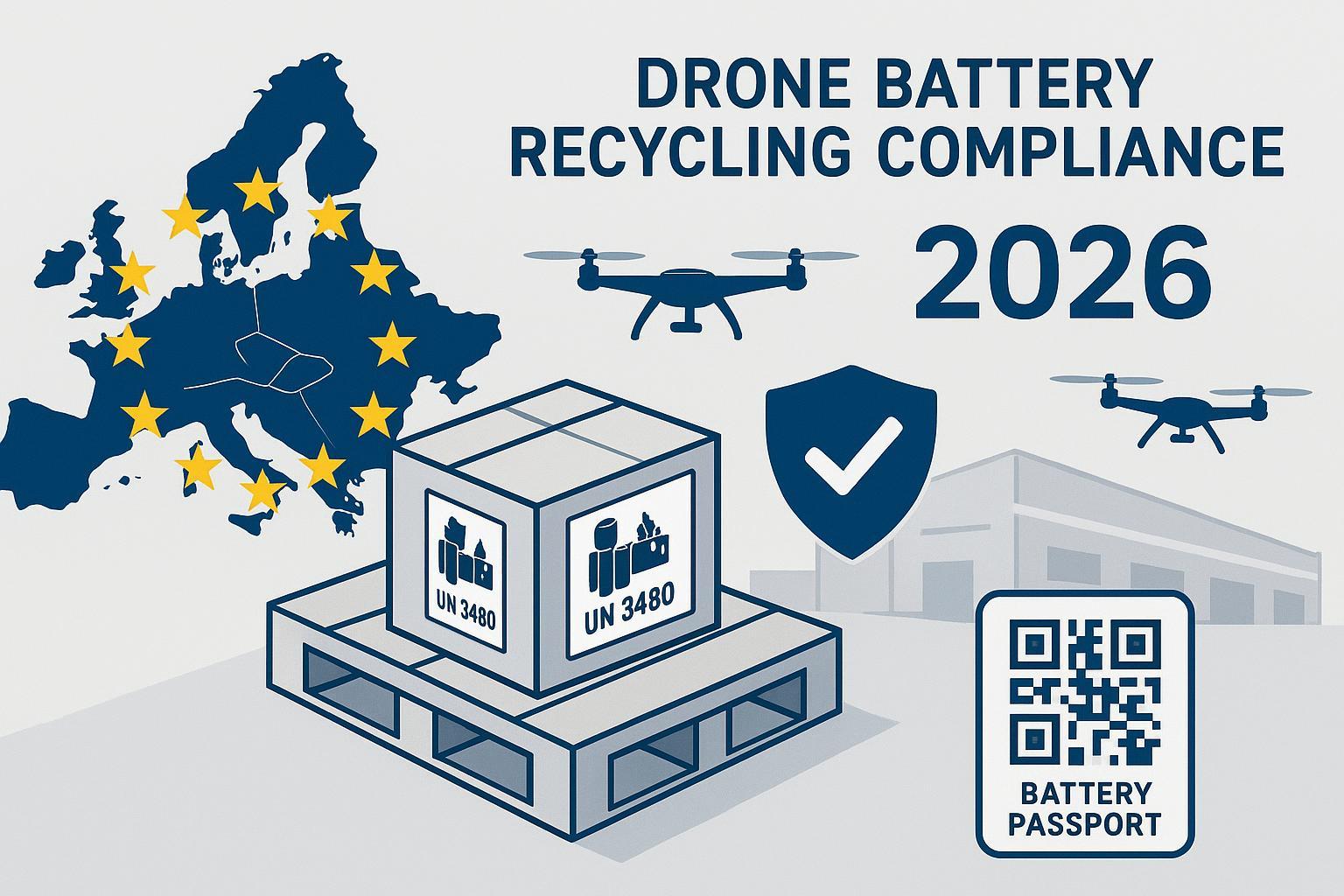
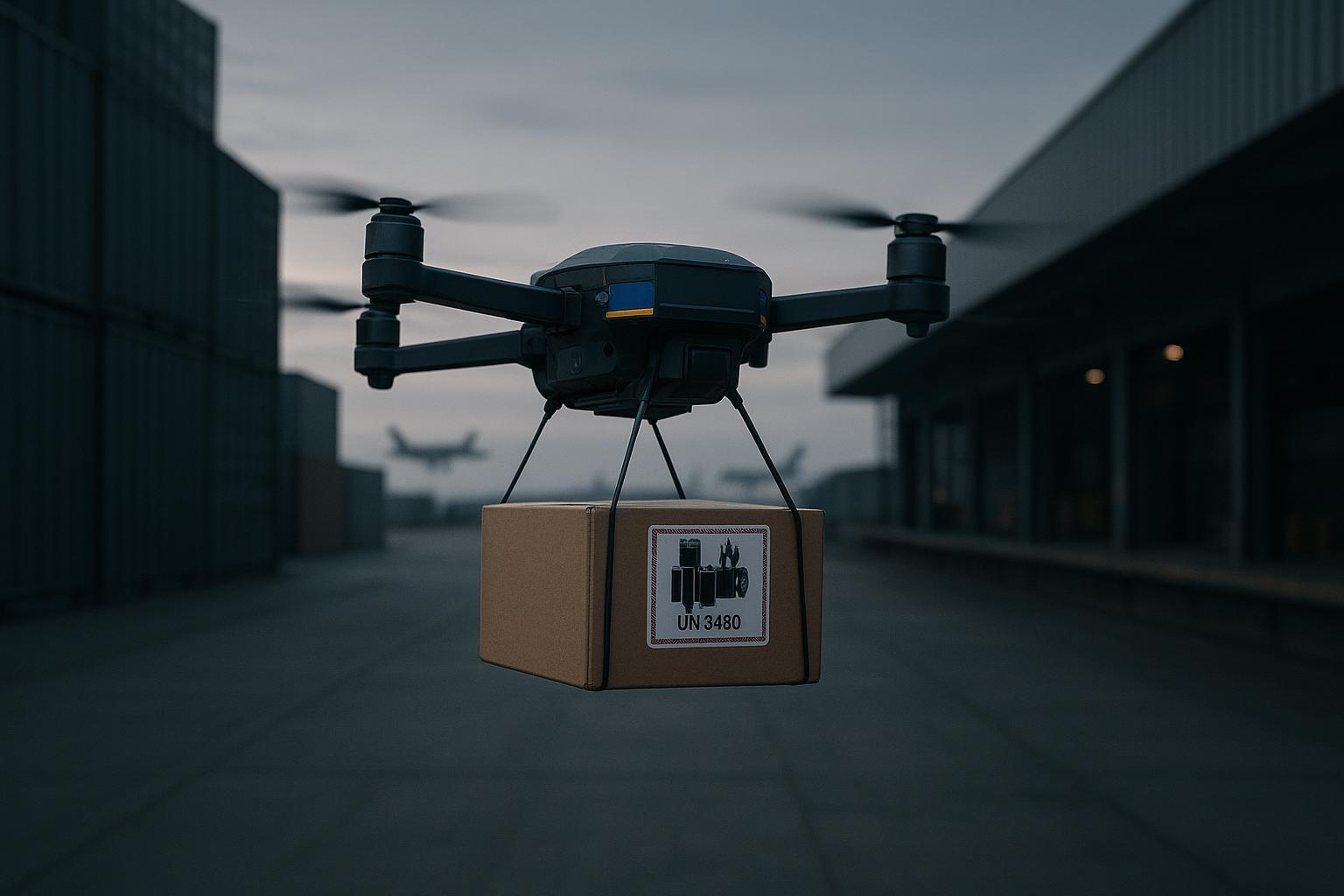
- UN38.3 transport compliance is non-negotiable. Ask for the UN38.3 Test Summary link/QR and report ID (cells and packs must pass altitude, thermal, vibration, shock, short, impact/crush, overcharge, and forced discharge). This Test Summary has been mandatory for shipments since 2019; see the UNECE UN Manual: Part III, Subsection 38.3 (UN38.3) for the canonical test list and requirements.
- Safety standards: For portable/industrial packs, ask for IEC 62133-2 or IEC 62619 test evidence; for North American mobility-style packs, ask about UL 2271 alignment.
- Corrosion validation: For urban spray and splashback, require IEC 60068-2-52 cyclic salt mist (state severity) on connectors/enclosure assemblies. ASTM B117 can supplement, but it’s a comparative test, not a life predictor.
RFP Copy-Ready Language: “Supplier shall provide an Urban Cleaning Drone Battery certified to IP67 (IEC 60529) with documented corrosion resistance per IEC 60068-2-52 at stated severity; UN38.3 Test Summary required for shipment.”
Choosing a cost-effective municipal battery
Selecting the right pack is a balancing act between runtime, mass, and reliability. For cost-effective municipal drone batteries, focus on:
- Chemistry and C-rate: High-power NMC or high-rate LiPo cells provide burst current with lower DCIR than pure energy cells. LiFePO4 trades energy density for stability and long life; if you fly close to maximum payload in wind, low-IR chemistries often outperform a slightly larger, higher-Wh pack that sags.
- Form factor and weight: Lightweight urban cleaning drone batteries can increase cleaning area per sortie. A 15–20% reduction in battery mass can translate to a similar increase in covered area per hour when the aircraft is thrust-limited. That’s why narrow alley cleaning drone lightweight batteries matter for tight spaces and frequent hover/translate.
- Connectors and plating: For alkaline exposure, prefer sealed connectors with nickel underplates and gold on signal contacts; stainless or hard-anodized shells; compression gaskets using silicone or fluorosilicone when compatible with your chemicals.
- Logistics and compliance: Confirm UN38.3 readiness and local safety standard alignment before you run pilots; shipping or site acceptance can stall projects.
Narrow alley operations: why lightweight matters
In tight passages, every gram hurts maneuverability and flight time. Choosing narrow alley cleaning drone lightweight batteries with low IR reduces current draw for the same thrust and helps the aircraft hold position without triggering undervoltage limits. Lighter packs also reduce operator fatigue during frequent swaps.
Urban cleaning drone battery power matching and BMS settings
Voltage sag is physics: V_drop = I × R. High current bursts, cold cells, and aging raise IR and the voltage drop. Here’s how to keep thrust and pumps running:
- Match power architecture: If your drone and pump allow, higher pack voltage means lower current for the same watts, which reduces heating and sag. Size conductors and connectors for peak amperage with margin.
- Calibrate BMS thresholds: Set undervoltage cutouts with realistic dynamic margins. Enable active balancing and log IR growth over time. Adopt temperature-based derating so the system won’t fast-charge a cold pack, and it will cool down before high-rate charge.
- Validate with flight logs: Look for synchronized dips in pack voltage with pump transients or gusts. Adjust current limits and SOC windows accordingly.
Field Case Study: Overcoming Voltage Sag in Façade Washing
Industry data consistently shows that the combination of high internal resistance (IR) and cold ambient temperatures is the primary cause of mid‑flight shutdowns. To address this in the field, a controlled test deployment used an IP67‑sealed pack during a windy, rainy day of building façade washing. (Disclosure: Herewin provided the test pack used in this trial.)
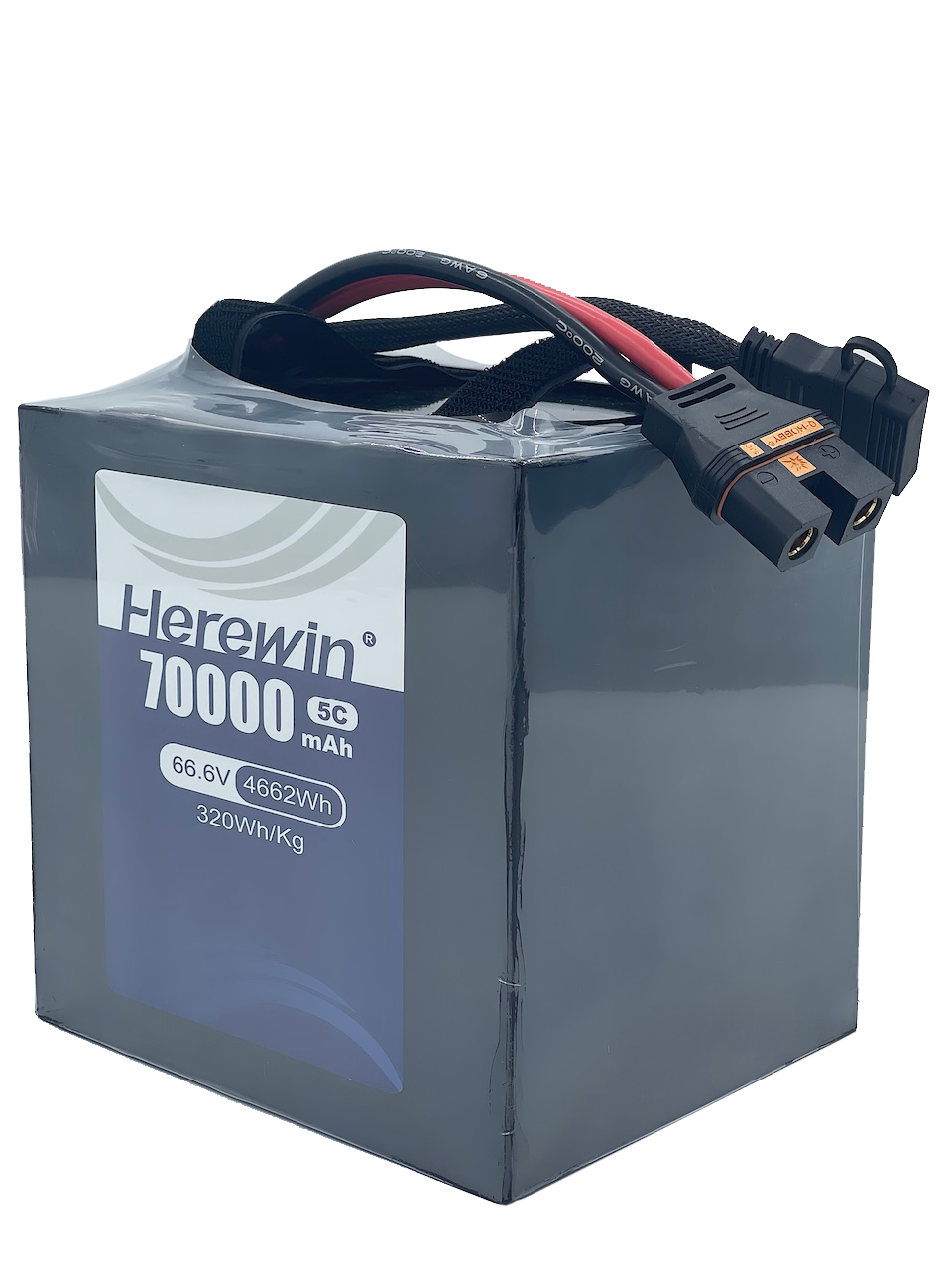
The pack used sealed, gold‑plated signal pins and nickel‑plated power contacts, paired with a BMS profile that limited instantaneous current spikes and enforced a 15–85% SOC working window. The result: pump burst loads no longer triggered undervoltage cutouts, and flight logs showed lower peak temperatures with stable voltage through gusts. Similar operational stability is achievable from any high‑tier vendor that combines proven IP67 sealing, anti‑corrosion connectors, and properly calibrated BMS limits — but always request test logs and corrosion/salt‑mist reports as procurement evidence.
Drone cleaning energy-saving settings
- SOC windows: Fly between ~20–85% SOC under heavy loads to avoid the steep ends of the discharge curve where sag is worse.
- Thermal bands: Preheat to ~10–35°C before high-C charge; cooldown pauses after hot sorties improve life. As noted by the National Renewable Energy Laboratory (NREL), temperature is the most critical factor in extreme fast charge degradation, requiring real-time adaptive controls.
- Mission planning: Minimize hover in strong headwinds; schedule short cooldowns between sorties to keep cell temperatures within the sweet spot.
Fast charging without killing cycle life
Fast charging without killing cycle life Ultra-fast charging (reaching 80% in 20–30 minutes using peak 5C bursts) is feasible in certain chemistries and temperature windows, but it requires smart BMS throttling to protect cycle life. Research from the U.S. Department of Energy (DOE) and the American Chemical Society (ACS) confirms that unmanaged extreme fast charging accelerates lithium plating and cathode cracking. Damage can appear rapidly at very high C-rates without adaptive, voltage-based control strategies. So, if you need fast turnarounds:
- Charge profile: Use vendor-provided CC/CV curves with reduced current above a defined cell voltage; don’t force constant current to 100%.
- Temperature control: Precondition packs (no fast charge below ~10°C; avoid fast charge when cells are heat-soaked). As highlighted by major battery research programs, internal temperature heterogeneity is a primary risk during extreme fast charging.
- SOC limits: Target 80–90% tops for fast charge during operations; complete to 100% only for calibration cycles.
Low-noise charging for urban drones
If you’re charging curbside or indoors, aim for charger acoustics under ~60 dB(A) at 1 m where possible. Fanless or water-cooled supplies reduce noise; standard industrial UPS vendors publish comparable acoustic specs you can reference in your RFPs.
Waterproof Protection & Daily SOP for Urban Drone Batteries
Ingress and corrosion protection are design choices you can verify, and daily routines you can control. For alkaline splash, require evidence of materials and tests:
- Tests: IEC 60068-2-52 cyclic salt mist on assembled connectors/enclosures at stated severity; ASTM B117 as a comparative check. Remember, IP67 alone doesn’t prove chemical resistance .
- Materials: Prefer nickel-underplated power contacts with gold on signal, stainless or hard-anodized shells, and silicone/fluorosilicone gaskets compatible with the detergents you actually use.
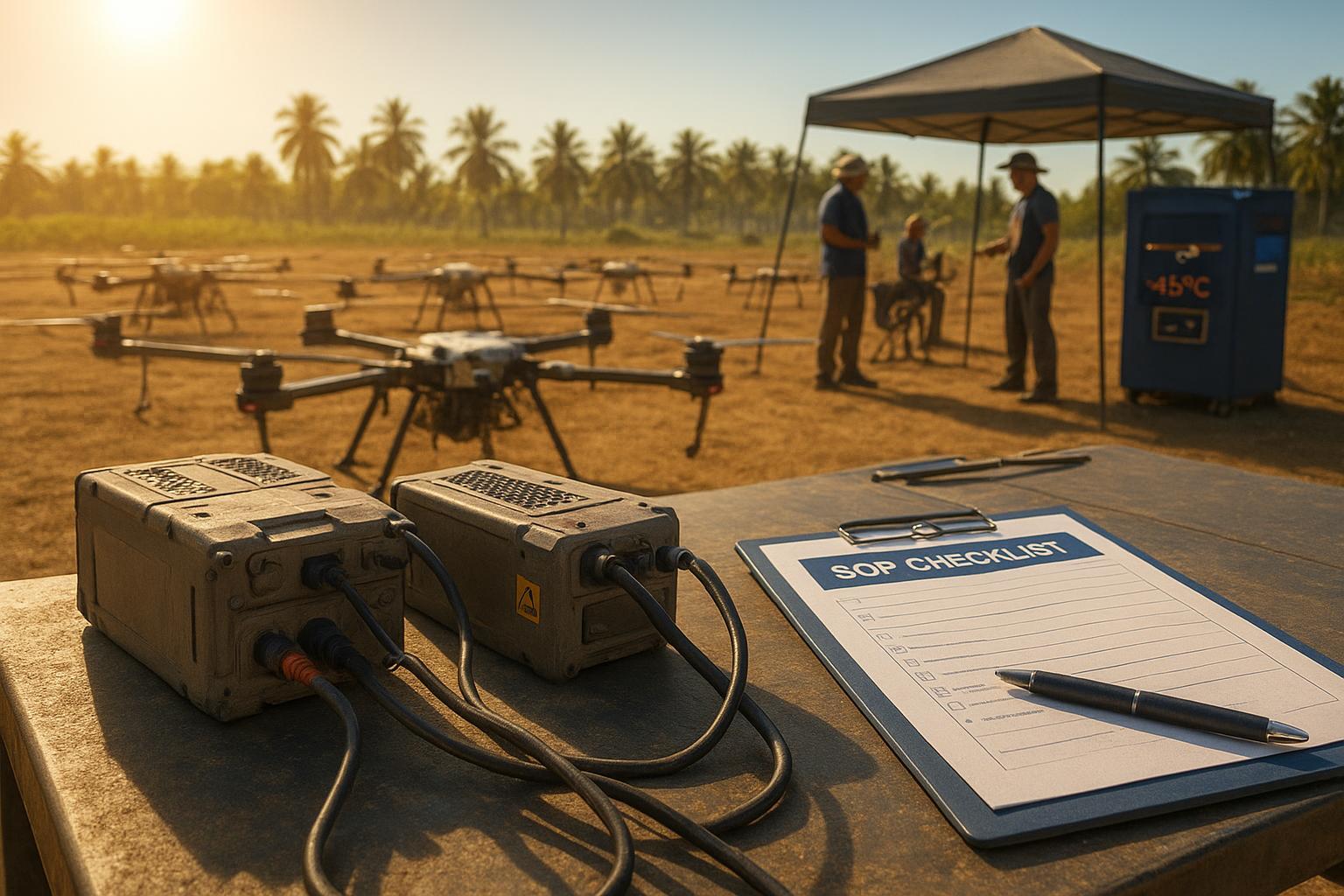
Daily checklist — Urban cleaning drone battery daily maintenance
- Visual check: seals/gaskets intact; no cracks, cuts, or compression set.
- Rinse and neutralize: after alkaline splash, lightly rinse the casing and connector exterior with clean water; avoid water jets at seals; if the detergent MSDS recommends neutralization, follow it.
- Drying: air-dry with low-velocity air; don’t bake or heat-gun the pack.
- Drone battery terminal corrosion prevention: inspect pins and sockets; avoid abrasive brushing on plated contacts; apply a thin layer of a compatible dielectric/contact lubricant rated for marine/alkaline environments, if approved by your vendor.
- Waterproof drone battery storage: store at 40–60% SOC in a dry, ventilated area; cap connectors; segregate any pack with ingress suspicion for further inspection.
Public safety advisories focus on preventing short circuits and safe storage; adapt them to field reality in wet work, and document your SOPs for crew training.
Scenario-specific solutions
- Building facade washing drone batteries: Prioritize low-IR cells, IPX6 exposure planning (shields, stand-off distance), and connector boots. Maintain BMS undervoltage margins to ride out gusts and pump spikes.
- Street cleaning drone lithium batteries: Demand IEC 60068-2-52 cyclic salt testing on the connector + enclosure set. Grit and saline splash raise contact resistance; weekly contact-resistance spot checks pay for themselves in avoided downtime.
- Waterproof lithium batteries for urban cleaning drones: If washdown is part of your routine, either specify IPX6 testing evidence or enforce procedural controls (no direct jets on seals, low-pressure rinse only) even when IP67 is met.
Tailoring battery specs to different operating environments is an ongoing engineering challenge. For a deeper dive into extreme wet‑weather operations, see our guide on IP67 architecture for emergency drones, which breaks down real‑world waterproof design trade‑offs and verification steps. Likewise, if your fleet is expanding into longer sorties, consult our mapping and inspection guide, which explains how to balance power density with maximum flight time.
ROI & procurement toolkit
Budget owners care about CPFH (cost per flight hour) and TCO (total cost of ownership). Use these baselines as placeholders and replace with your data. Formulas
- CPFH (energy) ≈ (Electricity cost per charge × charges per hour) + (Battery amortization per hour) + (Charger amortization per hour) + (Crew time tied to charging/swaps)
- Battery amortization per hour ≈ Battery price ÷ (Cycle life × average flight time per cycle in hours)
- TCO (annual) ≈ Battery procurement + chargers + replacements + electricity + downtime cost + maintenance/spares
Baseline ranges (illustrative)
| Parameter | Typical range/example | Note/source |
|---|---|---|
| Per-sortie flight time | 10–45 minutes | Varies from standard quadcopters to heavy-lift custom rigs (payload dependent) |
| Swap time | ≤45 seconds | With trained crews on standard modular battery mounts |
| Recharge time | 13–45 minutes | Dependent on charger power (e.g., 3kW vs 9kW systems) |
| Cleaning throughput | 500–1,000 m²/h | Based on façade/solar panel case studies; verify for your specific environment |
| Charger acoustics | ~55–80 dB(A) @1 m | Critical specification for operations in residential or quiet zones |
Procurement clauses (copy-ready)
- Evidence: “Provide UN38.3 Test Summary URL/QR + report ID; IEC 60529 IP67 test report; corrosion testing per IEC 60068-2-52 (state severity) and/or ASTM B117; safety testing per IEC 62133-2 or IEC 62619 (as applicable).”
- Materials: “List connector family, contact plating (e.g., Ni underplate + Au), shell alloy/coating, and gasket material; provide compatibility declaration for specified alkaline detergent.”
- Fast charge: “Provide charge profile (CC/CV), SOC limits for high-C charge, temperature windows, and cycle-life data under declared fast-charge regime.”
- BMS: “Provide OV/UV thresholds, current limits, JEITA-style temperature derating, balancing strategy, and sample logs demonstrating stability under pump transients.”
While strict procurement standards set the baseline, consistent daily operational practices — especially temperature and charge‑window management — help protect uptime and improve ROI. For a deeper look at how those controls prevent costly downtime, see the Herewin guide on stopping premature LiFePO4 battery failure — these practices are transferable to most heavy‑duty lithium chemistries.
FAQ
Does IP67 mean I can spray the pack with a pressure washer?
No. IP67 covers temporary immersion, not sustained water jets. For washdown, ask for IPX6 evidence or enforce controls (shielding, distance, low-pressure rinse).
How do I prevent voltage sag that causes mid-air shutdowns?
Use low-IR cells, healthy connectors, and correct wire gauges; raise system voltage if supported; and set BMS undervoltage thresholds with real transient margins. Review flight logs and tune.
Can I fast-charge at 5C without killing the battery?
Only within validated temperature/SOC windows and with adaptive profiles. Agency and academic research show unmanaged extreme fast charge accelerates plating and cathode damage; request the vendor’s life data under the stated regime.
What certificates should I request during procurement?
Require the UN38.3 Test Summary for transport, IEC 60529 (IP67) for sealing, IEC 60068-2-52 for corrosion resistance, and IEC 62133/62619 (or UL 2271) for operational safety.
How do I spec batteries for narrow alleys and tight workspaces?
Prioritize lightweight packs with low IR and sealed, compact connectors. The handling benefit plus lower thrust demand improves covered area per hour.
Next steps
If you’re standardizing your fleet spec, create two profiles: façade washing (gust handling and splash resistance) and street/solar (corrosion and grit). Map each to IP, corrosion tests, connector materials, BMS settings, and fast-charge windows. To bypass the guesswork, benchmark your draft RFP against the practices described here. For a working reference design or a technical review of your battery specs, consult the Herewin engineering team. Contact us today for project-specific guidance to ensure your fleet meets the highest performance and compliance standards.
 English
  Español
  한국어
한국어  Deutsch
  Français
  日本語
日本語  Русский
  Bahasa Indonesia
  ไทย
ไทย  العربية
  Português do Brasil
  Italiano
  Nederlands