

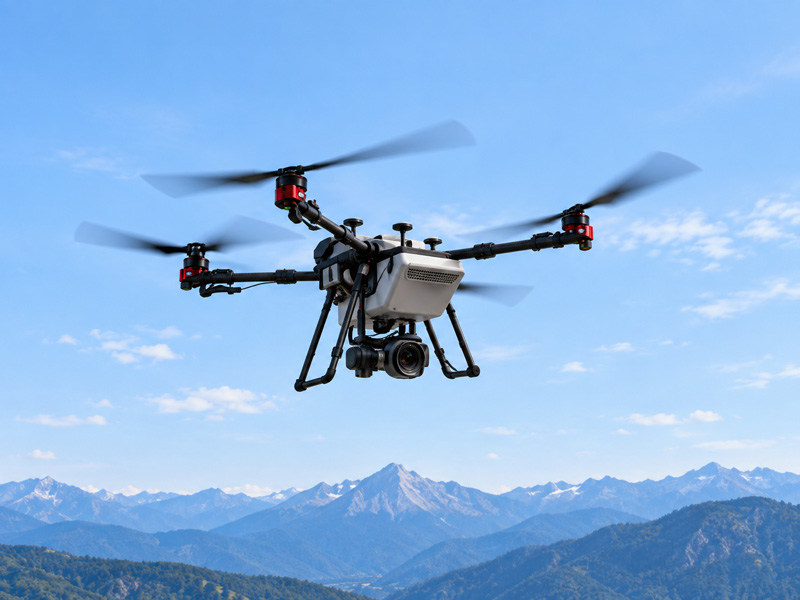


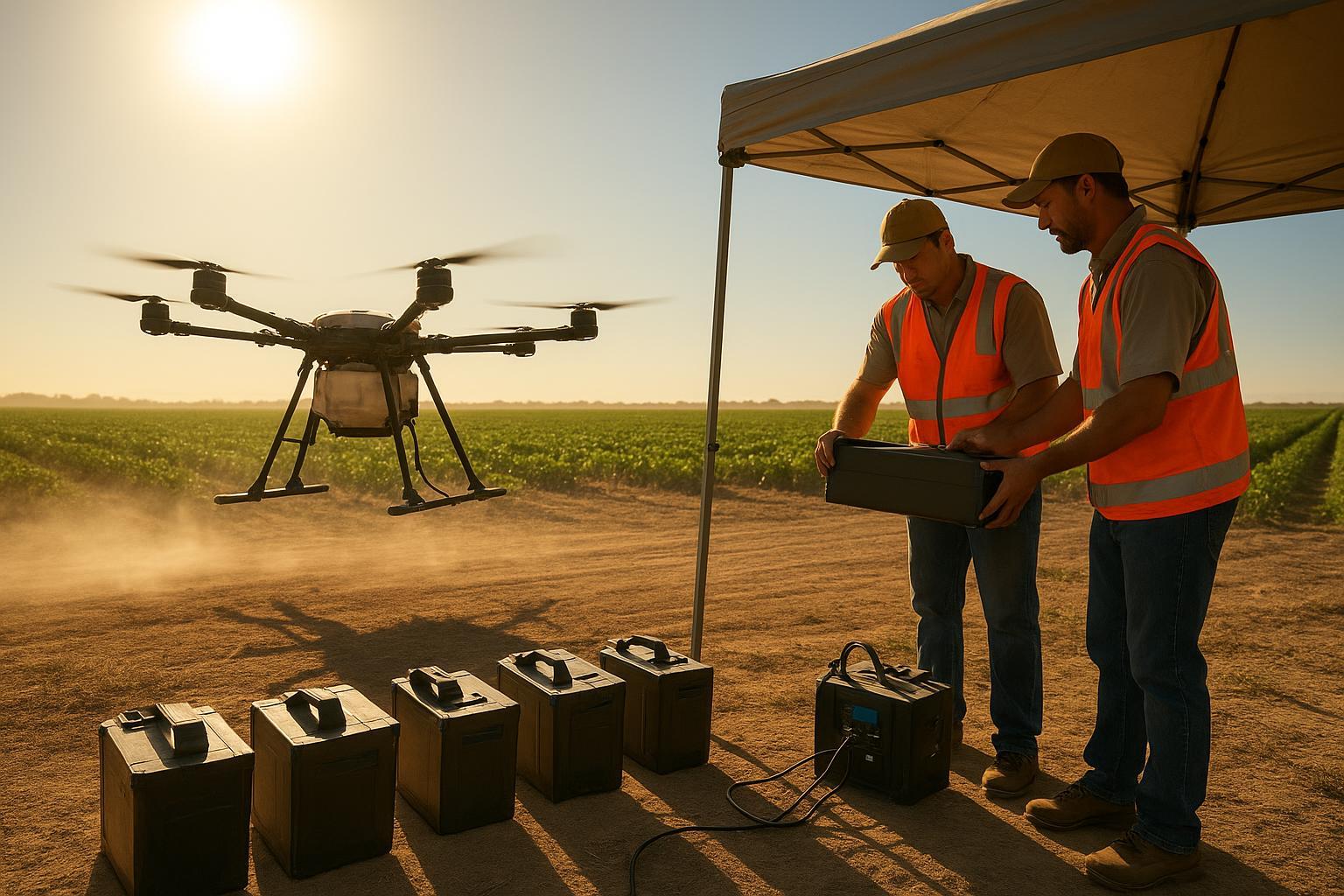
In peak spraying season, high temperatures don’t just shorten flight time—they reshape the whole field rhythm.
Batteries land hotter. Charging starts later (or won’t start at all). The day’s cadence slips, and the reliable “good hours” get squeezed.
For an agricultural drone fleet, that usually shows up in one metric: hectares per day per aircraft, delivered safely and predictably.
What matters is not only what happens in the air, but what happens between sorties on the ground.
This article follows the chain from a hot landing to the last sortie of the day—and explains why heat reduces productivity by affecting battery temperature, charging turnaround, and daily scheduling.
Why high temperature is a fleet-level operational constraint
Heat as a continuous operating condition in peak season
For spraying work, high temperature is often the baseline, not an edge case.
Peak spraying demand clusters in the hottest months. In hot regions (and in many summer geographies), midday heat is simply part of the operating environment. Field staging adds heat load too—direct sun, ground radiant heat, trucks/generators, and repeated high-current missions.
Most teams still treat heat like “bad weather.” But in real field operations, it behaves more like a daily operating limit—something that quietly caps throughput even when the skies are clear.
Once you treat heat as an operational constraint, the questions become operational too:
What’s our turnaround cycle under heat?
Where does the delay actually come from: cooldown, charging, or queueing?
How much spread do we see between packs on the same day?
What’s the impact on usable flight hours per day?
How heat impacts drone operational performance
Reduced flight time under thermal stress
You’ll often see shorter missions in high heat.
But what this means in the field is simple: each sortie returns with less usable energy and less margin for payload, wind, and route changes. You plan for a “normal” mission, and you end up flying a “safe” one.
When the BMS starts saying “no”
Spraying drones are high-power systems. Under load, packs can show voltage drop (“sag”) and reduced power headroom—especially as packs age or cell balance drifts.
The battery management system isn’t only protecting the pack. In hot conditions, it can end up limiting field productivity by reducing allowable current, capping charging, or triggering protective behavior.
So what this means in the field is more stops and starts: a pack that derates sooner, a sortie that ends early, or a charge session that refuses to begin.
For a quick, operations-friendly overview of common BMS protections (including thermal protection and fault handling), see our explainer on the role of a BMS in drone battery performance, safety, and lifespan.
In high heat, the operational pain is rarely “average performance.” It’s the spread—the one pack that derates sooner, the sortie that ends early, the charge session that won’t start.
The hidden failure chain behind high-temperature performance loss
System-level heat accumulation (battery + motor + environment)
In a hot-season workflow, heat doesn’t show up as one big failure. It builds across the system, mission by mission.
The battery heats during high-current discharge. Motors and ESCs run hotter too, which reduces overall margin. Then, on the ground, packs keep absorbing heat from direct sun and radiant surfaces while the next job is being staged.
Over repeated cycles, the operation can drift into a state where each next mission is slightly more constrained—until the BMS intervenes or charging simply takes longer than the team expects.
Why charging hot packs is restricted
Operators often experience this as “the charger won’t start” or “charging takes longer than the spec sheet.” The root problem is that charging at elevated temperatures accelerates unwanted side reactions and increases safety risk.
For the underlying chemistry and protection rationale, see the academic overview ScienceDirect: Safety mechanisms in lithium-ion batteries.
For a safety-oriented, operations-friendly baseline, NFPA maintains a public overview on Lithium‑Ion Battery Safety.
High temperature agricultural drone battery charging: why turnaround time becomes the real bottleneck
Agricultural drone battery cooldown time is now part of the cycle
In many real fleets, the day slows down on the ground, not in the air.
A common pattern is simple: a pack lands hot, and charging doesn’t begin right away. The team swaps batteries quickly—then waits.
Drone battery charging temperature limit 40°C
Above ~40°C, many systems won’t allow charging to begin immediately. Instead, packs must cool back into a safe window before the charger and BMS will proceed.
The exact “charge-allowed” temperature threshold and gating logic can vary by aircraft, cell chemistry, BMS strategy, and charger communication protocol. Treat ~40°C as a common field reference point—not a universal rule—and defer to your equipment manual and validated SOP.
In the guide above, the stated logic includes inhibiting charging if pack temperature exceeds about 40–42°C, and staging packs until they return to ≤40°C before charging.
Charging queueing breaks cadence
Once charging becomes temperature-gated, a queue forms—and it’s usually the queue, not the charger spec, that sets your pace.
Think of it as two stages: cooling to become charge-eligible, then charging to get back in rotation. If the first stage is unpredictable, your entire rotation becomes uneven.
A simple way to map it:
aircraft lands
battery is swapped
hot pack enters cooldown queue
only when cooled does it enter charging queue
At fleet level, the bottleneck becomes turnaround time, not flight time.
If you want a simple way to reason about it:
Sorties/hour are constrained by the slowest link in the cycle.
In hot conditions, that slowest link is often cooldown-to-charge eligibility.
How high temperature reduces daily spray capacity
Fewer usable cycles per day
In heat, each battery does fewer usable cycles because each cycle costs more time on the ground.
In practice, that shows up as “dead time” between sorties: the landing-to-takeoff gap grows, more missions are lost to waiting for charging to start, and the spread between your best packs and the ones that keep falling behind gets wider.
Shortened effective working window
Most teams see the same daily rhythm in peak season:
Morning: stable cycle rhythm
Midday: delayed turnaround (more thermal holds, more derating)
Afternoon: a smaller recovery window to hit the day’s target
Even if daylight hours don’t change, usable flight hours shrink—because the operation can’t maintain cadence when the ground cycle slows.
A simple throughput model: how heat turns minutes into lost hectares
The goal is not to produce a universal number (your aircraft, payload, and SOP differ). The goal is to give you a model you can audit.
Variable | What it means | How to measure it |
|---|---|---|
Flight time per sortie (min) | airborne minutes delivering spray | flight logs |
Swap time (min) | landing + pack swap + checks | timed SOP |
Cooldown time to charge-eligible (min) | time until pack is within safe charge window | pack temp logs / SOP timestamps |
Charge time to ready (min) | time to reach required SOC for next sortie | charger logs |
Packs per aircraft | inventory available for rotation | fleet inventory |
Chargers per aircraft | charging capacity | field setup |
Now compute:
Turnaround cycle time = flight + swap + max(cooldown, charger-available wait) + charge-to-ready
Max sorties per aircraft per day ≈ usable hours / turnaround cycle time
Example assumption (illustrative only): If your turnaround cycle stretches from 18 minutes to 26 minutes at midday, that’s a ~31% drop in sorties/hour—without any change in the aircraft.
The reason heat is so expensive is that it expands the “invisible minutes” (cooldown + charge eligibility), and those minutes multiply across the day.
Operational strategies for hot-weather deployment
Battery rotation: manage packs as a flow system
Treat batteries as a flow system, not as a pile of spares.
In the field, the easiest wins usually come from simple controls you can enforce:
Keep packs out of direct sun (canopy, reflective cover, shaded staging).
Keep air moving (don’t stack hot packs; separate them so they can shed heat).
Separate the flow clearly: cooling → ready-to-charge → зарядка → ready-to-fly.
Track pack health and cycle count; keep the weakest packs out of the hottest hours.
Charge profile discipline (speed и longevity)
Fast charging is not a single switch; it’s a profile plus boundary conditions.
Fast to ~80% then slower to finish/balance:0–80% at ~1C, then 80–100% at ~0.5C (actual implementation depends on pack/charger communication and validation).
Treat the rates above as an example profile, not a default recommendation. Only use a fast-charge profile that is explicitly supported by the battery manufacturer/BMS and charger, and only when the pack is within the validated temperature window. If the pack is still heat-soaked from flight, wait for cooldown instead of trying to “push through” with higher current.
If you push speed without temperature gating and a controlled profile, you don’t just risk damage—you create more spread between packs, and that spread is what breaks your daily cadence.
Scheduling your day around peak heat
Scheduling is a battery strategy.
A practical way to plan hot days:
front-load your most time-sensitive hectares into the most stable thermal window
treat the hottest hours as charging recovery + maintenance, not peak output
keep a “heat reserve” (extra packs/chargers) for midday so you aren’t forced into unsafe shortcuts
Once you treat heat as a throughput constraint, battery selection becomes less about nameplate capacity and more about how the whole system behaves under stress.
Implications for battery selection in hot agricultural regions
Battery choice is a throughput decision, not just a spec decision
For hot-season spraying, evaluating batteries purely on nameplate capacity or C‑rate misses the real constraint.
What to ask for | Why it matters in hot-season operations |
|---|---|
Charge-allowed temperature window and the exact gating logic | Determines whether packs can enter charge quickly after a hot landing |
Discharge curves and voltage sag at mission-relevant load and ambient | Predicts whether sorties will end early under heat and payload |
BMS protections and what the drone will do when thresholds are hit | Helps you forecast derating behavior and avoid surprise stops |
Traceability and compliance workflow (e.g., UN38.3 documentation) | Reduces procurement risk and supports audits, shipping, and after-sales |
Red flags to watch for:
“X-minute charging” claims without starting SOC and temperature conditions
no clarity on charger/BMS communication or profile enforcement
no explanation of variance after repeated hot cycles (variance trend)
Turn your heat problem into an SOP you can enforce
The quickest win is usually not a new aircraft—it’s a tighter turnaround system:
Measure your real midday turnaround cycle (landing → next takeoff).
Split the delay into cooldown vs charger queue vs charge time.
Set enforceable thresholds (max pack temperature to start charge, max thermal hold, minimum packs per aircraft).
Audit variance across packs; remove outliers from peak-heat windows.
If you do only one thing after reading this, make it this: measure the ground cycle, then engineer the rotation around your hottest hour, because that’s where throughput is won or lost.
If you want a partner to translate battery design choices into fleet-level throughput targets (turnaround time, variance control, traceability), Herewin can support you as an ODM/OEM provider: Herewin drone battery solutions.

 Русский
  English
  Español
  한국어
한국어  Deutsch
  Français
  日本語
日本語  Bahasa Indonesia
  ไทย
ไทย  العربية
  Português do Brasil
  Italiano
  Nederlands