




A North American UAV distributor with an established customer base may eventually consider two ways to expand its battery business: adding more products from an existing supplier, or developing a private-label battery range under its own brand. Both paths often lead toward the same group of manufacturers, and both typically begin with a sample request.
Buying batteries and building a supply relationship are different problems. A first purchase usually comes down to specifications, unit price and whether the sample performs. A long-term partnership tends to be judged on batch consistency, product fit as the customer base shifts, brand support, documentation, lead-time reliability and how failures in the field get handled. Passing the initial sample evaluation shows that a supplier can produce a battery that meets the agreed requirements; it does not yet show that the same performance holds across repeat production orders.
That gap is where many distributor decisions go wrong. A supplier that can fill an order is not automatically an OEM partner that can carry a product line for several years, and the two questions need different evidence.
How, then, should distributors tell one from the other?
Why Choosing a Drone Battery Supplier Is Different from Choosing a Long-Term OEM Partner
A one-time purchase and a long-term OEM relationship are evaluated against different questions, and the difference is not simply duration.
One-time purchase | Long-term OEM partnership |
|---|---|
Current product price | Total cost across the supply relationship |
Performance of the batch received | Consistency from batch to batch |
Whether an existing model fits today | Whether the range can extend to future platforms |
Whether one delivery arrives | Whether supply holds across repeated orders |
Purchase correspondence | Technical and after-sales collaboration |
A product that passes sample testing has not shown that it can be supplied at volume with the same result. Sample units are often built or selected with more attention than a production run receives, and the properties that matter to a distributor — capacity spread across a shipment, connector fit, BMS behavior on the customer’s airframe — are properties of a population, not of one unit.
The cost of changing suppliers is what makes the first decision consequential. Replacing a battery supplier touches live SKUs, warranty conversations, customer expectations and whatever inventory is already on the shelf, so the decision is hard to unwind. That is why the question is not whether a supplier can make batteries, but whether it can support the distributor’s product business after the first shipment is paid for.
Different Distributors Need Different Types of OEM Partnerships
Distributors do not all buy the same way, and a single list of supplier criteria applied to every channel model produces advice too general to act on. Three partnership types cover most of the market, and each shifts the evaluation toward different evidence.
Standard Battery Supply for Established Distribution Channels
This is the distributor that already sells drones and wants to add or widen a battery SKU line. The questions are concrete: does the supplier’s existing catalog match the airframes this distributor actually sells, across the capacity, voltage and discharge range those customers use? Can the same model be reordered months later without a specification change? Can the range be extended as sales data shows which segments move? Standard supply is a catalog-fit problem first and a manufacturing problem second.
Private Label Battery Programs for Regional Brands
Here the distributor or importer wants its own brand on the product. The scope usually covers logo and product marking, packaging and labels, product documentation and sales assets, and the consistency between the approved sample and the production run. The critical question is where the customization boundary sits: which changes are cosmetic and which touch the cell, the BMS or the enclosure. A program that changes only branding follows a different approval path than one that changes the pack.
Custom OEM Development for Specific UAV Applications
This applies to brands and equipment makers with a defined airframe or technical requirement. The work involves pack dimensions and structure, voltage, capacity and discharge requirements, connectors and communication interfaces, BMS requirements, and prototype validation before production. It is also where the supplier’s role needs to be named precisely: standard product purchase, OEM build-to-specification, and ODM work in which the supplier contributes to the design are three different commitments with different development timelines and different questions about who owns the design.
A distributor that identifies which of these three describes its business can read the evaluation criteria that follow against the right evidence rather than collecting all of it. If the practical difference between the last two is unclear, the short version is this: in OEM work the buyer defines the product and the supplier builds to that specification, while in ODM work the supplier contributes to the design itself. That shift moves development time, tooling cost and design ownership, which is usually why the two are quoted on different terms.
7 Key Factors to Evaluate a Drone Battery OEM Partner
The seven factors below are the ones that decide whether a supplier can carry a channel over several years. They are ordered from product fit through to what happens after delivery, and each one ends with what to ask for.
Product Range and Application Compatibility
The question is whether the supplier holds a portfolio that fits this distributor’s target customers. FPV platforms often prioritize high discharge capability relative to pack size, while agricultural drones place greater emphasis on usable energy, sustained power delivery, turnaround time and operating conditions. Industrial applications introduce different trade-offs depending on mission duration, payload and operating environment. Voltage, capacity, discharge rate and physical dimensions all have to line up with an actual airframe.
A long catalog is not the same as fit. A supplier can list dozens of models and still have nothing that mounts in the distributor’s best-selling drone, and a pack that does not fit has no channel value regardless of its specifications.
How a range is organized says something before you read a single datasheet. A supplier that groups packs by platform rather than by cell type has already done part of the fit work, and a distributor can check its own customer mix against those groups faster than by scanning cell-level specifications. Whether any of it fits a best-selling airframe is still a question only the distributor can answer.
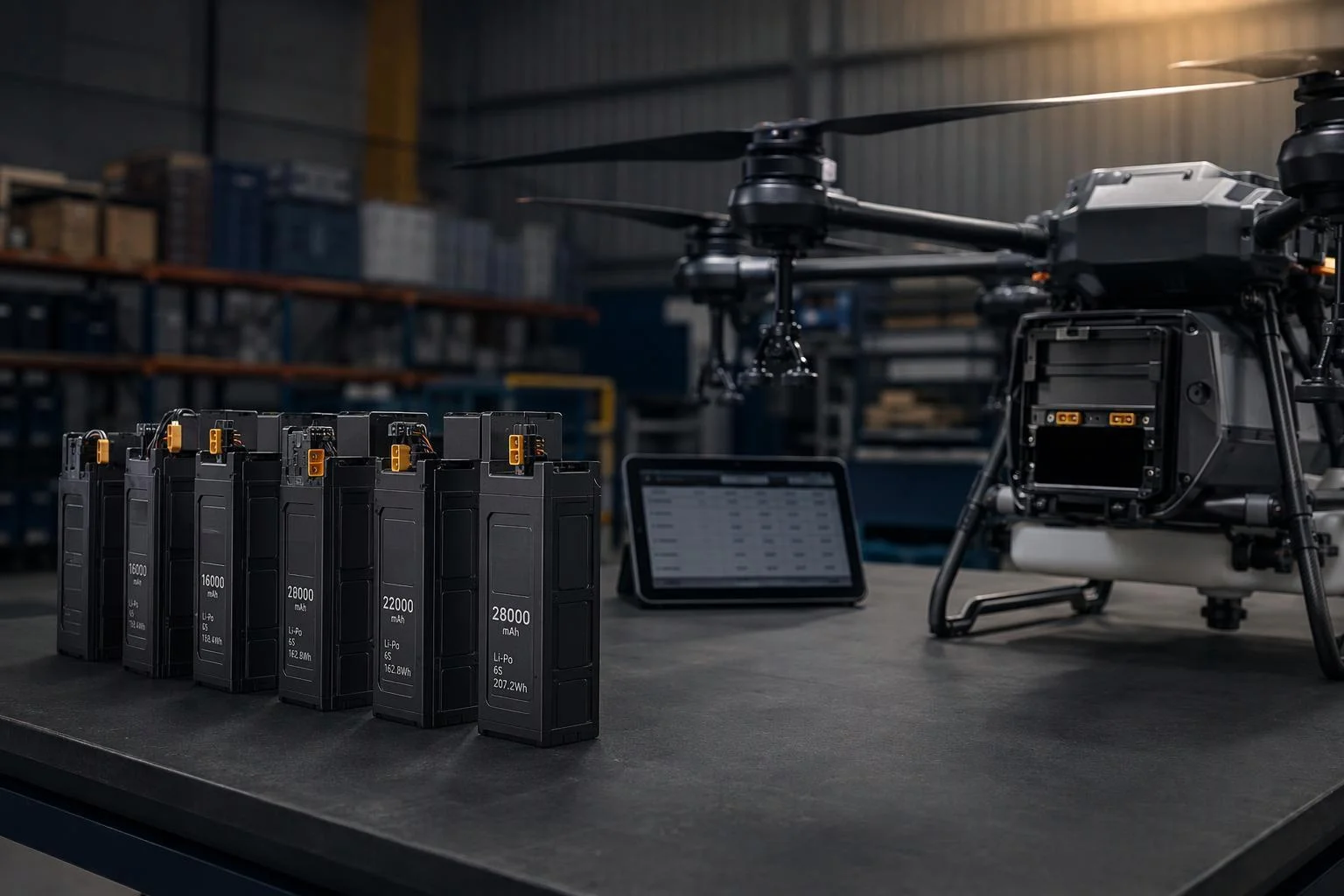
Chargers and accessories belong to the same question. A battery sold without a compatible charging path becomes a support problem, so battery and charger compatibility — connector types such as XT60, XT90 and JST-XH included — is a specification item to confirm at the sample stage.
What to verify: ask for the specific models that match your top three selling airframes, with dimensions, connector type and voltage, confirm which are standard stock versus custom, and ask which charger the supplier recommends for each pack.
Manufacturing Capability and Production Control
The question is whether the supplier actually manufactures and develops, or mainly sources and assembles. Cell and pack manufacturing capability, production lines and equipment, in-house development, in-process quality control and the handoff from sample to volume all bear on this.
The distributor does not need the largest factory in the category. It needs to know which production stages the supplier controls itself and which depend on outside partners, because the outside stages are where a supply relationship becomes unpredictable. Neither model — cell manufacturing or cell sourcing plus pack integration — automatically produces better quality. What separates suppliers is how each one manages cell selection, incoming inspection, grading, traceability and control over specification changes.
Change management deserves its own question. When a cell supplier, a key material, the BMS or a connector changes, what happens? A supplier with a formal process approves the change, re-validates the affected product and notifies customers before the altered unit ships. That mechanism is worth more than a line count on the factory floor.
Where a supplier does run its own plants, the useful answer is still a process description rather than a capacity number — a starting point for a document request, not a substitute for one.
What to verify: ask which stages — cell, pack assembly, BMS, testing — happen in the supplier’s own facilities, how incoming cells are qualified and screened, and how specification changes are approved and communicated. Request process and inspection documentation rather than facility photographs and capacity figures alone.
Quality Consistency Across Production Batches
A sample that passes tells you a unit passed. The question is whether the next thousand behave the same way. Consistency depends on cell grading and sorting, voltage and internal resistance screening, charge and discharge testing, BMS and communication checks where applicable, outgoing inspection and batch records, and a documented comparison between the approved sample and production units.
This is the factor most often reduced to a single test report, and that reduction is where distributors get caught. A test report describes the unit that was tested. It says little about how the supplier controls the units that follow. Four pieces of evidence make the difference: an approved reference sample held by both parties, inspection records for each production batch, a change control process, and a documented path for non-conforming units.
Change control matters most here. One of a distributor’s real risks is buying a product, then reordering a year later and receiving a unit with the same model number and a different configuration — a changed connector, an altered enclosure dimension, a different BMS firmware. Performance may still meet the datasheet while the part no longer drops into the customer’s airframe. A supplier that treats a configuration change as something to notify, rather than announce after shipment, is protecting the distributor’s installed base.
That distinction is easy to test. Any supplier claiming a defined inspection flow should be able to produce a batch file on request — and what that file contains is a separate question from whether the process provides for it. Asking for one batch record is the quickest way to settle both.
What to verify: ask how subsequent batches are controlled, whether inspection records can be provided per batch, how a production unit is compared against the approved sample, and how customers are notified when a component, firmware or BMS changes.
OEM Customization and Private Label Support
The question is whether the supplier can support the distributor’s own brand. The scope can include logo and marking, appearance and labels, packaging, model and specification customization, and product documentation and imagery, with a different development process at each level of change.
The three terms are worth separating because they carry different commitments. Private label applies branding and packaging to a mature product. OEM manufactures or configures a product to the customer’s requirements. ODM involves the supplier in the product’s design and development. A distributor should confirm which of these the supplier is offering for the specific product in question, and should not assume that every customization option applies to every model.
Custom work also raises a commercial question that surfaces late if nobody asks it early: who owns what. Does the design come from the distributor or the supplier? If a custom enclosure or pack structure is developed, who owns that design? Can the distributor specify the BMS software and communication protocol? These are not abstract legal matters — they decide whether the branded range can move to a second source in three years or stays tied to one factory.
A published scope is a better basis for that conversation than a verbal promise. Where a supplier publishes one, check whether it distinguishes between cosmetic changes and changes that touch the pack itself, and whether it names the product lines each option applies to. What sits outside the published scope for a specific model is still the question worth asking.
What to verify: ask for the customization scope per product line, which elements are confirmed for the specific model you would launch, the approval steps between artwork and production, how the approved sample is held against the production run, and who owns the design and documentation for any custom element.
Documentation and North American Market Requirements
The question is whether the supplier can provide documentation that matches the product and the shipment. The relevant set typically includes the UN 38.3 test summary and transport documents, an SDS/MSDS, product specifications, and applicable safety test reports — with each document traceable to the exact model and configuration being imported.
Two distinctions matter here. UN 38.3 refers to the transport testing requirements set out in Section 38.3 of the UN Manual of Tests and Criteria. It is not a North American product safety certification. In the United States, 49 CFR § 173.185 requires lithium battery manufacturers and subsequent distributors to make a compliant test summary available for applicable batteries. In Canada, lithium battery shipments and imports fall under the Transportation of Dangerous Goods (TDG) Regulations, with requirements varying by transport mode.
Equally, UL and IEC standards are not universal certification requirements for every drone battery. Their applicability depends on the product, its intended use and the requirements of the relevant buyer or market.
Each document then serves a different purpose. The UN 38.3 test summary provides evidence that the battery type passed transport testing; the SDS describes material hazards and safe handling; the product specification sheet defines the technical parameters of the specific model. Applicable safety standards address a separate set of requirements. None of these substitutes for another, and none of them is a blanket market approval.
How a supplier organizes its files often says as much as the files themselves, and it is worth checking that the paperwork is filed per model rather than per brand. A supplier may hold a quality management certificate such as ISO 9001, a body of transport testing documentation, and market-specific product documentation; these are different kinds of evidence and should be treated as such. The question that matters for a distributor is whether the documentation supplied matches the exact model and configuration being purchased — the file for the part number, not a certificate for the company.
What to verify: request the test summary and SDS for the exact model, check that model numbers and ratings agree across documents, and confirm with your own importer or carrier what the destination market requires. The PHMSA lithium battery guidance и Transport Canada’s TDG programme are the places to check before each new market entry.
Production Lead Times, MOQ, and Supply Planning
The question is whether the supplier’s commercial terms match the distributor’s purchasing rhythm. Sample and mass-production timelines are different things, MOQ and order quantity interact with pricing, standard and custom models have different delivery profiles, and raw material and production planning determine what happens when a repeat order arrives earlier or later than forecast.
Low MOQ and fast delivery are easy to advertise and hard to sustain. The useful question is not what the minimum is but whether the stated terms hold across order sizes, and what changes — price, lead time, allocation — as volume moves up or down. Order changes and delays also need a communication path agreed in advance, because a delay discovered at the shipping date is a customer problem for the distributor.
Forecasting and replenishment planning sit behind those terms. A distributor holds inventory against demand it cannot fully predict, so what matters is turnover, replenishment cycle time, how far demand swings between periods, how much safety stock the channel can carry, and whether the supplier can build ahead of peak season. A supplier who can discuss those realities, rather than only quote an MOQ, is easier to plan a year with.
Read a supplier’s published terms closely, because the shape of the disclosure tells you how to plan: sample timelines are usually short and fixed, while production timelines are ranges that move with the order. Treat any figure as conditional until it is confirmed in writing. Ask which product lines it covers, whether the sample clock starts at order confirmation or at dispatch, and whether the same terms apply to orders shipped to North America.
What to verify: ask for sample and production lead times separately, the MOQ per model, how custom versus standard models differ, what happens to lead time at two or three order sizes, and how the supplier plans stock ahead of peak demand.
Technical Communication and After-Sales Support
The question is what happens after the product ships. Battery-to-airframe fit issues, charger and communication compatibility, a route for technical questions, failure analysis and quality complaint handling, spares and replacements, and technical communication during product iteration all belong here.
For a distributor, after-sales support is not only about returns. It is about whether the distributor can answer its own customer quickly when a pack behaves unexpectedly in the field. A supplier that responds only through a sales contact leaves the distributor exposed at the point where the customer relationship is most fragile.
What separates a real process from a promise is the sequence behind a complaint: failure reporting, technical assessment, root cause analysis, corrective action. When a distributor can hand a field failure into that pipeline and get back a cause and a fix, it can manage the customer conversation. When the only reply is a replacement offer, the distributor is guessing. One caution, though: an incident in the field does not automatically indict the battery. Chargers, the airframe, the operating environment and how the pack was used all sit in the chain, and a supplier that jumps straight to blaming its own product is no more useful than one that denies everything. You want analysis, not a reflex.
The same standard applies to any claim about overseas warehouses or local support teams. Treat such a statement as an opening position for a conversation, not a coverage map: the region, the product and the escalation path still have to be confirmed in writing before anyone relies on them in front of a customer.
What to verify: ask who handles technical questions, what the failure analysis process is, what the warranty terms are for the specific product, which region is covered by which support channel, and where support is actually delivered from. Get the answers for the region and product you actually sell into.
How to Move from Battery Samples to Long-Term Supply
The path from a first sample to a repeat supply relationship runs through five stages, and each one answers a different question.
Stage | What the distributor needs to confirm |
|---|---|
1. Requirement review | Target applications, specifications, estimated volumes and destination market |
2. Sample evaluation | Performance, dimensions, connectors and compatibility with the actual airframe |
3. Pilot order | Quality and delivery of a small production batch |
4. Production confirmation | Final specifications, packaging, inspection criteria and delivery schedule |
5. Repeat orders | Batch consistency, replenishment and how problems are handled |
The stages are not interchangeable, and a common mistake is treating stage two as if it settled stage three. Sample validation and production validation answer different questions: the sample asks whether the design can meet the requirement, while the pilot order asks whether the supplier can reproduce it at volume, on schedule, with the packaging and documentation agreed.
Each stage tests a different capability. Stage one tests whether the supplier engages with your requirement at all. Stage two tests design fit against the actual airframe. Stage three tests reproducibility — batch inspection records, the comparison against the approved sample, the real lead time against the quoted one. Stage four fixes final specifications, packaging and inspection criteria in writing. Stage five tests whether all of it holds on a routine reorder. A supplier can pass one stage and stumble at the next, so none of the five can really be skipped or merged.
What a Long-Term OEM Partnership Should Deliver Beyond the Battery
Delivering batteries that consistently meet agreed specifications is only the starting point of a long-term partnership. What separates a supplier from a partner is what comes alongside the product, and how the two parties work together once the first order is behind them.
A distributor going through the five stages may reasonably expect the supplier to participate in the requirement review, not just quote against it. Product selection, sample confirmation and the move to volume production work better as a joint process, and the suppliers worth keeping are usually the ones that ask questions at stage one.
A Product Portfolio That Can Grow with Your Channel
A distributor’s customer base is not static. The single model that anchors the line today may be joined by a smaller platform for a new customer segment or a higher-capacity pack for an existing one. A supplier whose range can extend across those tiers — and whose custom capability can fill the gaps the catalog does not cover — reduces the number of times the distributor has to re-run the entire evaluation.
Branding and Sales Enablement
A distributor selling under its own brand needs more than a logo on a case. Packaging and labeling, product images, video and specification material all feed the distributor’s own sales process, and their availability affects how quickly a new SKU can be launched. The scope of what the supplier will produce should be agreed in writing, because sales assets are frequently assumed rather than contracted.
Supply Continuity and Ongoing Cooperation
Repeat purchasing depends on specification maintenance: the product the distributor reorders in eighteen months should be the product it qualified. Demand changes, model updates and technical questions all need a channel that stays open between orders. None of this guarantees sales growth, and a supplier should not claim that it does. What it does is make the distributor’s own operation easier to run — fewer surprises on reorder, faster answers on technical questions, and a documented basis for what was agreed.
Exploring an OEM Partnership with Herewin
This guide comes from Herewin, so this last part is about us rather than a neutral view. It follows the same criteria set out above and leaves the gaps visible.
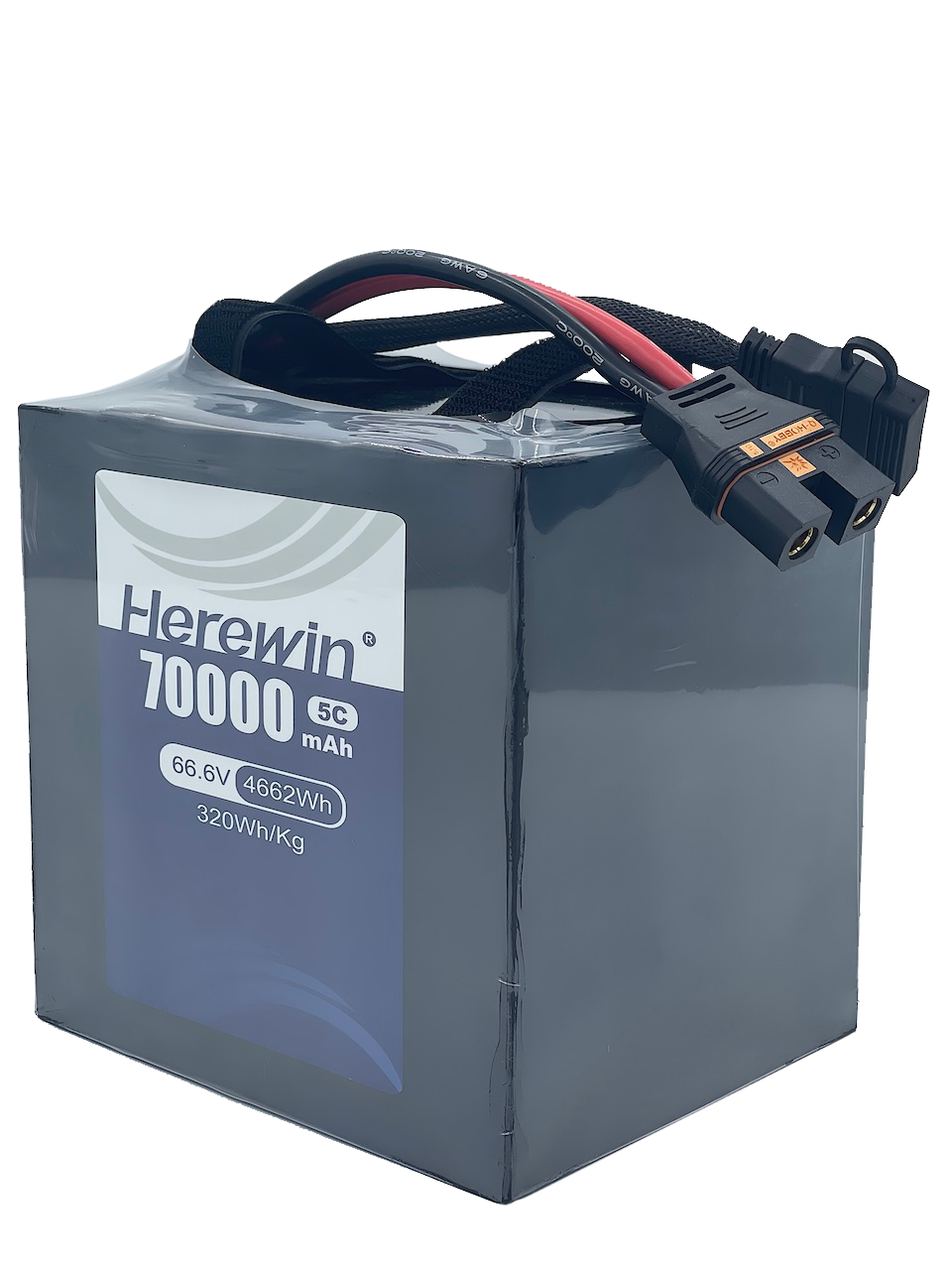
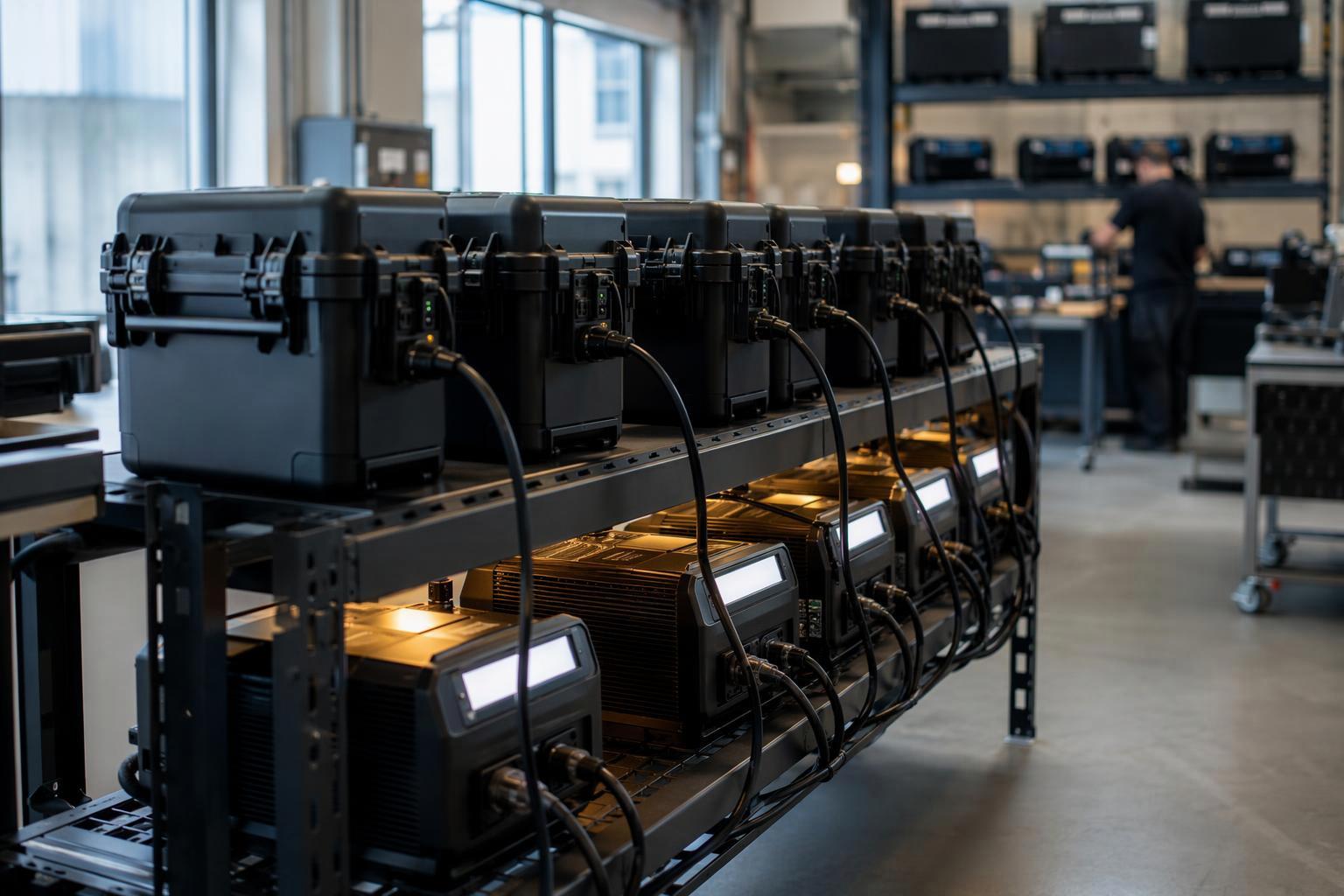
We develop and manufacture lithium battery solutions for UAV applications. Our range is organised by application rather than by cell type — agricultural, logistics, FPV and mapping packs — with connector options that can be matched to an existing charging system, and chargers sit alongside the packs so a battery and its charging path can be specified together. Cell and pack production both take place in-house; the process is described as running to more than 20 steps, 10 key control points and four inspection stages, and the documentation behind those stages can be requested. For private-label and custom work, our LiPo range has a defined scope covering connectors, pack configuration and branding elements. On quality systems and transport testing, we hold UN 38.3 test documentation, CE-related product documentation and ISO 9001 certification — each of which covers a different thing.
Two limits are worth stating plainly. A range organised by application is not the same as confirmed compatibility with a specific North American airframe — that gets settled at the sample stage. And a described production flow is not proof of batch consistency; the batch records and change-control trail are what to ask for, for the exact part number. Commercial terms follow the same rule: a one-unit minimum with small trial orders accepted, stock samples at around one business day and mass production at 15–25 days depending on volume and customization are figures we quote for specific products and projects, not a blanket delivery promise.
If the fit looks plausible, the most useful next step is a requirements conversation: the platforms you serve, the models you need, expected volumes, and whether private-label or custom development is involved. Apply for a distributor partnership to start that review.
Вопросы и ответы
What should distributors look for in a drone battery OEM manufacturer?
Start with product fit, then move to production control — specifically how the supplier holds consistency across batches. Commercial terms and after-sales come after those two, because a competitive price won’t rescue a supplier that fails either.
Can drone battery manufacturers provide private-label solutions?
Many can, but the scope varies by model, so confirm it per product rather than per catalog. If the change touches the cell, BMS or enclosure rather than branding alone, it becomes an OEM or ODM project with a different development path.
What documents should distributors request when importing drone batteries into North America?
The UN 38.3 test summary for the exact model, an SDS/MSDS and the product specification sheet, plus anything your importer or carrier requires. UN 38.3 covers transport testing, not market safety certification, and the U.S. and Canada apply separate transport rules.
What is the difference between a drone battery OEM and ODM supplier?
An OEM supplier builds to a specification the buyer defines; an ODM supplier contributes to the design, which shifts development time, tooling cost and design ownership. Confirm which applies before development starts.




 Русский
 English
 Español
 한국어
 Deutsch
 Français
 日本語
 Bahasa Indonesia
 ไทย
 العربية
 Português do Brasil
 Italiano
 Nederlands