




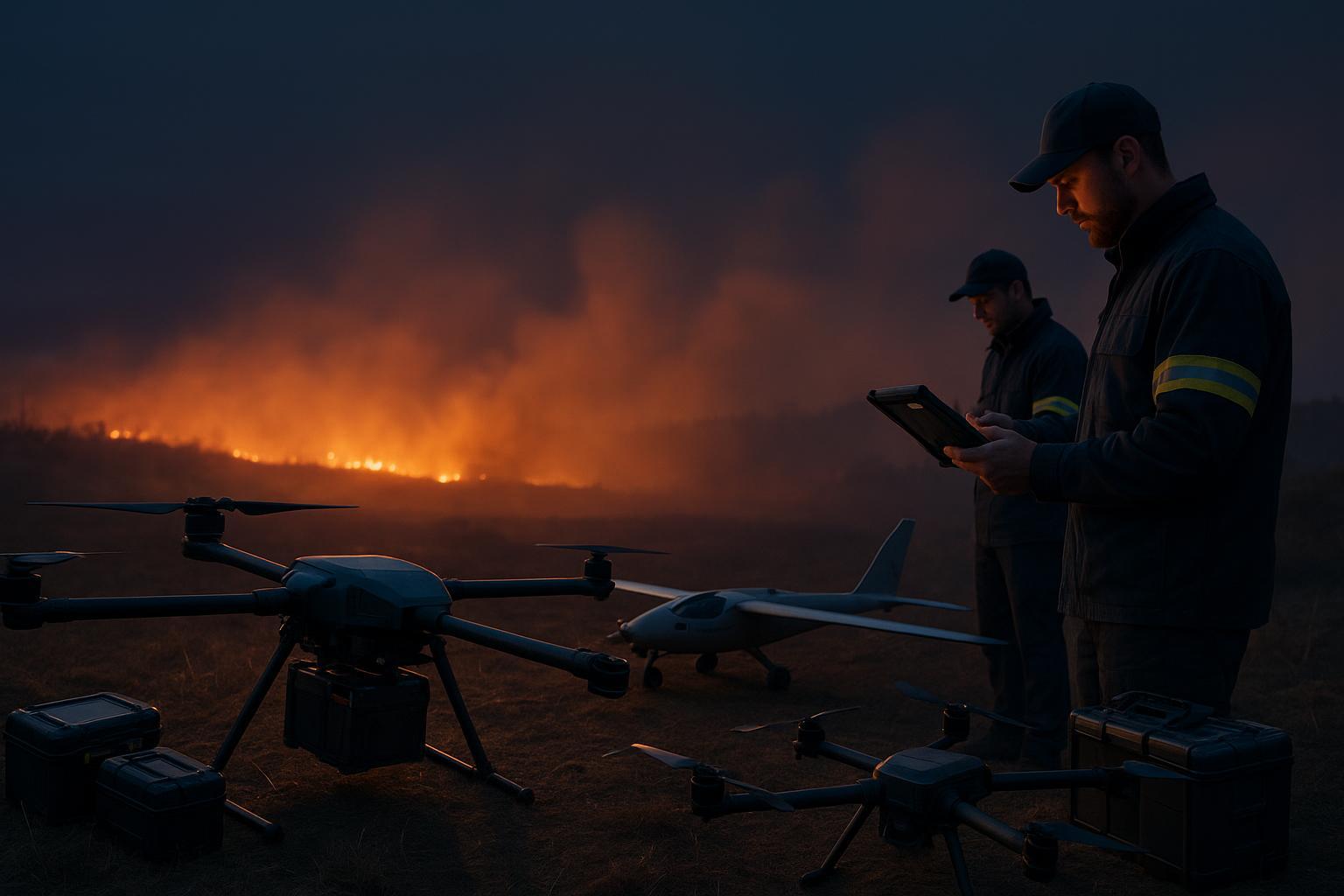
Wildfire drone operations don’t stop for heat—or for batteries that can’t keep up. High-heat missions (40–55°C) strain conventional LiPo packs, causing voltage sag, SOC drift, and lost sorties. This guide translates semi-solid (gel-rich) battery engineering into operator-ready SOPs, helping fleets sustain high-tempo missions, minimize thermal idle, and maintain audit-ready telemetry. Semi-solid architectures are designed to resist thermal derating in extreme fireline conditions, providing more consistent voltage under load and faster turnaround between sorties.
High-Heat Wildfire Drone Battery Selection
Conventional liquid‑electrolyte LiPo batteries often face serious challenges in high-heat wildfire drone operations. As ambient temperature and load stress increase, internal resistance (IR) rises, generating additional I²R heat. This creates a feedback loop in which voltage sags under load, onboard protections engage, and mission legs shorten—precisely when maximum thrust is required for heavy payload climbs.
Challenges of Conventional LiPo in High-Temperature Missions
Heat exposure softens polyolefin separators and accelerates interfacial degradation, making cells more prone to local hotspots and shutdown behaviors. Research has shown that ceramic‑coated separators (e.g., Al2O3) can dramatically reduce high-temperature shrinkage compared to uncoated membranes. This improvement enhances dimensional stability and puncture resistance under abuse, as demonstrated in peer-reviewed and lab studies from ORNL and ACS/ASME venues between 2021 and 2025 (for example, the Al2O3/ceramic separator findings summarized in ORNL’s roll-to-roll work and ACS publications).
Elevated ambient heat further magnifies thermal gradients and narrows safe operating windows, which in turn increases degradation risk and exacerbates voltage sag during high C-rate events. These factors combine to challenge both battery reliability and mission throughput in real-world wildfire operations.
Field Symptoms of Thermal Derating
Operators typically observe the following indicators when LiPo packs are stressed by heat:
Voltage sag spikes above 30°C during steep climbs, particularly when carrying payload.
Extended cool-down periods are required before safe charging can begin.
SOC drift after repeated hot cycles, making reserve margins uncertain and flight planning less predictable.
Alternatives and Trade-Offs
High-grade liquid LiPo packs with ceramic-coated separators can offer a baseline improvement, but they still contain higher free-liquid content, introducing potential leakage and flammability pathways.
When choosing chemistry, operators often weigh LFP versus NMC:
LFP provides superior thermal stability and cycle life, though at the cost of lower energy density.
NMC delivers higher Wh/kg, but requires stricter thermal control to avoid derating.
The optimal choice depends on airframe mass budget, payload requirements, and mission duty cycle.
Safety Considerations: No battery chemistry is immune to abuse, so platform-level validation, thermal standoff from radiant heat sources, and strict adherence to manufacturer guidelines are essential for safe operation and mission success.
Semi-Solid Batteries for High-Heat UAV Missions
Semi-solid (gel-rich) battery systems offer a thermal-resilient alternative to conventional liquid LiPo packs, particularly in wildfire drone operations where ambient temperatures can exceed 40–55°C. While these systems typically carry a higher upfront cost per watt-hour, the operational payback often comes from improved mission throughput: shorter post-landing cool-downs, more consistent voltage under heavy-lift climbs, and fewer aborted flight legs due to thermal derating. The exact ROI depends on duty cycle, staging conditions, and validated charge protocols.
How Semi-Solid Electrolytes and Ceramic-Coated Separators Improve Thermal Stability
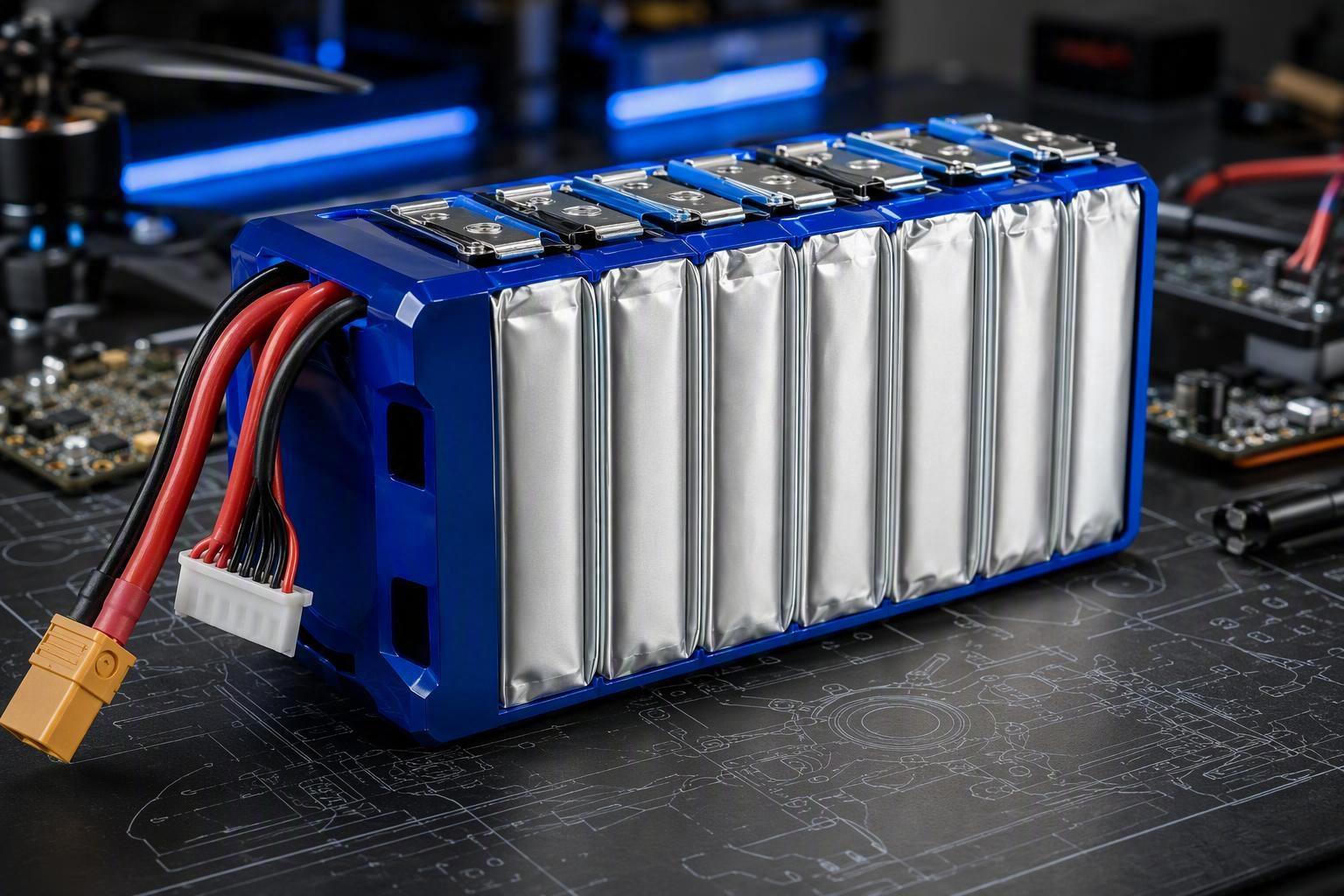
Semi-solid packs convert part of the electrolyte to a gel-rich matrix, limiting free-liquid migration under heat and vibration. Ceramic-coated (Al₂O₃) separators reduce shrinkage and maintain cell spacing under stress. Together, these features stabilize voltage under load and shorten cool-down times while requiring platform-level validation.
Supplier Evaluation Considerations
Operators should request from suppliers:
Temperature-dependent internal resistance (IR) curves over 20–55°C,
Shrinkage and thermal-propagation barrier data for separators,
Environmental sealing evidence, including IP rating summaries and corrosion/coating descriptions for humid or ash-laden air.
Rapid Response Battery Deployment for Wildfire Drone Fleets
Fast turnaround for wildfire drone operations—especially wildfire UAV battery fast charging in the 1.5C–3C range—requires more than high-power chargers; it demands charging only when battery packs are within a safe operational window and stopping before the chemistry is stressed. Achieving this balance supports aggressive 1.5C–3C charging while protecting battery longevity.
Safe Fast-Charging Windows for High-Heat UAV Batteries
Operators manage thermal and SOC windows to maximize safe throughput:
Temperature gates: Initiate fast charging only within manufacturer-specified T-charge windows. Many workflows target starting above the mid-teens °C and taper intensity as temperature or SOC rises, since charging below safe thresholds increases plating risk.
SOC windows: Mid-band charging (approximately 20–80% SOC) with tapering at the upper range limits SEI damage; exact windows are chemistry- and pack-specific and must be validated by the supplier.
Cooling strategies: Stage packs in shaded, ventilated areas, ensure airflow across cells, and avoid direct radiant heat from the fireline. Thermal cameras can verify uniformity prior to charge initiation.
Design guidance from NREL (2024) highlights that electrode optimization and tortuosity control are key enablers for higher C-rates with reduced degradation, reinforcing that safe fast charging is both a design and operational protocol.
Operator-Oriented Sortie Throughput Comparison
Internal tests and industry norms indicate that semi-solid packs deliver measurable mission benefits compared to conventional liquid LiPo systems:
KPI | Conventional liquid LiPo (industry avg) | Semi‑solid series (internal‑test example) |
|---|---|---|
Temperature window for charge starts | ~10–35°C | ~5–40°C (validated per pack) |
Cooling hold (post‑landing to T‑charge) | 10–15 min | < 5 min (shaded, ventilated staging) |
Voltage sag at heavy climb | ±15% at 30C spikes | ~±5–10% at comparable load |
Sorties per aircraft per day | Baseline | ~+20% (mission‑profile dependent) |
Note: The comparative data above is based on internal test results under simulated heavy-lift conditions; industry averages are provided for reference purposes only.
Methods: Identical airframes and payloads were used; ambient 35–42°C; controllers logged voltage/current; charge initiations were only within validated gates; 4–6 cycles per aircraft per day across a 3–5 aircraft cohort. Sortie-rate deltas are modeled outcomes tied to specific turnaround workflows, including multi-pack rotations, high-C discharge spikes, and active shaded/ventilated cool-downs. The semi-solid series reflects internal R&D stress testing and field-representative trials; actual performance must be validated on each platform.
24/7 Fire Monitoring Batteries: Translating SOC Accuracy into Mission Range
High-fidelity SOC (State of Charge) estimation allows operators to optimize reserve policies and maximize usable endurance without adding battery mass. In well-characterized systems, targeting a ±3% display error enables safer reduction of reserve buffers, effectively extending mission range—provided the estimator is calibrated and temperature-compensated for the duty cycle.
Algorithmic Stack and Calibration
Modern BMS (Battery Management Systems) typically combine coulomb counting with model-based observers such as Extended Kalman Filters (EKF) or Unscented Kalman Filters (UKF). These systems fuse voltage response and cell characterization to maintain SOC stability even as load, temperature, and internal resistance vary during high-heat wildfire operations.
Periodic full-span calibrations in controlled conditions, aligned with maintenance windows, are essential to track offsets and correct drift. Exportable telemetry logs—including current, voltage, temperature, SOC, and SOH flags—support audit readiness and after-action reviews.
Practical Considerations
Environmental factors can skew sensor readings. High heat or humidity may impact SOC accuracy, so connectors should be shielded, housings sealed to at least IP65 standards, and potential condensation paths mitigated within packs and harnesses. Operators should request error-budget breakdowns and test documentation from suppliers to verify that SOC performance meets operational targets.
By maintaining a well-calibrated, high-fidelity SOC estimation system, wildfire drone fleets can safely reduce reserve margins, improve mission predictability, and optimize overall sortie throughput.
Learn more about BMS methods and SOC/SOH estimation trade‑offs in this engineering overview on battery BMS technology and safety performance.
Case Study & Standards: From California Wildfire to Amazonian Deployments
Lessons from California: high‑intensity payload climbs
Heavy-lift platforms (50–100 kg payload class) supporting wildfire suppression often experience transient 30–50°C current spikes on climbout. Operator-tested mitigations to maintain performance under these conditions include:
Using packs with ceramic-coated separators and robust propagation barriers to limit voltage sag and thermal unevenness.
Staggering launches to keep swap/charge stations within validated temperature windows; when ambient exceeds T‑charge, adding active airflow or delaying starts.
Engineering for humid and corrosive environments
In Amazonian deployments, operators face high humidity, long logistics chains, and corrosive ash. Durable field-proven measures include:
IP65-class sealing for packs and BMS enclosures, plus gaskets and vent designs that allow pressure equalization (per IEC 60529).
Conformal coatings on boards and anti-corrosion plating on connectors.
Periodic fresh-water rinses for external housings after ash exposure, followed by drying and re-lubrication.
Portuguese-language documentation packs for audits (UN38.3, MSDS, shipper declarations) to streamline customs and air-cargo acceptance.
Compliance and Documentation
To ensure safe deployment and regulatory alignment, operators should maintain:
Battery Transport Documentation:
UN38.3 Test Summaries
IEC 62133‑2 applicability
UL evaluation letters if required
Temperature-Dependent Performance Records:
IR curves
Separator shrinkage
Propagation barrier data
Regional Compliance Notes:
U.S. – PHMSA Lithium Battery Shipper Guide, FAA hazmat advisories (≤30% SOC for air shipment)
Brazil – ANAC/IATA alignment and operator approvals for watt-hour thresholds
Australia – CASA Part 92 and Pack Right guidance for safe transport and audit readiness
Authoritative References for Procurement
PHMSA & FAA guidance on transport and SOC limits (U.S.).
Brazil ANAC materials aligned with ICAO/IATA and operator approvals.
Australia CASA Part 92 and Pack Right resources for watt-hour thresholds.
Wildfire Drone Maintenance for High-Heat UAV Batteries
Field-Ready High-Temperature Checklist
Stage batteries in shade or ventilated areas; keep distance from radiant heat and vehicle exhausts to slow thermal derating and avoid uneven cell heating.
Verify pack temperature is inside manufacturer T‑charge gates before fast charging (IR thermometer or embedded telemetry) because charge acceptance and plating risk are temperature-dependent in high-heat UAV battery workflows.
Avoid immediate fast charge above ~40°C unless explicitly validated; allow passive or assisted cool-down to reduce additive heat generation and voltage sag on the next sortie.
Schedule periodic SOC calibration cycles and document drift/correction factors so SOC accuracy remains reliable after repeated hot cycles.
Store packs at mid‑SOC when idle; avoid long-term high‑SOC exposure in heat to reduce calendar aging and keep internal resistance from creeping up.
Inspect seals, connectors, and fasteners after ash or moisture exposure; rinse, dry, and re‑lubricate as appropriate to prevent corrosion-driven contact resistance and intermittent power loss.
Lifecycle Management and TCO Considerations
Reserve policy vs. SOC error: Tighter SOC error enables smaller fixed reserves, effectively increasing usable mission range without adding hardware.
Cycle-life budgeting: Track throughput at temperature; retire packs based on SOH and internal resistance trends, not just cycle count.
Spare management: Balance high-capability packs (fast charge, high-heat performance) with fewer total spares and lower generator runtime for remote operations.
Engineering disclaimer
All performance metrics and comparative data cited in this guide are derived from internal R&D stress testing and specific field‑representative mission profiles. Actual flight performance depends on airframe efficiency, payload dynamics, operating altitude, and local environmental variables (including radiant heat exposure and staging airflow). Validate batteries, charging gates, and SOPs at the platform level before fleet‑wide deployment.
References
Elevated‑temperature effects on Li‑ion behavior, 2024 review: battery thermal management review — background on heat generation, gradients, and degradation risk.
Ceramic‑coated separators and high‑temp stability (examples 2021–2025): ORNL on Al2O3/TiO2‑coated separators, ACS Omega study — evidence for reduced separator shrinkage and improved dimensional stability.
Semi‑/quasi‑solid electrolyte mechanisms and safety window (2022): quasi‑solid electrolyte study — mechanism context for gel/quasi‑solid electrolyte stability.
Fast‑charge design lever (FY24): NREL electrode/tortuosity guidance — why electrode design matters for higher C‑rate charging.
SOC estimation fundamentals: BioLogic primer on SOC/SOH — SOC/SOH definitions and estimation basics.
Transport and SOC limits: PHMSA Lithium Battery Guide 2024, FAA hazmat lithium batteries — shipping constraints and ≤30% SOC air-cargo norms.
IP rating definition: IEC 60529 overview — what IP65 does (and does not) mean.




 Español
  English
  한국어
한국어  Deutsch
  Français
  日本語
日本語  Русский
  Bahasa Indonesia
  ไทย
ไทย  العربية
  Português do Brasil
  Italiano
  Nederlands